Coin Community Family of Web Sites Join Thousands of Coin, Bullion, & Money Collectors
Join Thousands of Coin, Bullion, & Money Collectors Coin, Banknote and Medal Collectors's Online Mall Specializing in Modern Numismatics Shop for APMEX Bullion on eBay!Royal Canadian Mint products, Canadian, Polish, American, and world coins and banknotes. Vancouvers #1 Coin and Paper Money Dealer 300,000 items to help build your collection!


Username:
Password:
Save Password
Forgot your Password?


This page may contain links that result in small commissions to keep this free site up and running.

Welcome Guest! Registering and/or logging in will remove the anchor (bottom) ads. It's Free!

Is This A Speciman Dime In A PL Pliofilm Package?

To participate in the forum you must log in or register.
Author Previous TopicReplies: 5 / Views: 898Next Topic  
Valued Member

Canada
78 Posts
 Posted 02/11/2022  3:18 pm Show Profile   Bookmark this topic Add mgalb to your friends list Get a Link to this Message Number of Subscribers
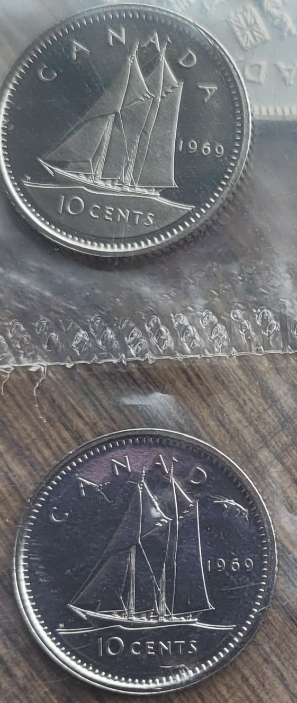
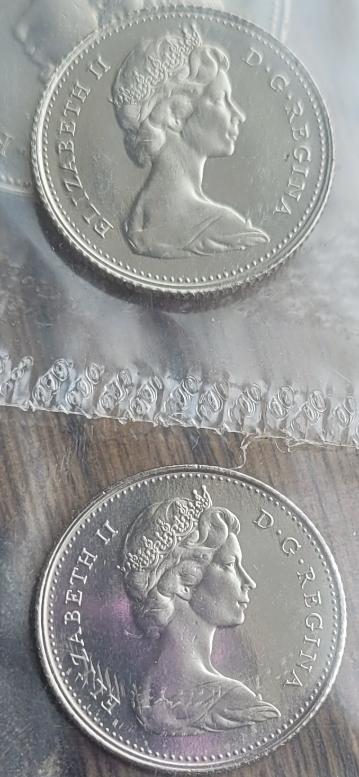
Going through all the coins we found in deceased father-in-laws home and when I looked at 1969 sets I noticed the dime is frosted on water and boat with a shiny field. The other set does not have that. It is all shiny. The frosty one is magnetic.
Is-This-A-Speciman-Dime-In-A-PL-Pliofilm-Package?
Pillar of the Community
Learn More...
Canada
9863 Posts
 Posted 02/11/2022  3:25 pm  Show Profile   Bookmark this reply Add DBM to your friends list Get a Link to this Reply
Not Specimen.
PL
Cameo (frosted) PL coins of this are not uncommon.
"Dipping" is not considered cleaning...
-from PCGS website
Valued Member
Canada
78 Posts
 Posted 02/11/2022  3:27 pm  Show Profile   Bookmark this reply Add mgalb to your friends list Get a Link to this Reply
Why is one frosted and the other not? Did they mix the finishes in these pliofilm sets back in 1969? Kind of hard to see with the pic, but one is definately frosted while the other is not.
Pillar of the Community
Learn More...
Canada
9863 Posts
 Posted 02/11/2022  3:38 pm  Show Profile   Bookmark this reply Add DBM to your friends list Get a Link to this Reply
The first coins struck by the dies were frosted, the etched recessed portions of the die became polished by the striking action so subsequent coins had a brilliant finish.
"Dipping" is not considered cleaning...
-from PCGS website
Pillar of the Community
westcoin's Avatar
United States
9792 Posts
 Posted 02/11/2022  3:39 pm  Show Profile   Bookmark this reply Add westcoin to your friends list Get a Link to this Reply
While I can't speak to why a certain date is frosted in Canadian coinage, (not my area of expertise) I can tell you how and why a proof or specimen coin gets frosted.

It is from the die being polished a certain way. the lower incuse recesses are not polished but often sandblasted, these are the higher points on the coin (opposite from the die) and the flat surface area is polished to a high shiny mirror surface. This is what leaves the frosty cameo look,which I particularly like on my proof coins from the USA. After so many strikings, the frost begins to fade, hence why there are various levels in the grading of the look, semi-prooflike, cameo, and deep cameo or ultra cameo (depending on the grading service). Proof coin are also using a specially prepared planchet (coin blank) usually washed and tumbled in steel bearing and oil to prevent corrosion and to help polish the blank previous to striking. Then the actual striking is often at a much higher tonnage and often struck multiple times to help build up the relief and make the strike stand out more than say coins struck for normal commerce.

In USA Proof sets you can often find a mix of frosted and just plain brilliant proof coins in the same package. It all depends on what the coins are like that come down the line at assembly time. Some years are known for all being well frosted while others are pretty difficult to find in a cameo or frosted look. Often in the much older (1800's era) coinage the normal strikes and also exhibit the frosted look and be quite deceiving as to whether or not they are proofs or regular business strikes. We see this on a lot of the Seated coinage in the USA from 1840's to 1890's.
"Buy the Book Before You Buy the Coin" - Aaron R. Feldman - "And read it" - Me 2013!
ANA Life Member #3288 in good standing since 1981, ANS, Early American Coppers Member (EAC), Colonial Coin Collectors Club member (C4), Conder Token Collector Club member (CTCC), Civil War Token Society (CWTS) member, Liberty Seated Collectors Club (LSCC) & Numismatic Bibliomania Society member (NBS), USMex, Member in good standing, 2¢ variety collector.

See my want page: http://goccf.com/t/140440

Valued Member
Canada
78 Posts
 Posted 02/11/2022  3:49 pm  Show Profile   Bookmark this reply Add mgalb to your friends list Get a Link to this Reply
So this is not an error on the part of the mint then. thanks for your help. I was able to find what looks like a strike through a thread and what may be doubling on the set without this finish.
  Previous TopicReplies: 5 / Views: 898Next Topic  

To participate in the forum you must log in or register.


Disclaimer: While a tremendous amount of effort goes into ensuring the accuracy of the information contained in this site, Coin Community assumes no liability for errors. Copyright 2005 - 2026 Coin Community Family- all rights reserved worldwide. Use of any images or content on this website without prior written permission of Coin Community or the original lender is strictly prohibited.
Contact Us  |  Advertise Here  |  Privacy Policy / Terms of Use

Coin Community Forum © 2005 - 2026 Coin Community Forums
It took 0.33 seconds to rattle this change. Forums