Here I is.

These are all medieval Islamic coins, from territories in what is now Iraq, Syria and eastern Turkey. Most early coins from the Muslim world don't have pictures of people and animals on them, out of respect for the Islamic tradition of avoiding graven images. But the coins issued by the Turkic rulers of these regions were a notable and spectacular exception.
The good thing about trying to identify these coins is, I don't even have to be able to read the Arabic script; I can be lazy and just match the pictures with the ones in my books and on zeno.ru.

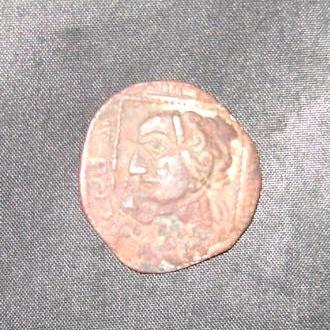
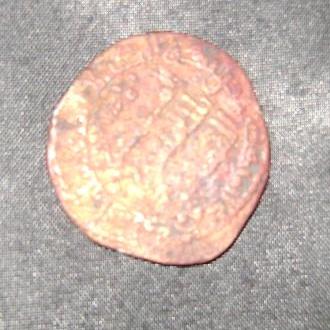
#1: a bronze dirham of Badr al-Din Lu'Lu', atabeg of Mosul from AD 1233 to 1259 (631 to 657 in the Islamic calendar). Lu'lu' was a former slave who overthrew the Zengid dynasty as rulers of Mosul, but his Lu'Lu'id dynasty did not last long; in 1262 the Mongols invaded. These "head left" coins are dated to his accession year, AH 631 (AD 1233).
Examples on Zeno.ru. The portrait was copied off ancient Greek and Roman coins.
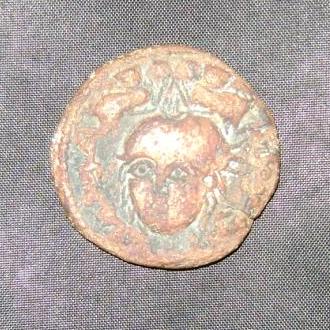
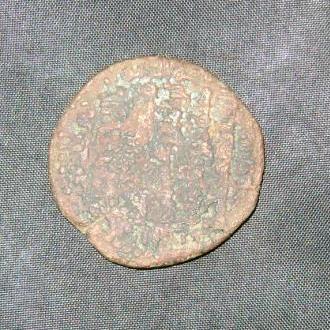
#2: this very artistic three-quarters-turned portrait (based on portraits on ancient Greek coins, similar to my avatar) is very distinctive of Qutb al-Din Mawdud, the first Zengid atabeg of Mosul (now in Iraq) to issue these "pictorial bronze" coins. Mawdud ruled from AH 544 to 564 (AD 1149-1169), but these coins all seem to be dated 555 or 556. There are several examples on
his zeno.ru page.
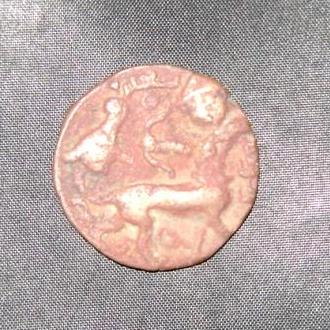
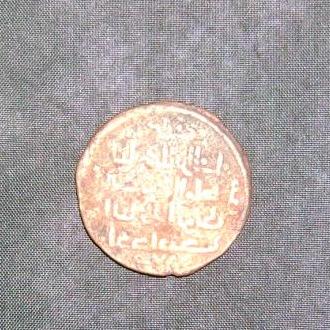
#3: This is a bronze dirham of Nasir al-Din Artuq Arslan, the Artuqid ruler of Mardin (now in southeastern Turkey) from AH 597 to 637 (AD 1201-1239). The coin dates from the early part of his reign.
Example on zeno.ru.
This third coin is perhaps the most interesting of the three you've shown, at least from my perspective as an astronomy buff. Many of these "pictorial" coin depict astrological references. On this coin, you can clearly see the centaur-archer representing the constellation Sagittarius. You can also see he's aiming his arrow at a dragon's head which seems to be growing out of the poor guy's tail. A dragon is astrological code for a solar eclipse, and checking the records we see that there was indeed a solar eclipse, occurring when the Sun was in the constellation Sagittarius, passing almost directly over Mecca and at least partially visible from Mardin
as seen here, which occurred in AD 1201 - just after Artuq Arslan came to the throne. It was seen as an auspicious sign for the reign of the new ruler, and worthy of commemorating on the coinage.
Don't say "infinitely" when you mean "very"; otherwise, you'll have no word left when you want to talk about something really infinite. - C. S. Lewis





 FirstFront.jpg
 FirstBack.jpg
 SecondFront.jpg
 SecondBack.jpg
 ThirdFront.jpg
 ThirdBack.jpg


 Posted 01/31/2009 6:02 pm





 Sherif.


