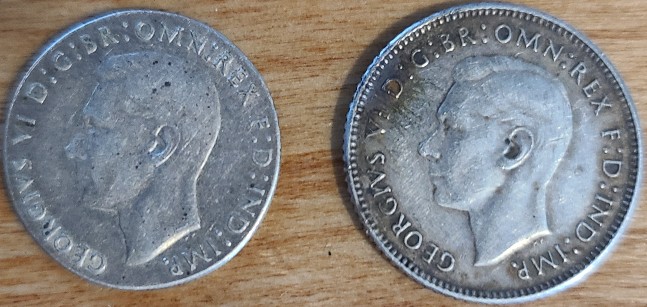
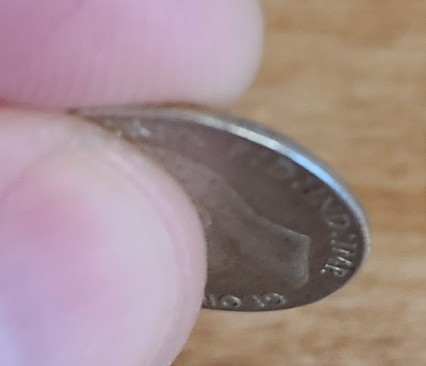
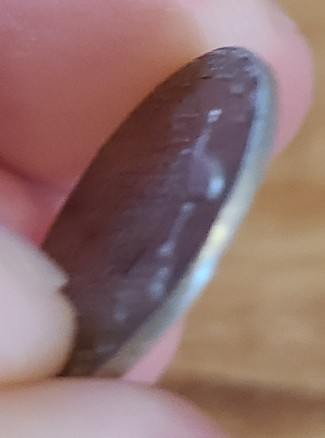
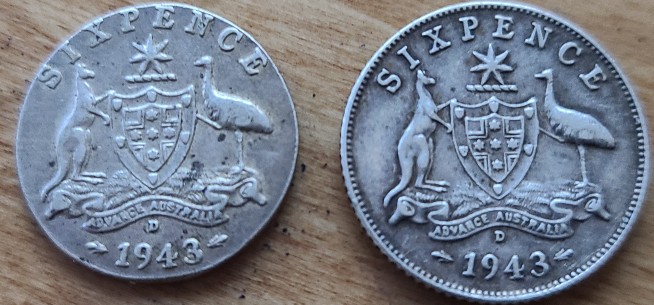
What you've got here is a classic case of "clipping", the mediaeval practice where small shavings were snipped or filed off the edge of a silver coin and the coin put back into circulation for full face value; the clipper now has a little pile of silver shavings they can sell for a profit. In this case, 0.5 grams worth of silver.
Clipping is, of course, illegal, and always has been. Ever since the invention of coinage presses that did away with the old-fashioned big-guy-with-a-hammer method of coinage production, the vast majority of silver coins have been given reeded edges, specifically to prevent clipping from happening in the theory that it would be too difficult or time-consuming for a clipper to convincingly fake the reeding. Threepences, for whatever reason, don't have milled edges, so they don't have this anti-clipping protection. It was presumably reasoned by the people who designed threepences that the amount of silver obtained by clipping a tiny coin like a threepence is so small, that it simply wouldn't be worth most people's time. The fact that more clipped threepences are not encountered is perhaps testament to the truth of this theory.
Don't say "infinitely" when you mean "very"; otherwise, you'll have no word left when you want to talk about something really infinite. - C. S. Lewis









 Posted 06/20/2022 12:14 pm