In 1999, the Royal Canadian Mint used its annual commemorative silver dollar to celebrate the 1774 voyage of Juan Perez (full name: Juan Josef Perez Hernandez) and his sighting and recording of the islands that would subsequently be named the Queen Victoria Islands (by the British); later in the expedition, Perez sighted present-day Vancouver Island.
The voyage of Perez had far grander objectives vs. simply sighting/naming islands in the Pacific Northwest.
Perez was a Spanish explorer who sailed from California, a Mexican territory at the time, northward with a mission to secure Spain's claims on lands of the Pacific Northwest, prevent encroachment by Russian (and other) explorers, identify good harbors and locate promising sites for Spanish colonies.
He captained the
Santiago, and charted the coasts of northern California, Oregon, Washington and the Alaska panhandle (all future States of the US) in addition to Canada's West Coast (present-day British Columbia); he is generally considered the first European to sail as far north along the North American West Coast as he did.
(Note: The crew of Perez' ship was Mexican, and it shared in many of the voyages "firsts.")In early July 1774, a group of islands was sighted and named Santa Margarita (from 1787 to 2010, the Queen Victoria Islands, now Haida Gwaii). Perez established a friendly relationship with Haida people before leaving and, ultimately, returning to California/Mexico. He did not fully accomplish his primary objectives - for example, he never went ashore to formally claim any territory for Spain - but his "first contact" with the Haida will forever link him to the history of British Columbia and Canada.
The obverse of the coin features a right-facing portrait of Queen Elizabeth II; the portrait was the work of Dora de Pedery-Hunt.
1999 225th Anniversary of the Voyage of Juan Perez and the Sighting of the Queen Charlotte Islands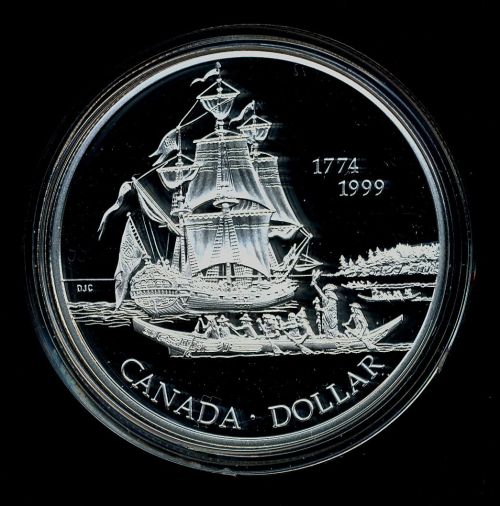
The coin's commemorative reverse design features the
Santiago at anchor off Langara Island at the northern tip of present-day Haida Gwaii with a delegation of local First Nations Haida people approaching the ship in a canoe (foreground) with additional canoes in the background. Per the diaries of the voyage, the Haida approached the
Santiago in a friendly, welcoming manner, singing as they did so. The Haida traded with the crew during the engagement. The design was created by David J. Craig and engraved by the Mint's Stan Witten.
Craig was a Canadian-born artist (Saskatchewan) who specialized in paintings of Canadian history. Unfortunately, the last interview I found with him (2017) indicated that he was suffering from Parkinsons Disease, and was no longer able to paint. He died in July 2019 in Hamilton, Ontario; he was 73.
The coin was struck on a Sterling Silver (0.925 fine silver) planchet. It has a diameter of 36.07 millimeters and a weight of 25.175 grams. It was struck in Proof and Brilliant Uncirculated (BU) versions; the individual Proof coin had an issue price of $29.95, with the BU coin released at $19.95.
Per the Mint, the individual Proof version of the SD sold 126,435 pieces with the BU version selling an additional 67,655 units; an additional 95,113 Proof Sets with the Juan Perez SD were also sold, bringing the net overall mintage of the Proof coin to 221,548. Though much smaller then sales figures of SDs from the early days of Canada's non-circulating legal tender (NCLT) SD series, the numbers are much larger than what is seen today.
I think the coin's design is terrific and the Mint's technical execution of it to be top rate. I'm happy to have the coin in my cabinet.
In my collection, I have three examples of the SD: one individual BU example, and two Proof examples courtesy of the special packaging options produced by the Mint (these are called "Derivatives" in the Charlton catalogues). Here are links to the posts I've done about these alternative packages:
-
1999 Juan Perez Coin and Pin Set-
1999 Juan Perez Coin and Journal Gift SetFor other of my posts about coins and medals, including posts about Canadian commemorative pieces, check out:
Commems Collection.




 Posted 08/23/2022 8:25 pm





