I've been meaning to get back to this one for quite some time. I began drafting it months ago, but it got put aside and "forgotten" about as I posted on other topics. Better late than never I suppose...There are certain coins among the classic US commemorative pieces that set a precedent that would be followed by other coins of the series. Even when a coin presented was the first in its category, simply being first was not necessarily what made them a "trendsetter" - the distinctive characteristic each possessed had to be repeated by multiple of the coins that followed it to attain the "trendsetter" status.
So, let's begin at the beginning...
1892-93 World's Columbian Exposition Half Dollar (Christopher Columbus)IMO, it's impossible not to consider the first US commemorative coin to be a trendsetter. It was, after all, the FIRST US commemorative coin!
The Columbian half dollar represented the first time in
US coinage history that legal tender coinage of a special design was struck for a non-Government entity. It was the first coin to be provided to a third-party organization for use by it as a fundraising tool, the first US coin to be struck for an Exposition/World's Fair, the first US commemorative coin to be struck in multiple years (1892 and 1893), the first US coin to feature an actual person from history vs. an allegorical figure, as well as a number of other
US coinage firsts. A no doubt trendsetter, if only for its precedent of being a coin issued to be a non-Government fundraiser! Let the commemorative coins begin!

 1903 Louisiana Purchase Exposition Gold Dollar
The Louisiana Purchase Exposition Gold Dollars (Thomas Jefferson Type and William McKinley Type) of 1903 introduced the possibility of using gold coins as commemorative pieces and set the stage for the $1.00 denomination to become the most oft-used denomination for gold commemorative coins.
In time, the silver half dollar became the dominant format for US commemorative coins and thus limited the number of gold coins struck. Before that happened, however, the gold dollar was the most-used denomination for US commemorative coins. Between 1903 and 1920, there were seven different gold dollars struck, plus one gold quarter eagle and two gold $50 coins - a total of ten different gold coins (for six design Types). Over the same stretch, there were four commemorative silver half dollars struck (for four design Types).


 1918 Illinois Statehood Centennial Half Dollar
The Illinois Statehood Centennial Half Dollar earns its "Trendsetter" badge by having the language of its authorizing legislation be used as the template for multiple commemorative coin bills that followed (e.g., 1920 Maine Statehood Centennial, 1920-21 Landing of the Pilgrims Centenary, 1921 Alabama Statehood Centennial, among others) It was also the first US commemorative coin to honor a Statehood milestone anniversary.
In the years following the Illinois Statehood Centennial coin's approval, commemorative half dollars were authorized for multiple Statehood Centennial anniversaries: 1920 Maine, 1921 Alabama and 1921 Missouri, the 1925 California (75th), 1935-39 Arkansas, 1936 Arkansas-Robinson and 1946 Iowa.

 1921 Alabama Statehood Centennial Half Dollar
The 1921 Alabama Statehood Half Dollar made it "OK" for US commemorative coins to go against tradition and feature a living person within its design. The Alabama half dollar features a "Then & Now" theme on its obverse with Governor William Bibb, the first Governor of Alabama, being the "Then" and Governor Thomas Kilby, the current Governor during the State's 1919 Centennial, filling the role of "Now."
The precedent enabled US President Calvin Coolidge to appear on the 1926 American Independence Sesquicentennial coins, Senator Carter Glass to appear on the 1936 Lynchburg, VA Sesquicentennial half dollar and Senator Joseph T. Robinson to appear on the second Type of 1936 Arkansas Statehood Centennial half dollar. All were alive at the time the coin was released.

 1926 Oregon Trail Memorial Half Dollar
Though there were several two-year coin programs that predated it; the program sponsored by the Oregon Trail Memorial Association broke new ground in terms of extended, multi-year, multi-mint coin programs. The coin's bill was approved May 17, 1926 and would ultimately result in coins dated: 1926, 1928, 1933, 1934, 1936, 1937, 1938 and 1939. Though not struck every year, there were Oregon Trail half dollars produced in Philadelphia, Denver and San Francisco over the course of its multi-year run.
It set a precedent followed by the 1935-38 Arkansas Statehood Centennial, 1934-1938 Daniel Boone Birth Bicentennial, 1934-38 Texas Independence Centennial, 1946-51 Booker T. Washington Birthplace Memorial and 1951-54 George Washington Carver - Booker T. Washington Memorial half dollar programs.

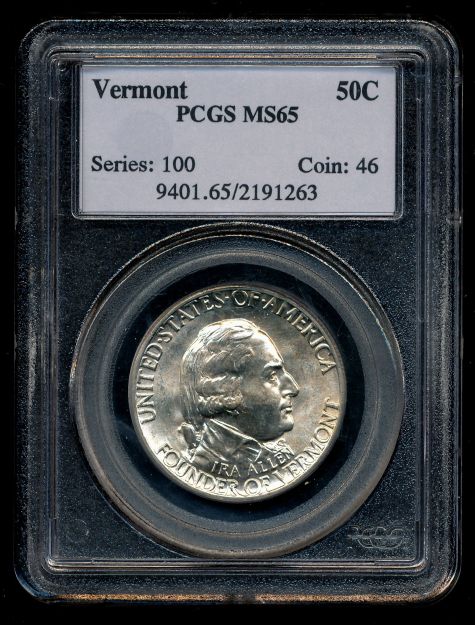
 1927 Battle of Bennington / Vermont Independence Sesquicentennial
Prior to the 1927 Bennington / Vermont half dollar, all the silver half dollars included in approved programs had a mintage of 100,000 or more (with two clocking in at several million - Columbian and Oregon Trail). In contrast, the mintage for the Bennington / Vermont was set at no more than 40,000 coins.
Of the 31 US commemorative coin programs struck/authorized after the Bennington / Vermont, 17 of them had legislated mintage limits of 25,000 or less, five had a mintage of 50,000 and just nine had a legislated mintage of 100,000 or more - 71% of the coins had a mintage limit of 50,000 or less. The Bennington / Vermont half dollar definitely started a "reasonable mintage" trend that was followed by most coin sponsors.
 1936 Long Island Tercentenary Half Dollar
I've written about the Senate Committee on Banking and Currency and its lead role in limiting the potential abuse of collectors via it adoption of several standard provisions for all commemorative coins it reviewed. (You can read about the Committee and its provisions here here:
Senate Banking and Currency Committee.)
The first coin to feature the Committee's new provisions was the 1936 Long Island Tercentenary half dollar; it was approved on April 13, 1936. Other commemorative coin bills soon followed the path set by the Long Island bill, and as such, a level of control to support collectors was injected into the US commemorative coin series.


Those are the coins that I believe were
trendsetters within the classic-era series. Do you have another?
For other of my posts about commemorative coins and medals, including more details on all of the coins discussed here, see:
Commems Collection.






 Posted 08/29/2022 2:03 pm





