| Author |
 Replies: 10 / Views: 2,638 Replies: 10 / Views: 2,638 |
|
|
Pillar of the Community
United States
3360 Posts |
During the 19th century gold rushes, gold flake and nuggets were used as money. Has anyone here tried that as a bullion investment? Some sellers price fine gold dust and flake close to spot.
My big concern is being able to resell gold dust. I would expect that it would be more difficult than selling scrap jewelry or silverware, and heavily discounted. Has anyone here ever tried to resell gold flakes?
Out of curiosity I called a local dealer. They pay 75% of spot for the gold content (karat). Size is unimportant (no premium for nuggets) but the flake has to be clean. "Two minutes ago I would have sold my chances for a tired dime." Fred Astaire
Edited by thq
09/06/2022 4:55 pm
|
|
|
|
Pillar of the Community
United States
2341 Posts |
There may be a few Youtube videos about this. I think you are correct, the downside is when you go to sell, would be difficult for buyers to know if the dust, nuggets are genuine without a tester. Coin Stores, Jewelry stores usually have a tester, but in general I don't think dust, granules, nuggets are real popular with collectors, thus keeping prices down? Same goes for silver granules, lumps/bars that some people make themselves.
As an investment, gold nuggets with provenance might be a way to go, like California nuggets or from a shipwreck, etc.
I don't have any, I buy gold/silver from governments and well known private mints.
Edited by livingwater
09/06/2022 6:19 pm
|
|
Bedrock of the Community
Australia
21789 Posts |
In the mineral collectors scene in Australia,
natural gold nuggets over 1 oz can attain an asking price of double their pure gold bar equivalents.
Gold dust not so much.
|
|
Pillar of the Community
 United States
3360 Posts |
Big nuggets sell at a premium because of their scarcity sel. However the dealer I talked to only paid for the gold content, regardless of size. She had tried to resell nuggets in the past without luck. She also had no interest in nuggets containing quartz. Rock collectors pay a premium for those, but they are unsalable in the bullion market.
Considering that all you get is 75% of karat, and that nuggets are not 24K, it's a pretty poor return, unless you dug the gold and got it for free. Raw gold falls in the same category as scrap dental gold and jewelry. I understand better why my local dealer was selling nuggets for 10% below spot. Specialist raw gold dealers ask 50-100% over spot, but for bullion dealers it's just low grade bullion at best.
"Two minutes ago I would have sold my chances for a tired dime." Fred Astaire
Edited by thq
09/07/2022 07:56 am
|
|
New Member
United States
9 Posts |
80 percent spot if 22 k and.above so cal placer gold from east fork sam Gabriel river never tested under 22k also nuggets from there from 1 to 4.9 ozt sold for spot and half also don't always trust a buyers test kit some only go to 18 k so they will always test 18 k even if it's 22 23k cal gold so cal did that. With several prospectors including myself and lost a lot of business because they tried to screw over the prospecting community
|
|
New Member
United States
9 Posts |
If you dug it out of ground you'd get up to 80 percent spot depending on purity ,it would be better to purify it thru agua Regina to purify it or at least use borax pure soap to draw out impurities and no black sand it will decrease value I had jewelry that loved the gold I bought him he paid 80 percent spot because it never tesed under 21 k with 3 different test 22k he said he's never seen that pure placer gold unrefined from so cal or anywhere else
|
|
New Member
United States
9 Posts |
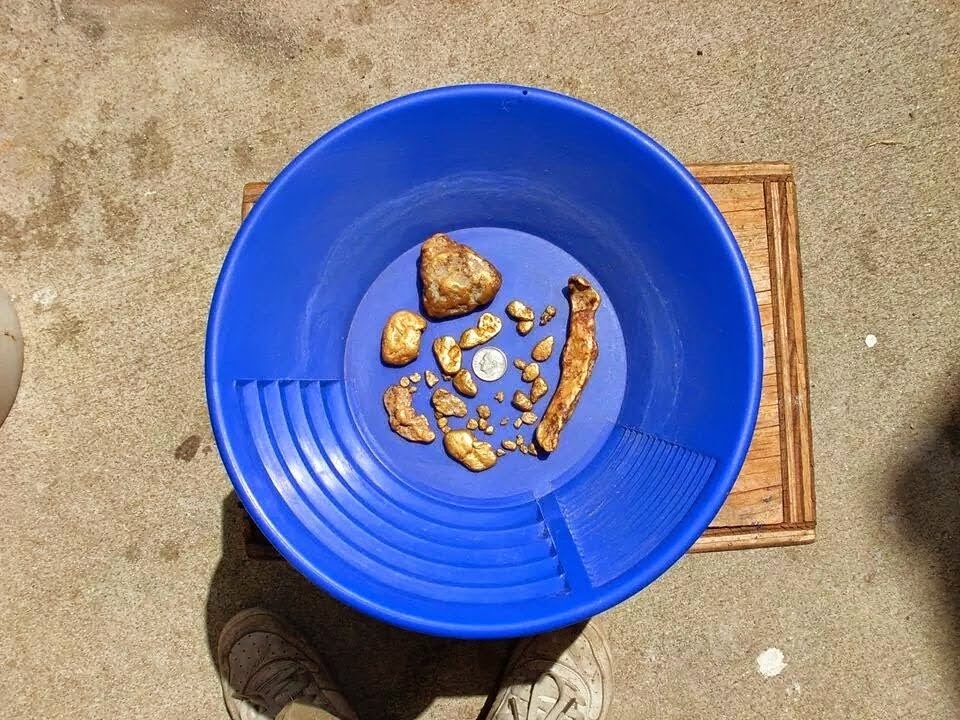 So California gold 12 ozt East fork. Narrows San Gabriel river angeles national forest Edited by Zephdron
09/07/2022 5:28 pm
|
|
Pillar of the Community
United States
738 Posts |
|
|
Moderator
 Australia
16985 Posts |
Raw gold nuggets ought to be more valuable as "collector pieces" than as raw gold, for the same reason that most coins are more valuable to collectors than to gold melters. Main problem is, even today there tend to be far more nuggets around than "collector demand" can absorb, so it can be much harder to find a buyer who's a collector and who wants it. So unless there's something particularly amazing about a specific nugget, in terms of size, shape or provenance, then the melter's rate might be the best available price.
Don't say "infinitely" when you mean "very"; otherwise, you'll have no word left when you want to talk about something really infinite. - C. S. Lewis
|
|
Pillar of the Community
United States
3360 Posts |
Those are really nice Zephdron. How did you recover them?
Gold in quartz brings a big premium from mineral collectors. However gold miners put that ore into stamp mills and crushed the quartz into sand to recover the gold. Vein gold is pretty, but from a bullion standpoint it's valueless. My little collection of alluvial nuggets shows the progress of the quartz removal - from nuggets with a lot of quartz inclusion, to those with small bits of remaing inclusion, to fully beaten out rounded pieces with no quartz.
"Two minutes ago I would have sold my chances for a tired dime." Fred Astaire
Edited by thq
09/07/2022 10:38 pm
|
|
Valued Member
Canada
54 Posts |
On a visit to the Klondike we bought a couple nuggets. Then I got some nuggets from a friend in Yukon. Found some more in a pendant from a storage locker labeled as Alaska Gold. I consider it sort of bullion, but not something I would sell unless very hard up for cash. Than I'd go to a company that buys gold from miners like General Refining. They obviously know how to evaluate the raw gold and must pay a fair price or they would go out of business when the miners switch to someone who pays more. The guys running dredges and sluices are not selling to coin shops or pawn shops or APMEX generally. Go where they want what you have to sell. |
| |
Replies: 10 / Views: 2,638 |
|










 Posted 09/06/2022 6:29 pm


