Next up in my US commemorative coins survey-by-century, the 1700s.
My previous surveys:
-
Quick Bits #82 - Celebrating the 1400s / 1500s-
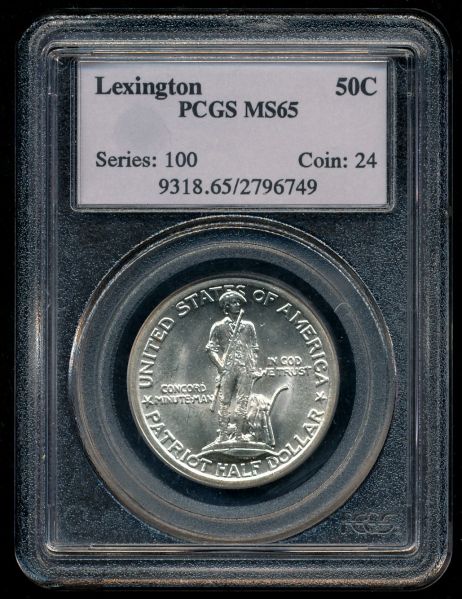
Quick Bits #76 - Celebrating the 1600s1925 Battle of Lexington-Concord Half DollarAuthorization for the 1925
Battle of Lexington-Concord Half Dollar was included in a Joint Resolution "Establishing a commission for the participation of the United States in the observance of the one hundred and fiftieth anniversary of the Battle of Lexington and Concord, authorizing an appropriation to be utilized in connection with such observance, and for other purposes." The battles took place on April 19, 1775 and are considered the initiating military event of the American Revolution. Among the "other purposes" in the Joint Resolution was the authorization of a series of commemorative stamps and a silver commemorative half dollar.
 1926 American Independence Sesquicentennial
The 1926
American Independence Sesquicentennial Half Dollar and Gold Quarter Eagle were also authorized via a Joint Resolution "Providing for the cooperation of the United States In the sesquicentennial exhibition commemorating the signing of the Declaration of Independence, and for other purposes." The July 4, 1776 signing of the
Declaration of Independence was the impetus for the Exposition. Once again, the "other purposes" of the Joint Resolution included the authorization of commemorative coinage.


 1927 Battle of Bennington / Vermont Independence Half Dollar
The 1927
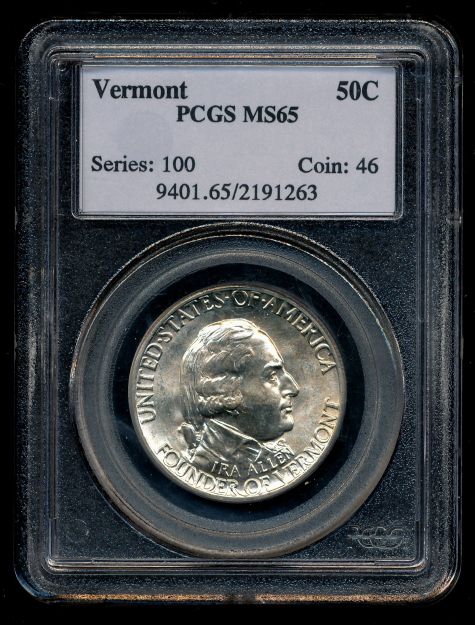
Battle of Bennington / Vermont Independence Half Dollar was struck "in commemoration of the one hundred and fiftieth anniversary of the Battle of Bennington and the independence of Vermont." The dual-purpose commemorative coin was part of a three-coin Act, sharing the legislative spotlight with the 1925 California Statehood Jubilee and 1925 Fort Vancouver Centennial half dollars. Each of the two events on the Bennington/Vermont coin date to 1777, near the outset of the American Revolution..
 1928 Hawaiian (European) Discovery Sesquicentennial
The 1928
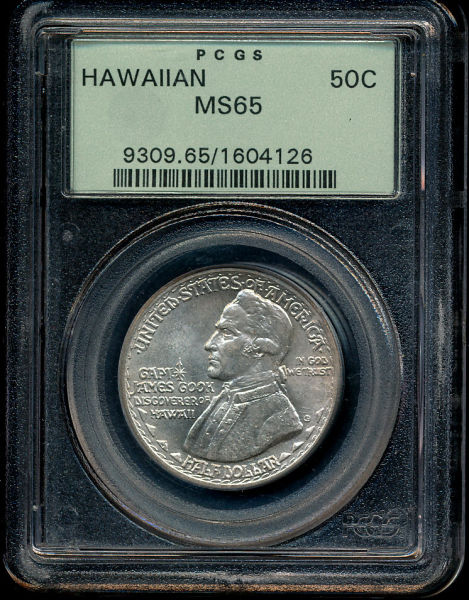
Hawaiian (European) Discovery Sesquicentennial Half Dollar was struck "in commemoration of the one hundred and fiftieth anniversary of the discovery of the Hawaiian Islands by Captain James Cook, and for the purpose of aiding in establishing a Captain James Cook memorial collection in the archives of the Territory of Hawaii." Captain Cook visited the Sandwich/Hawaiian Islands in 1778 during his Third Voyage.
 1934-38 Daniel Boone Birth Bicentennial Half Dolllars
The 1734 birth of pioneer/hunter/explorer/businessman/politician/folk hero Daniel Boone was celebrated by a series of commemorative half dollars struck "in commemoration of the two-hundredth anniversary of the birth of Daniel Boone." The Boone coin was the only 1700s-themed commemorative coin of the US series to celebrate an individual vs. an event.

 1935 Hudson, NY Founding Sesquicentennial Half Dollar
The
1935 Hudson, NY Founding Sesquicentennial Half Dollar was struck "in commemoration of the one hundred and fiftieth anniversary of the founding of the city of Hudson, New York." Hudson, NY traces its roots to 1785. The Act that authorized the 1935 Hudson, NY half dollar also authorized the 1936 Providence, RI Tercentenary half dollar. The design of the Hudson half dollar is well-known for the "uniqueness" of its "
Neptune-on-a-Whale" design!

 1936 Columbia, SC Sesquicentennial Half Dollar
The 1936
Columbia, SC Sesquicentennial Half Dollar was struck "in commemoration of the sesquicentennial anniversary of the founding of the capital of South Carolina at Columbia, South Carolina." The first capital of South Carolina was Charleston. The SC General Assembly (GA) voted to move the State Capital from Charleston to Columbia in 1786.

 1936 Lynchburg, VA Sesquicentennial Half Dollar
The 1936
Lynchburg, VA Sesquicentennial Half Dollar was struck "in commemoration of the one hundred and fiftieth anniversary of the issuance of the charter to the city of Lynchburg, Virginia." John Lynch, the City's namesake, petitioned the Virginia General Assembly for a land grant/town charter in 1784. In 1786, 45 acres of land were granted and the Town of Lynchburg was founded.

 1936 Norfolk, VA Bicentennial / Tricentennial Hald Dollar
Another dual-purpose US commemorative coin, the 1936
Norfolk, VA Bicentennial / Tricentennial Half Dollar was struck "in commemoration of the three hundredth anniversary of the original Norfolk (Virginia) land grant and the two-hundredth anniversary of the establishment of the city of Norfolk, Virginia, as a borough." The coin's obverse side celebrates the bicentennial (of 1736), the reverse the tricentennial (of 1636).
(Note: The dual nature of this commemorative half dollar led me to include it in my "Celebrating the 1600s" post as well.)
 Note: The text enclosed in quotation marks for each coin was taken from the coin's authorizing Act - i.e., the "official" purpose of the coin as specified by the US Congress.
Next up, the 1800s. Stay tuned!
I've posted lots more history and background information on each of coins presented here; the posts can be accessed via:
Commems Collection. Have a look!




 Posted 10/23/2022 06:18 am





