PCGS - The PCGS Banknote grading room is no stranger to rarities of all kinds, from all categories, all classifications, and all continents. This includes much of the better, tougher material cataloged in the seminal Paper Money of the United States by Arthur and Ira Friedberg, the standard reference work on American paper currency from colonial times to the present. While we still stand in awe of and reverence for the many five-, six-, and even seven-figure banknote wonders that regularly grace us with their presence, we are typically not shocked to see them submitted and entrusted into our custodial care for authentication and grading. We are PCGS Banknote graders. We've practically seen it all.
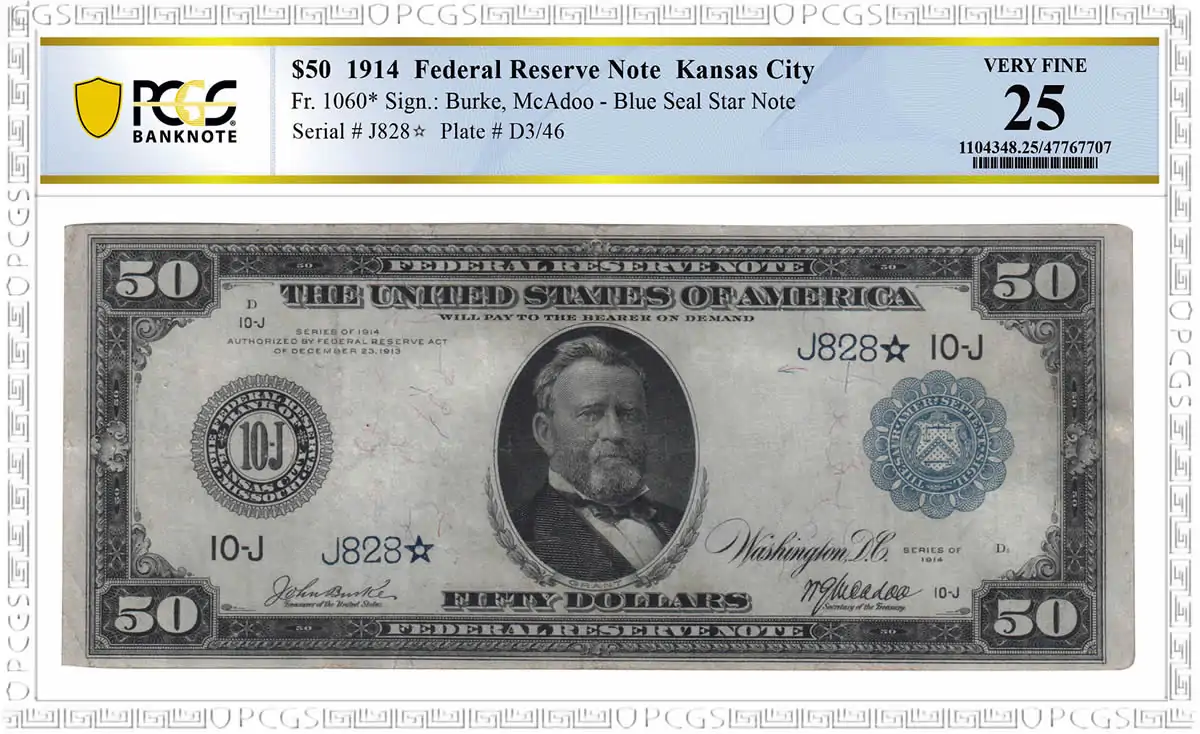
But we must admit, this blue-sealed, Burke-McAdoo-signed 1914 Series $50 Federal Reserve Star Note from the Kansas City district was a little shocking. It may not be the most valuable banknote we've ever certified, nor the oldest. It may not be in the best condition or have the most flashy, colorful design out of the hard-hitting U.S. large-size type note lineup. Yet from a sheer how-many-in-existence statistical standpoint, this numismatic unicorn can lock its mythological horn with the scarcest of them.
If a note is rare, Friedberg will usually tell you. After scratching our collective heads and trying to remember if we had ever handled any Friedberg 1060* examples (we hadn't), we cracked open our well-used 22nd edition and saw that as of its 2021 publication date, only a single example was known to exist. Then, after consultation with the array of reliable census data at our disposal, we discovered that this sole documented torch bearer for the Friedberg number was not the banknote in our possession (serial numbers make such conclusive determinations possible). Our note was new to the census.
The Federal Reserve Act of 1913 set up the legal framework for a nationwide central banking system that ushered in brand-spanking-new designs of circulating banknotes the following year. The series of 1914 and 1918 Federal Reserve Notes represent a bountiful collecting jackpot. The many denominations ($5 through $10,000), differing seal colors (red and blue), issuing districts (12), and signature combinations (four), along with stars and other quirky varieties and anomalies, are enough to keep even the most aggressive of U.S. type note collectors busy for decades. Their well-balanced, dignified designs set the firm precedent for how successor Federal Reserve Notes would generally look for the remainder of the 20th century: portrait of dignitary at the very center, conspicuous denomination counters at each corner, seals and serial numbers at center left and center right, and historical or geographic vignettes artfully displayed on the back.
Beginning hobbyists may be wondering what the bold, blue stars overprinted at the end of the serial numbers are all about. To put it succinctly, this note - as evidenced by those stars - was meant to replace another note from the rather limited $50 Kansas City print run that somehow became damaged or was deemed defective or otherwise unusable before issuance. The replacement run quantity would have been even more limited considering its narrow purpose, which explains the sharp scarcity of this survivor today.
More advanced hobbyists may wonder why this note seems to have the older, 19th-century serial number typeface font, considering the BEP's 1903 roll-out of the higher-speed rotary presses. First, excellent eye... You'd be right! Second, it was common for numbering-division press operators to use the old paging machines (which still delivered the old-style font) for the first thousand notes of a particular run. This, given the setup of the eight-subject numbering heads and the transitioning between single-, double-, and triple-digit serial numbers on the new equipment was impractical and unwieldy.
One was just too lonely of a number. So, then there were two.
 Check out 1914 $50 notes on ebay
.










 Posted 02/22/2024 3:15 pm


