





 First Page




 Posted 12/17/2022 11:53 am


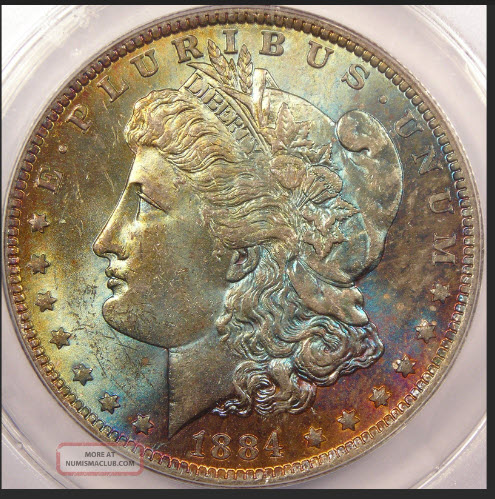
AU58. Beautiful toning. I would love to own it.
The drop in quality of SF mint Morgans from 1878-1882 to 1883-1884 is quite noticeable.
1878-1882 are some of the most beautiful Morgans ever struck (IMO) with lots of prooflike/DMPL coins, full strikes, great luster, etc.
In 1883 the quality of the coins being struck suddenly falls off sharply, a trend which accelerates further in 1884 and does not really start to recover until 1890.
This trend is mirrored in the population of SF dates in MS grades from 1878 to 1884, and especially in MS PL/DMPL grades.
Using 1883-S as an example, VAMworld reports that 105 die pairs were used that year (per Mint records) with a total mintage of 6,250,000, an average of about 59.5k coins per die pair.
1884-S mintage fell further to only 3.2 million.
1880-S, a date well known for quality, reports 110 die pairs were used that year with a total mintage of 8,900,000, an average of 80.9k coins per die pair.
So despite minting fewer coins with each die pair, the quality of the coins struck did not improve; in other words, the dies were wearing out faster or being retired for other reasons without having struck as many coins.
A look at the VAM 4 series for 1884-S provides a bit of insight.
VAM 4A has a large die chip on the left wreath between NI, and later, a die chip on the right wreath at M
The left die chip is present even in the earliest die states, meaning the damage to the die occurred before many coins were struck.
VAM 4B has a left wreath die chip as well but develops an additional chip at the I in IN GOD, and the left wreath die chip progresses from rough to smooth as the dies wear down. Again, the die chip can be found in the early die states, including at least one EDS that's nearly prooflike.
VAM 4D gains the die chip above the eyebrow but has no die chips on the reverse; instead, the breast of the eagle is now poorly defined, probably due to extensive polishing.
4D also has a very flatly struck obverse, especially in the later state. Even AU+ EDS 4D coins have flat gray luster; extensive flowlining.
In my experience with Morgans, 1883 and 1884 SF mint coins tend to cap out around XF45 before prices start getting a bit silly, then progress into ridiculous, and eventually ludicrous.
An 1881-S in MS66 can be had for 1/10th the cost of an 1884-S in the same grade, assuming you could actually find someone who both had an 1884-S in MS66 and was actually willing to part with it.
So even if this is an AU coin and not Unc, it's still an outlier and a scarcity, both for the toning and for the condition, and far better than most 1884-S I have encountered through the years.
The toning is indeed odd. Not to the point where I would immediately bodybag the coin, but it merits closer scrutiny.
Coins like the Jack Lee example are truly the rarest of the rare -- fully struck with good cartwheel, undisturbed fields and minimal signs of handling, struck from fresher dies -- this is a combination that is exceptional in every sense of the word, in a series with no shortage of exceptional coins. But look at the Lee coin and what do you see in that left wreath across from the I in UNITED? Yup, a die chip, already present!
The drop in quality of SF mint Morgans from 1878-1882 to 1883-1884 is quite noticeable.
1878-1882 are some of the most beautiful Morgans ever struck (IMO) with lots of prooflike/DMPL coins, full strikes, great luster, etc.
In 1883 the quality of the coins being struck suddenly falls off sharply, a trend which accelerates further in 1884 and does not really start to recover until 1890.
This trend is mirrored in the population of SF dates in MS grades from 1878 to 1884, and especially in MS PL/DMPL grades.
Using 1883-S as an example, VAMworld reports that 105 die pairs were used that year (per Mint records) with a total mintage of 6,250,000, an average of about 59.5k coins per die pair.
1884-S mintage fell further to only 3.2 million.
1880-S, a date well known for quality, reports 110 die pairs were used that year with a total mintage of 8,900,000, an average of 80.9k coins per die pair.
So despite minting fewer coins with each die pair, the quality of the coins struck did not improve; in other words, the dies were wearing out faster or being retired for other reasons without having struck as many coins.
A look at the VAM 4 series for 1884-S provides a bit of insight.
VAM 4A has a large die chip on the left wreath between NI, and later, a die chip on the right wreath at M
The left die chip is present even in the earliest die states, meaning the damage to the die occurred before many coins were struck.
VAM 4B has a left wreath die chip as well but develops an additional chip at the I in IN GOD, and the left wreath die chip progresses from rough to smooth as the dies wear down. Again, the die chip can be found in the early die states, including at least one EDS that's nearly prooflike.
VAM 4D gains the die chip above the eyebrow but has no die chips on the reverse; instead, the breast of the eagle is now poorly defined, probably due to extensive polishing.
4D also has a very flatly struck obverse, especially in the later state. Even AU+ EDS 4D coins have flat gray luster; extensive flowlining.
In my experience with Morgans, 1883 and 1884 SF mint coins tend to cap out around XF45 before prices start getting a bit silly, then progress into ridiculous, and eventually ludicrous.
An 1881-S in MS66 can be had for 1/10th the cost of an 1884-S in the same grade, assuming you could actually find someone who both had an 1884-S in MS66 and was actually willing to part with it.
So even if this is an AU coin and not Unc, it's still an outlier and a scarcity, both for the toning and for the condition, and far better than most 1884-S I have encountered through the years.
The toning is indeed odd. Not to the point where I would immediately bodybag the coin, but it merits closer scrutiny.
Coins like the Jack Lee example are truly the rarest of the rare -- fully struck with good cartwheel, undisturbed fields and minimal signs of handling, struck from fresher dies -- this is a combination that is exceptional in every sense of the word, in a series with no shortage of exceptional coins. But look at the Lee coin and what do you see in that left wreath across from the I in UNITED? Yup, a die chip, already present!
Member ANA - EAC - TNA - SSDC - CCT #890
"Most of the things worth doing in the world had been declared impossible before they were done." -- Louis D. Brandeis
"Most of the things worth doing in the world had been declared impossible before they were done." -- Louis D. Brandeis


