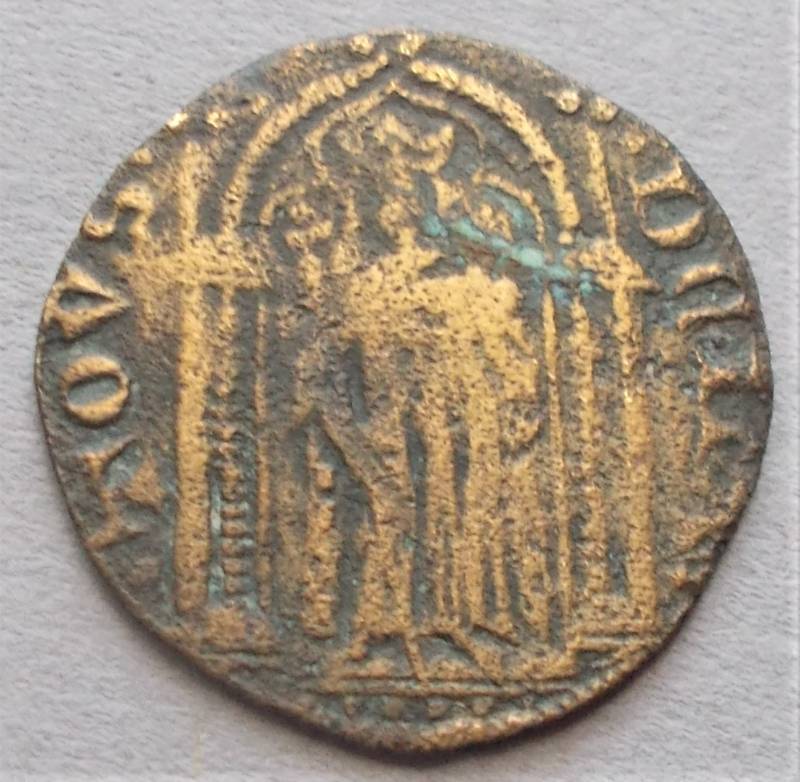
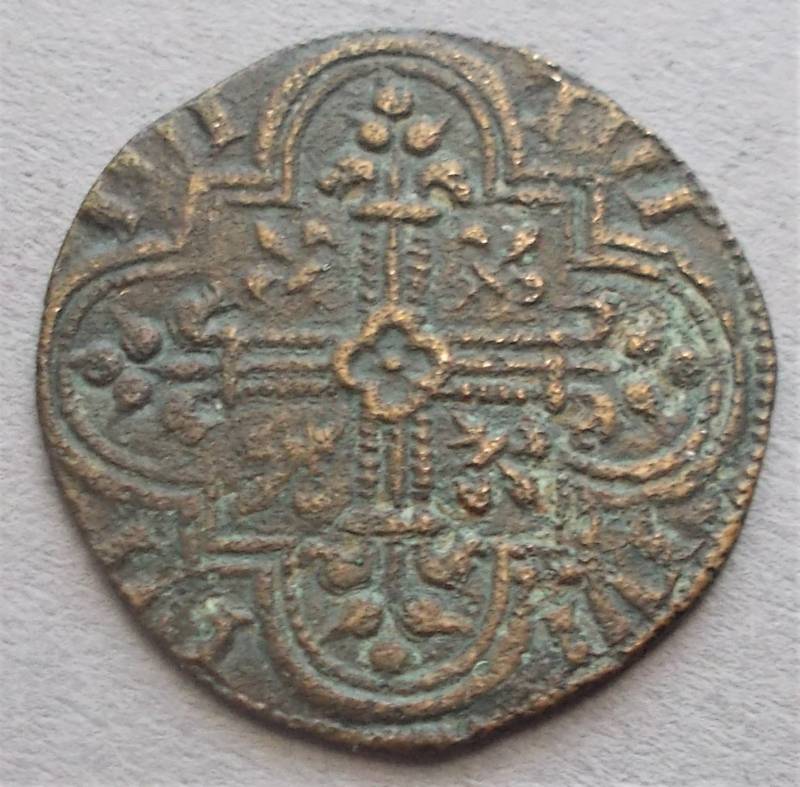
Yep, it's a brass jeton. From the 1500s, judging by the shape of the lettering.
Jetons are not "coins", but they are still strongly numismatic-related. Jetons were used as counters on counting-boards, which were used much like beads on an abacus to help people do complex maths like multiplying and dividing, back when numbers were written in Roman numerals and doing maths in your head was next to impossible.
Counting-boards were also necessary for financial transactions, especially when the values of coins were not always simple multiples or fractions of the money of account.
The word "jeton" is French. In royal France, jeton issue was controlled by the government and privately making jetons was a crime as serious as counterfeiting actual coins. In England, like in most other countries in Europe, jetons were either privately made, or imported from Nuremberg, Germany, which was well established as a jeton-making town; the token-masters of Nuremberg were able to make jetons cheaper and quicker than anybody else. In German, jetons are called "rechenpfennige" (counting-tokens).
In later centuries, after Europeans learned to use Arabic-style numbers and counting-boards went out of fashion, the jeton-makers of Nuremberg branched out, making tokens for card games and such. But your jeton dates from the counting-board days.
Trivia: Financial counting-boards usually had a chequerboard pattern on them (they could double as gaming tables for games like chess or checkers when you weren't using them for counting money), which is why the British treasurer / finance minister is still titled the "Chancellor of the Exchequer".
Don't say "infinitely" when you mean "very"; otherwise, you'll have no word left when you want to talk about something really infinite. - C. S. Lewis









 Posted 12/22/2022 9:08 pm





