| Author |
 Replies: 14 / Views: 1,533 Replies: 14 / Views: 1,533 |
|
|
Pillar of the Community
United Kingdom
2931 Posts |
Here is a nice set of coins that I picked up many years ago. I always thought they were interesting and to be honest I think Krause has them undervalued - you don;t see them that often and as they are Iron, they can rust if you are not careful 1 Kopek (KM21] mintage - 11,942,000 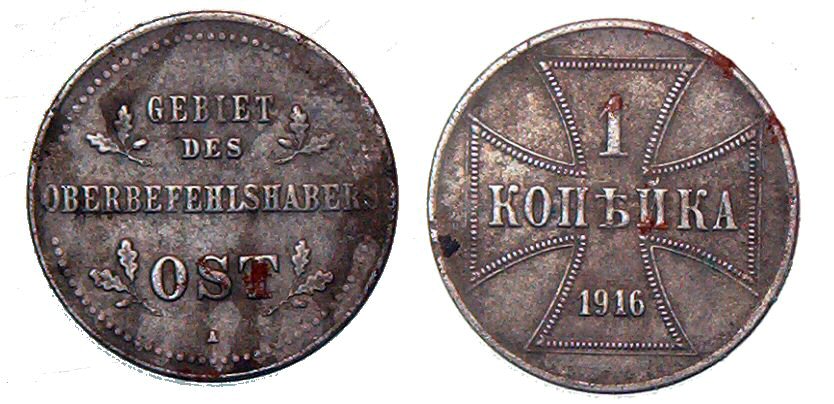 2 Kopeks (KM22] mintage - 8,000,000 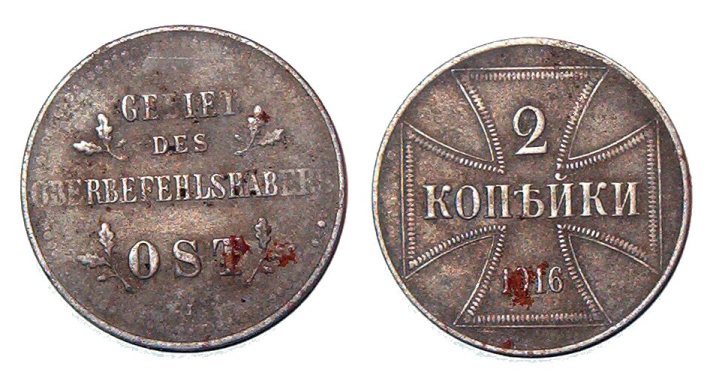 3 Kopeks (KM23] mintage - 8,000,000 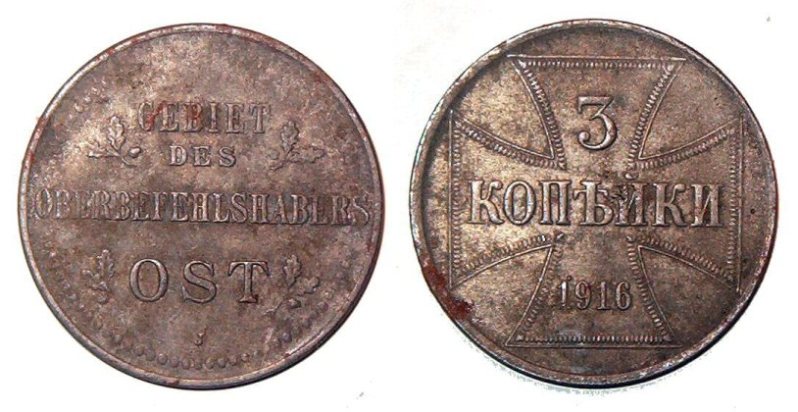 |
|
|
|
Moderator
 United States
23731 Posts |
|
|
Valued Member
Poland
392 Posts |
Nice coins, I have similar set in my collection  But I've always thought about these coins as "German coins for east territories"  |
|
Moderator
Australia
16993 Posts |
I only have a 3 kopek, and apart from some nasty-looking rust spots on the obverse, it's in very nice condition.
I file these particular coins under their own separate country, "German Occupied East".
Don't say "infinitely" when you mean "very"; otherwise, you'll have no word left when you want to talk about something really infinite. - C. S. Lewis
|
|
Pillar of the Community
 United Kingdom
2931 Posts |
Yes - that seems sensible - I had them stored along with my German coins and I'll probably continue to do so, though I'll re-label then as "East" rather than "Russia"
|
|
Pillar of the Community
Germany
1238 Posts |
Makes sense. Those coins (and several paper denominations) were issued by the Ostbank für Handel und Gewerbe, first by its Darlehnskasse Ost in Posen (Poznan, PL), then also in Kowno (Kaunas, LT). The area where those means of payment were used was basically the German occupied Eastern territories, roughly what today is Estonia, Latvia, Lithuania, parts of Belarus and Poland. In Lithuania (ie. in those parts that were not occupied by Poland) these notes stayed in official use until 1922.
Christian
|
|
Valued Member
Australia
432 Posts |
Again, Chris has all the info :) My only contribution is on value - these things are not THAT valuable. You see the odd eBayer trying to pass them off as 'XXX RARE RARE RARE' etc, but yeah, they're realistically only worth a few bucks per coin once you have any sign of rust on them. Now a corrosion free, UNC example on the other hand; that would be worth something (However, I know my rust free 3 Kopeken, only cost me Au$4.00 last year). Still, Krause has some strange values on a lot of German coins - get your hands on the Jaeger Katalog.
|
|
Pillar of the Community
United Kingdom
1077 Posts |
Where do these coins appear in Krause?
|
|
Pillar of the Community
Egypt
3470 Posts |
|
|
Valued Member
Australia
432 Posts |
Quicksilver; I'm not sure if they do appear in Krause - don't remember ever seeing them... But in Jaeger they're in the rear sections of the book, with other WW1 occupation types.
|
|
Pillar of the Community
United Kingdom
1077 Posts |
On the original post there were KM#s given with the pics? I can't find them though.
|
|
Moderator
Australia
16993 Posts |
In my 33rd edition Krause, they're listed at the back of the Germany - Empire section, under "Military coinage - WWI". I assume the numbers belong to the regular "Germany" series.
Don't say "infinitely" when you mean "very"; otherwise, you'll have no word left when you want to talk about something really infinite. - C. S. Lewis
|
|
Pillar of the Community
United Kingdom
1077 Posts |
Thanks Sap, not sure how I missed them!
|
|
Pillar of the Community
United Kingdom
2931 Posts |
Yes - I used the 2006 edition
|
|
Valued Member
Australia
432 Posts |
I really should update - I'm still using a 1999 Krause, although I guess with my main interest being German Third Reich, its not REALLY needed...
|
| |
Replies: 14 / Views: 1,533 |
|








 Posted 03/03/2009 09:50 am


