| Author |
 Replies: 11 / Views: 1,659 Replies: 11 / Views: 1,659 |
|
|
Valued Member
United Kingdom
477 Posts |
Hi, I've had the coin for some time now and only really had time to have a closer look at it. It came in a lcgs inner holder or similar(as pictured). In the flesh this coin looks like a pure Matt finish, but I can't find any detail regarding a 1920 Matt Finish Florin. However I did stumble upon something saying that in 1920 until late 1922, the florins had a duller sheen on them and it wasn't until late 1922 they changed the alloys around to create a shinier coin. Is this the same for all .500 coinage 1920-1922? I hope these pictures do justice to the finish of the coin, it looks truly Matt in finish. Is this the same for your coinage of the same year? This coin looks uncirculated, however the 3 lions on the upper reverse have had there faces rubbed?  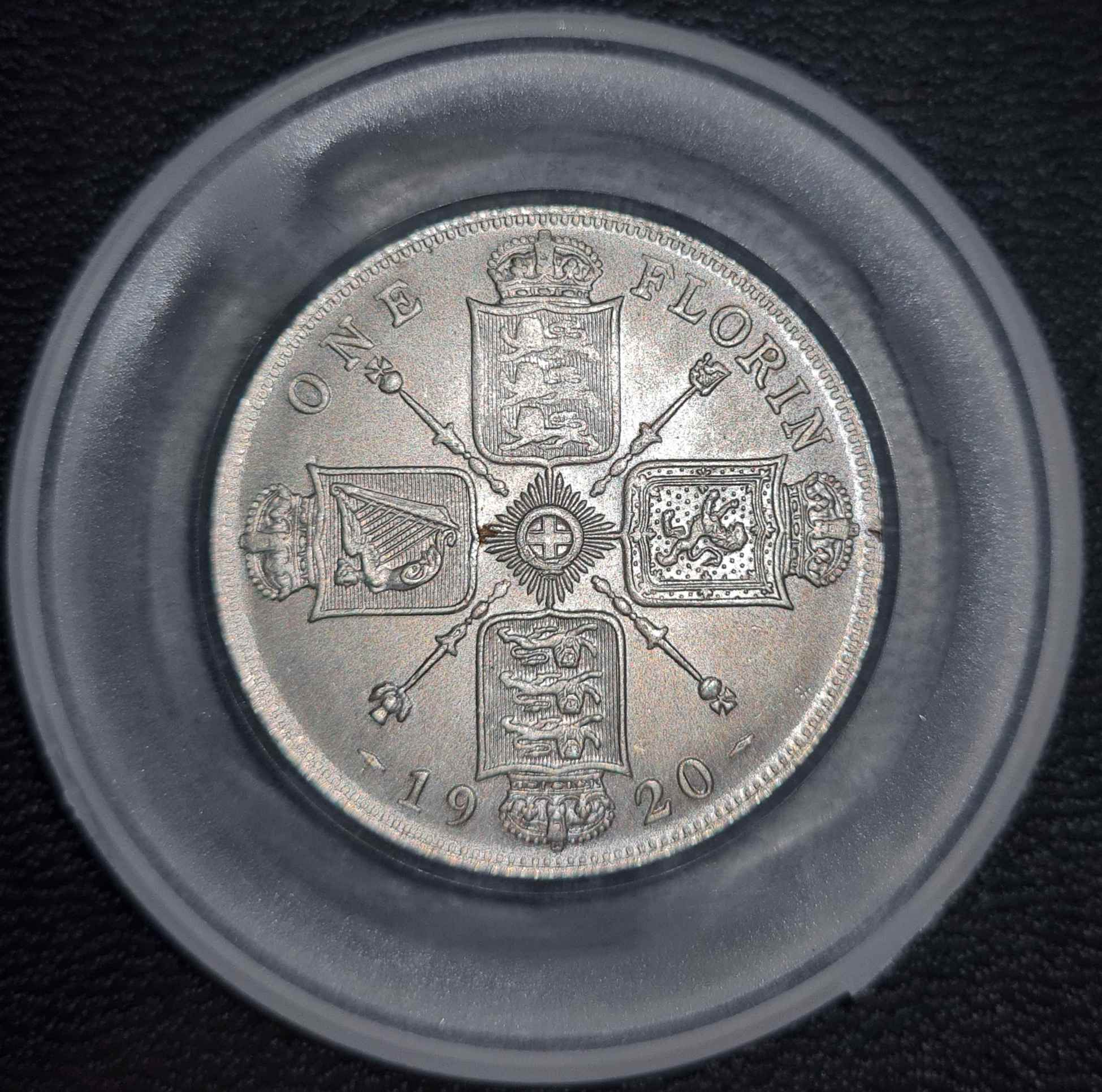 |
|
|
|
Bedrock of the Community
Australia
21792 Posts |
As you most probably already know, 500 fine silver, 40% copper, 5% nickel, 5% zinc.
After these coins were rimmed into planchets from blanks, they were blanched (dipped in acid to preferentially leach base metals out of the surface) then washed before striking into coins.
Freshly minted 500 fine silver coins still had the nice radial lustre of 925 fine coins, but this coin this coin does not have that appearance.
My first thought was perhaps that it may have been acid? cleaned, but I modified that idea.
My theory is that this coin escaped the blanching process.
I think that would help to explain the lack of lustre, especially between the lettering.
Bear in mind that this coin has developed it's own patina, since it was struck in 1920.
It is common for the lions' faces to not be fully struck up with this series, although this appears to be a more extreme example.
It looks like it has a light strike on that half segment only; the thickness of the coin between opposite field faces may vary a little, probably undetectable by measuring for variations in rim thickness. Observations for variations in rim height may give a clue.
|
|
Valued Member
 United Kingdom
477 Posts |
@sel_69l, this has been an incredible reply.
I to suspected some level of cleaning, I checked the outer rim to see if it matched the obv/rev in terms of signs of aging. I couldn't see anything obvious.
I genuinely started suspecting it had been spray painted due to the finish I can see infront of me and lack of similar finishes to compare the coin to of the same year. But dismissed this, mainly down to the coin really not being worth this level of effort.
I'll try and get some rim measurements to see if there is some variation(veneers). Also I'm guessing weight may also slightly be off aswell following this train of thought.
Thankyou for your response, it has been most educational and helpful.
|
|
Valued Member
United Kingdom
477 Posts |
Added a pic of the rim for more detail. 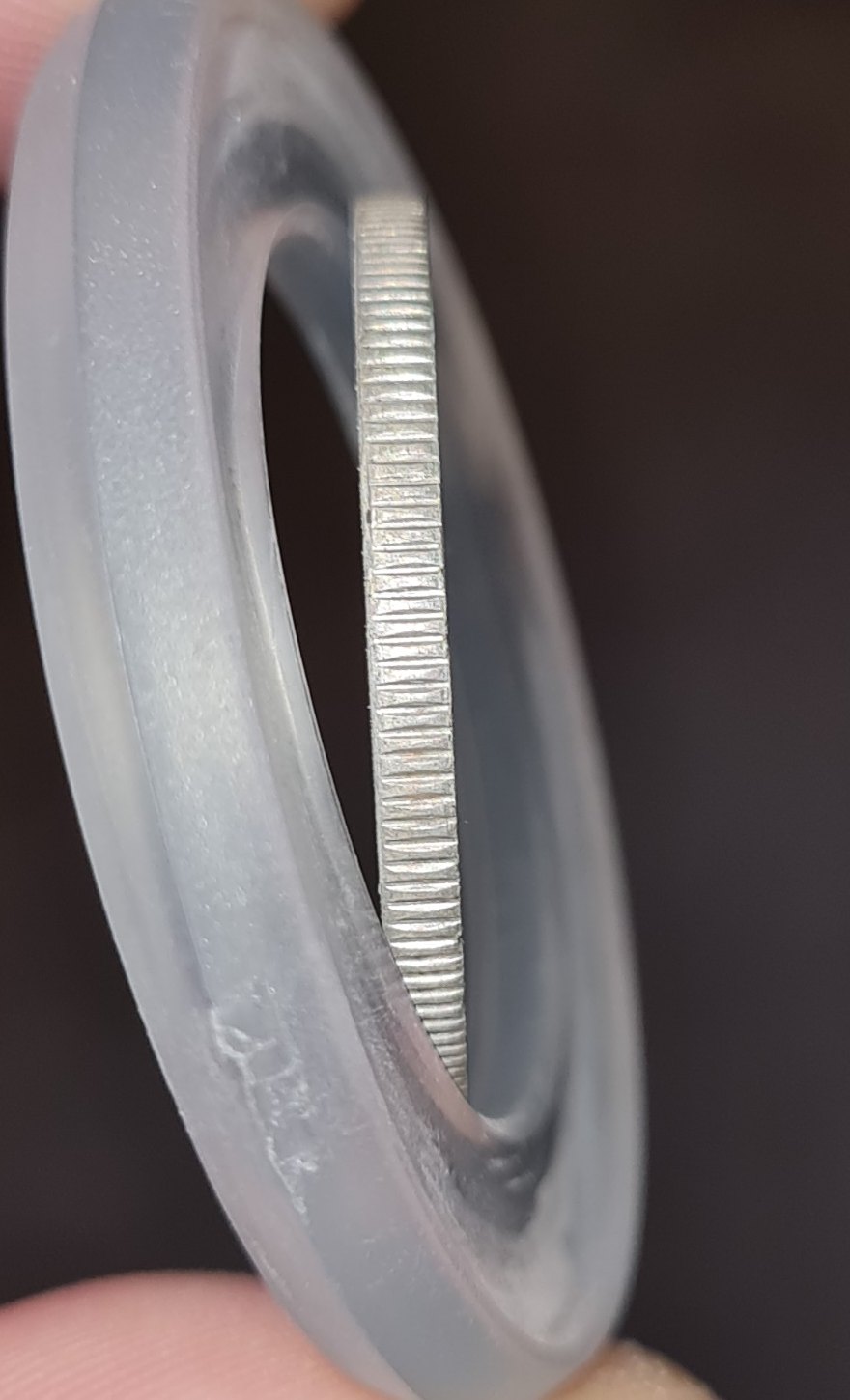 |
|
Pillar of the Community
Australia
606 Posts |
If a silver coin is left in silver dip for too long it will take on a "matt" finish.
Watch your top knot
|
|
Bedrock of the Community
Australia
21792 Posts |
As regards current appearance, my theory, is just that.
Echidna may well have the right explanation, - I have never experimented Silver Dip for varying periods of treatment.
Rim appears to be of constant height, milling appears normal.
Nevertheless, exact weight may well reveal more info regarding planchet thickness between the fields.
|
|
Valued Member
United Kingdom
477 Posts |
Hi both, so the coin weighs correctly so there's not much excess or variance there. It could be a silver dip, I'm guessing like a jewellery dip. It'd be a shame if that is the case, but maybe someone was experimenting. The coins certainly not worth the work to try and make it appear or be a higher grade for some level of financial gain as its just not one of those coins. I'll add a screenshot of something that spurred my original convo, where did they get this info from I wonder? 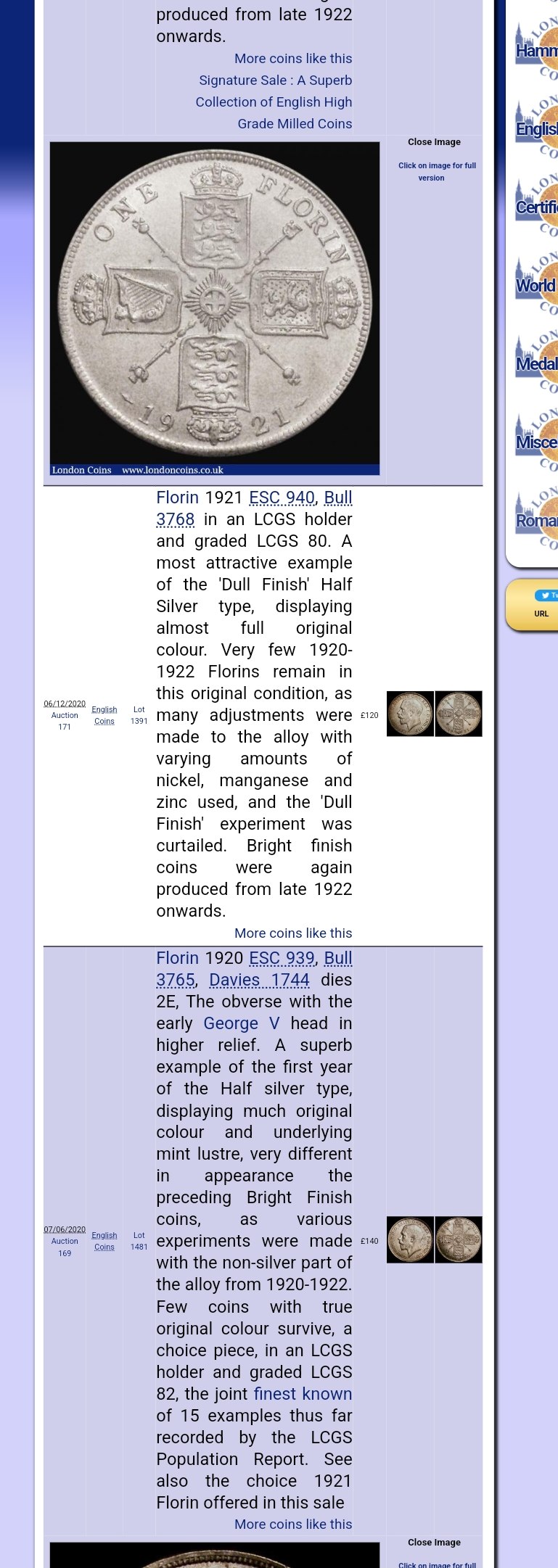 |
|
Bedrock of the Community
Australia
21792 Posts |
The info in the screenshot does not actually reveal how the dull finish was produced, except that various coinage alloys were experimented with. It seems that the dull finish may have been achieved by deliberately not blanching the planchets before striking into coins, and The Royal Mint decided that after 1922, blanching of the planchets produced a much brighter, more silvery, and thus preferred appearance. Perhaps my theory may have some credence after all. According to a reference in Coincraft's 1998 Standard Catalogue of English and UK Coins 1066 to Date (P. 514) :- "Because of the increase in the price of silver in 1920, the alloy was changed to include 50% of silver instead of 92.5%. Coins up to 1922 tarnished very unattractively, and the change in the base metal (non silver) constituents after then rendered the alloy more acceptable in this respect. The striking of the 50% silver coinage appears in lower relief relative to that of the 1911-19 coinage, due possibly to the different metal resistance, or a change in the method of striking to accommodate the new alloy". Reasons for experimenting with the alloy become a bit more obvious. Two problems had to be addressed in combination:- 1. tarnishing - blanching of planchets before striking needed to be part of the coinage process, and 2. undesirable lower relief - an optimum 50% silver alloy 50% was decided eventually upon, and remained standard after 1922, for all British and Commonwealth Countries, that used 500 fine silver coinages. Australia debased it's coinage from .925 to 500 fine in 1946. |
|
Valued Member
United Kingdom
477 Posts |
@sel_69l Absolutely incredible, you're a wealth of knowledge.
I think you were right to begin with, it's interesting to think how many variants they may have created during that time frame.
Currently going through my collection and this coin brought me to a stop, now I have some understanding and something to write next to its description thanks to you.
The reference you quoted from, was that an online source or book you own? For future ref.
Thankyou again appreciate your time and effort.
|
|
Pillar of the Community
 Australia
2583 Posts |
 It's a beautiful coin, awallin01. I wish.... Quote:
It is common for the lions' faces to not be fully struck up with this series, although this appears to be a more extreme example.
It looks like it has a light strike on that half segment only; the thickness of the coin between opposite field faces may vary a little, probably undetectable by measuring for variations in rim thickness. Observations for variations in rim height may give a clue. I agree that OP coin had a light strike in that segment. This 1921 was circulated with typical wear, the lions are more pronounced. It also has the dull finish.  The Ox moves slowly, but the Earth is patient.
|
|
Bedrock of the Community
Australia
21792 Posts |
I have a copy of the abovementioned book, from which I quoted.
Have eagerly waited for a revised edition, but that never happened.
A Krause publication, it looks like a Krause World Coins old style telephone book, except that it has hard covers.
|
|
Valued Member
United Kingdom
477 Posts |
@ttkoo I need to work on my photography as it looks even better in the flesh.
I'm happy to hear that it's a light strike, I genuinely believed it was wear on the coin.
@sel_69l I've ordered a copy of that book just now.
Thanks both
|
| |
Replies: 11 / Views: 1,659 |
|










 Posted 12/31/2022 05:51 am


