| Author |
 Replies: 9 / Views: 1,254 Replies: 9 / Views: 1,254 |
|
|
Valued Member
United States
258 Posts |
|
|
|
|
Pillar of the Community
Australia
3839 Posts |
Coins from this era are overstruck over various Spanish reales which includes other colonies. What you are showing are signs of the original host coin
|
|
Moderator
 Australia
16964 Posts |
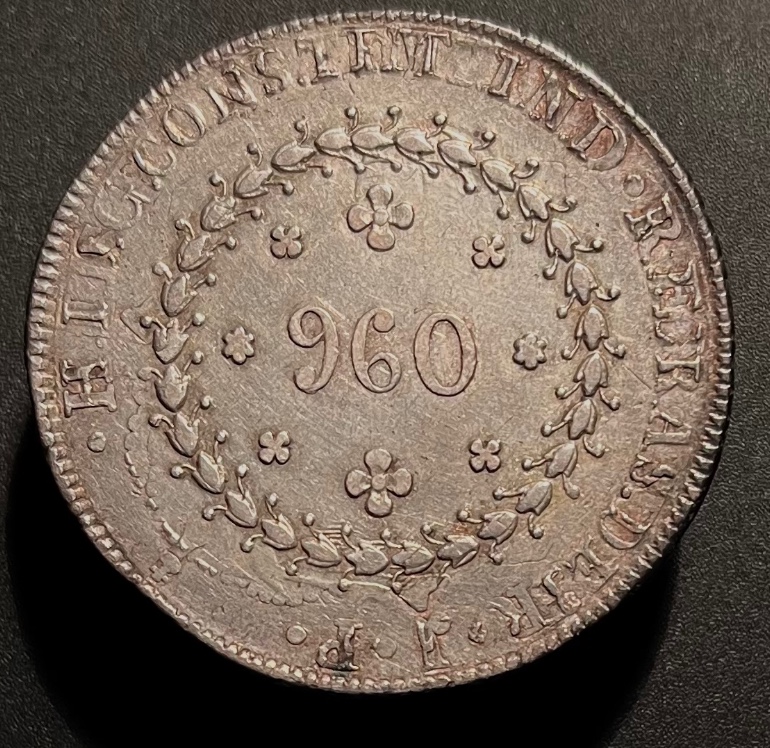
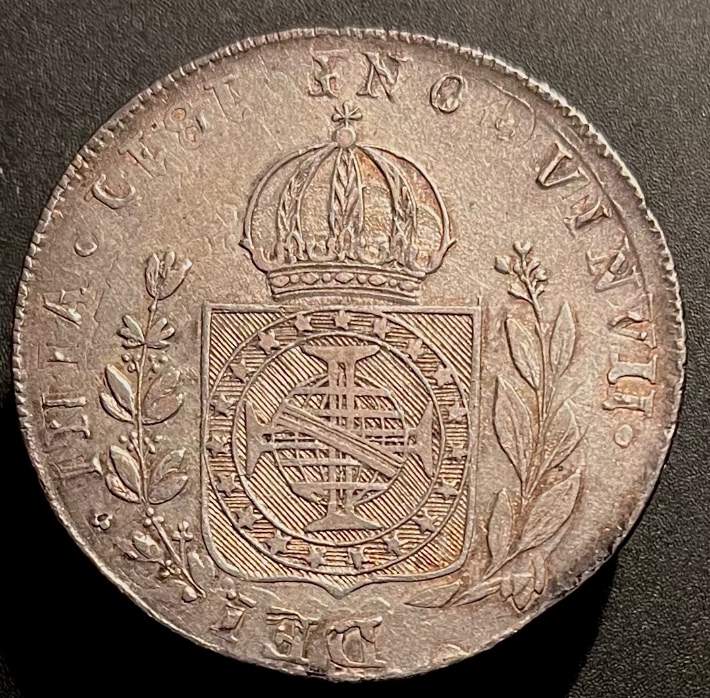
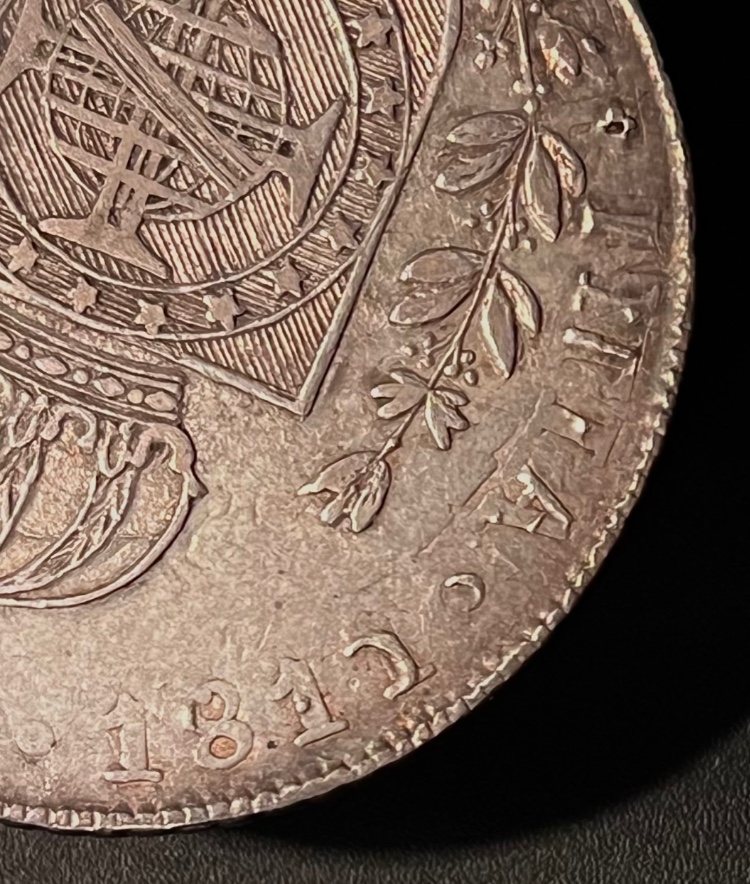
It's been very weakly struck, meaning a lot of the detail - including the 1811 date - is actually a surviving relic from the undertype Spanish dollar. But that coat of arms is the Brazilian Empire coat of arms, not the Portuguese coat of arms, so the overstriking must date from after the foundation of the Empire in 1822. This design for the 960 reis was used 1823-1827. The actual coin date is at 6 o'clock near the rim on the reverse, below the "960"; see this example on NGC. On your coin, this is a weakly overstruck area, where the undertype's "JP" initials are coming through. I think I can see a remnant of a "4", sitting on top of the "J", so "1824" would be my best guess for the actual date for your coin. The undertype coin was originally a Lima mint 8 Reales, 1811, J.P. mintmaster's initials. This coin. Don't say "infinitely" when you mean "very"; otherwise, you'll have no word left when you want to talk about something really infinite. - C. S. Lewis
|
|
Valued Member
 United States
258 Posts |
Sap and gxseries. Thanks for the tutorial. Just amazing. If they restruck using old coins how did they do that. Did they heat the old coin and then strike the new one on top? Thanks again.
|
|
Moderator
Australia
16964 Posts |
As far as I am aware, they just fed the Spanish dollars directly into the coining presses, as if they were blanks. No pre-treatment. That's why so much of the design of the undertype survived the restriking. Most examples of Brazilian 960 reis coins have some evidence of the undertype coin visible; yours has more than most.
I'm guessing the Brazilians were copying what the British were doing. Britain also restruck Spanish dollars to create the Bank of England dollars, starting in 1804. But the BoE dollars were obliterated first by squashing them flat in a blank coin press (two blank dies), before being restruck again with the BoE dollar design, so very little of the original undertype design usually survives on those coins.
Apparently, the British never told the Brazilians their secret recipe.
Don't say "infinitely" when you mean "very"; otherwise, you'll have no word left when you want to talk about something really infinite. - C. S. Lewis
|
|
Valued Member
United States
258 Posts |
Haha, guess not. Thanks Sap for your help, really appreciate it.
|
|
Pillar of the Community
Australia
3839 Posts |
Overstruck coins can come up with some interesting feature Here is my example. Holed but it shows strong under layer 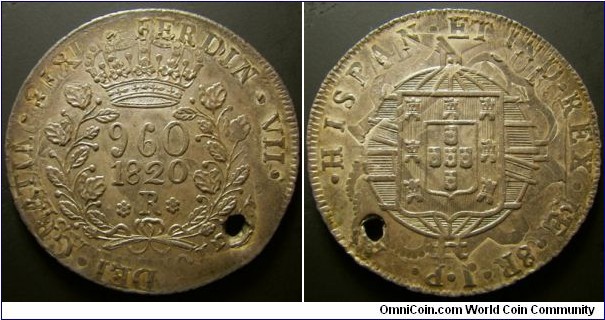 Brazil 1820 960 reis overstruck over Lima 1813 8 reales My partial coin collection http://www.omnicoin.com/collection/gxseriesMy numismatics articles and collection: http://www.gxseries.com/numis/numis_index.htmRegularly updated at least once a month. |
|
Pillar of the Community
Portugal
717 Posts |
That one from 1820 is very interesting. Can it have been re-struck on a coin that already had a hole?The position would be on top, to wear as a pendant, on the 8 reales
|
|
Valued Member
Brazil
67 Posts |
The coin is definetely from 1824. I confirmed with a catalog that lists all the die combinations used. It has 29 tulips and vertical flowers (the 6 petals ones on the sides of the face value), being the only variety in this subset that has the "CONS.TIMP." spelling (it should've been CONST.IMP.). It's the 4A variety (Catálogo Descritivo dos Patacões da Casa da Moeda do Rio - Lupercio Gonçalves Ferreira).
|
|
Valued Member
Brazil
67 Posts |
As far as the restrikes went, the 8 Reales used to circulate in the brazilian territory for about 850 Reis. So the government decided to start buying them use as bases for new coins. In the beginning (1809) they sent some sets of stamps to various "Casas de fundição" (places in the provinces where the gold was melted down and a part of it was taken as a tax), where a lot of spanish coins circulated after spilling from the borders. This only lasted a while, maybe it was supposed to be this way from the beginning, or they were afraid of forgeries (this stamp was even used in gold bars). So in 1809/1810 they started minting 960 Reis coins using spanish 8 Reales as bases. As far as the visibility of the bases is concerned, some authors mentions that the base coins may have been left visible because the spanish currency was widely accepted, serving as a "reassurance" of the value of the coins. Personally, I'm not so convinced. The truth seems to be that it was simply too much work to do it properly, not to mention that the available equipment and techniques wasn't up to the task. There are other examples of restrikes during this period, mainly over copper coins, and in most of then the reassurance argument doesn't seem to apply, since there are equally poorly struck restrikes. There are also 960 Reis struck over other bases, mostly irregularly, some of the rarest reported cases are american dollars, austrian thalers, french coins, etc. Here are some coins that illustrate what I said: 960 Reis 1809 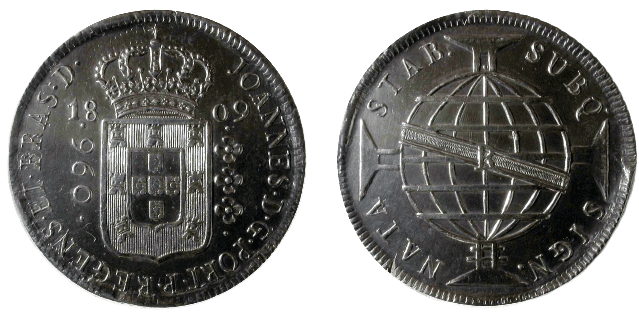 960 Reis stamp   Gold bar made with the previous stamp  |
| |
Replies: 9 / Views: 1,254 |
|











 Posted 01/09/2023 5:00 pm


