A rather interesting type of coinage was issued by the Dutch from their East Indies colony in the late 18th and early 19th centuries was the so called 'bonk' coinage. Cut from oval or rectangular copper bars known as 'bonks' (meaning 'large piece' in Dutch) the irregular lozenge shaped bonk coinage was usually stamped with a year and denomination. It was an emergency or stopgap issue designed to quickly and cheaply supply coinage to a colony that was rich with trade yet short on coinage. The reasons for the shortage of coinage in the East Indies were strongly linked to the political upheavals in the parent Netherlands from 1795 through to 1815. Political turmoil in the Netherlands during the period of mintage of Bonks included the end of the Dutch Republic in 1795, the formation and collapse of the French Batavian Republic from 1795 to 1806, and the founding of the French puppet Kingdom of Holland from 1806-1813. This Kingdom ended with the defeat of Napoleon at Leipzig in 1813 and was succeeded by the independent Kingdom of the Netherlands in 1815 which only ceased to exist in 1949.
During the period of the puppet Kingdom of Holland the Netherlands actually lost control of the East Indies Colonies completely to the British (in 1810), but Dutch rule was re-established in 1814. One can imagine that during this 20 years of chaos that the supply of coinage to a colony several thousand miles away would have been far from the minds of government officials. Thus the East Indies had to rely on counter stamped coinage of other countries and colonies as well as locally minted currency.
The bonk coinage was made in preference to milled round coinage in times of immediate need because they were much cheaper and easier to make. Manufactured in Batavia (Java), they were cut from copper rods which varied greatly in size and were generally imported from Japan. Denominations issued included the 1/2 Stuiver, 1 Stuiver, 2 Stuiver, and 8 Stuivers. The weights of the coins varied considerably as quality control was poor and the stuiver was continually being de-valued, however the bonks made in the late 18th century massed about 20g of copper for a single stuiver and 45g for a 2 stuiver. Those bonks made later were lighter, down to 19g for a stuiver in 1805 and to 15g for one minted in 1818-9. This effectively devalued the stuiver against the Dutch Guilder (the normal rate was 20 Stuivers to the guilder and ended up being 24 Stuivers to the guilder in later years).
Copper bonk coins were minted in 3 distinct periods, 1796 to 1806 (under the Batavian Republic), 1807 to 1810 (under the Kingdom of Holland), and 1818-1819 (under the Kingdom of Netherlands). Many varieties existed but generally those minted prior to 1818 displayed the value in a pearled or dotted border on one side and the date in a similar border on the other. Those minted in 1818-1819 displayed the value on one side without a border and the date on the other in a lined rectangle. The coins minted earlier can be quite rare and valuable while the later dates are a little more common. Collectors should be aware that being pure copper these coins can attain a green patina (as distinct to harmful verdigris).
Some observations from the John Lorenzo Collection:
1. From a collection of 20 pieces now in my collection I found no errors to the above which is the best overview currently on the Internet. Specifically the earlier pieces are the rarest with 1797 being the most common year - then the 1818-1819 period - and finally the 1807-1810 period the most common with perhaps the year 1810 being the most common.
2. In terms of denominations the 1/2 Stuiver's seem to the rarest then followed by 2 stuiver and the 1 stuiver being the most common denomination.
3. The earliest group is the only period that followed a specific good weight standard protocol. All pieces in my collection for 1S or 2S we see near 20 grams for 1S: 1797 ~19g; 1803 ~19 & 19.6g; 1805 ~17g. The 1/2S we see 3.4-3.8 grams.
4. Once we progressed probably to the most common date during the next period 1807-1810 the 1810 we see no weight standard with high variability: the 1810 2S's in my collection are at even 8 grams, 16 grams - all over the place. My 1818 a Choice XF with a complete date weighs just 13g for a 1S.
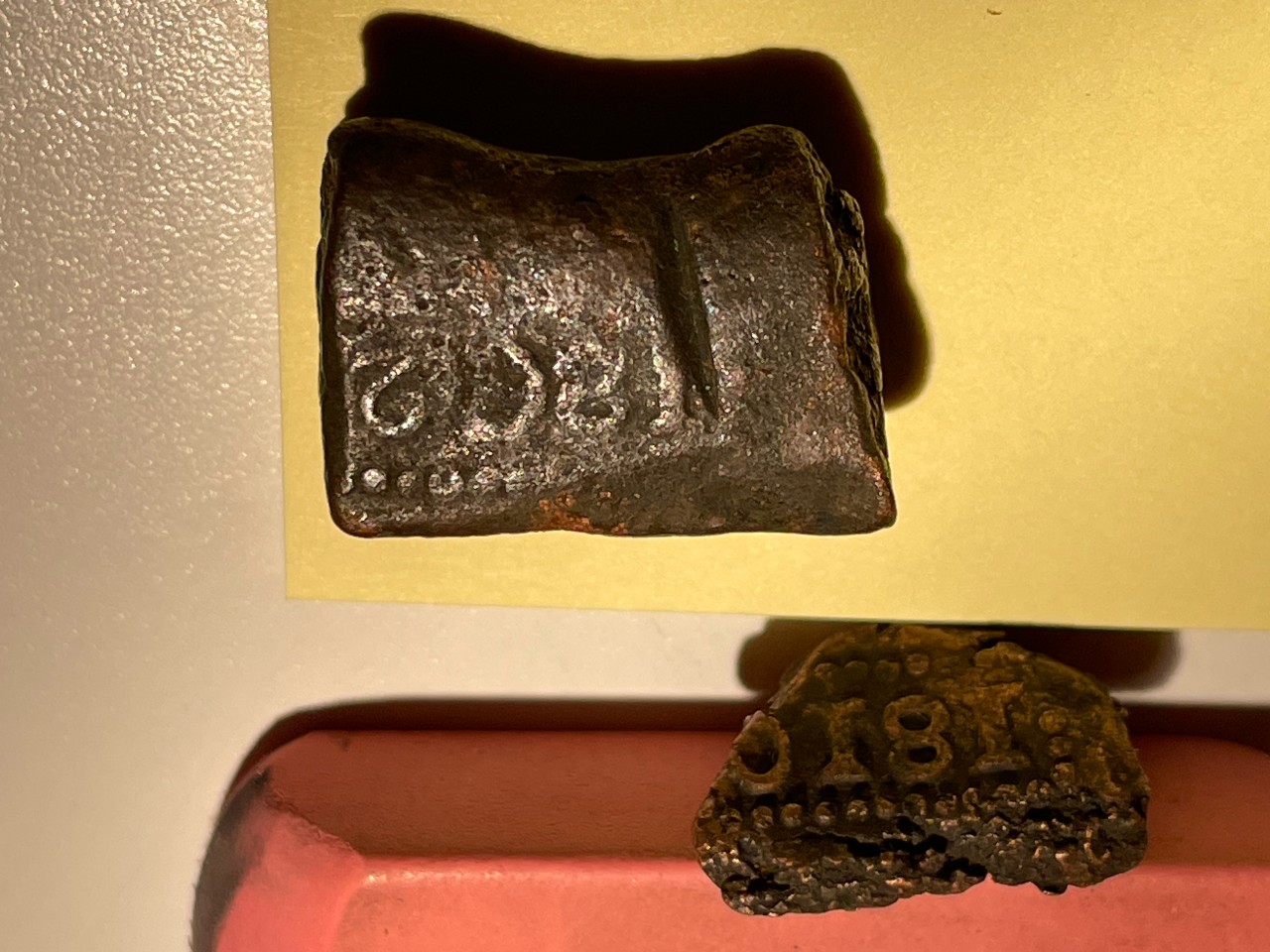
5. FRAGMENTS - Not sure if this is an error coin or just part of the lower QC during the second period in my collection. I have two 2S's which I call fragments both obverse & reverse stamped and weigh ONLY 2.6 grams and 5.8 grams! Both dated 1810. Both KM#224.1. see the next post for its photo.
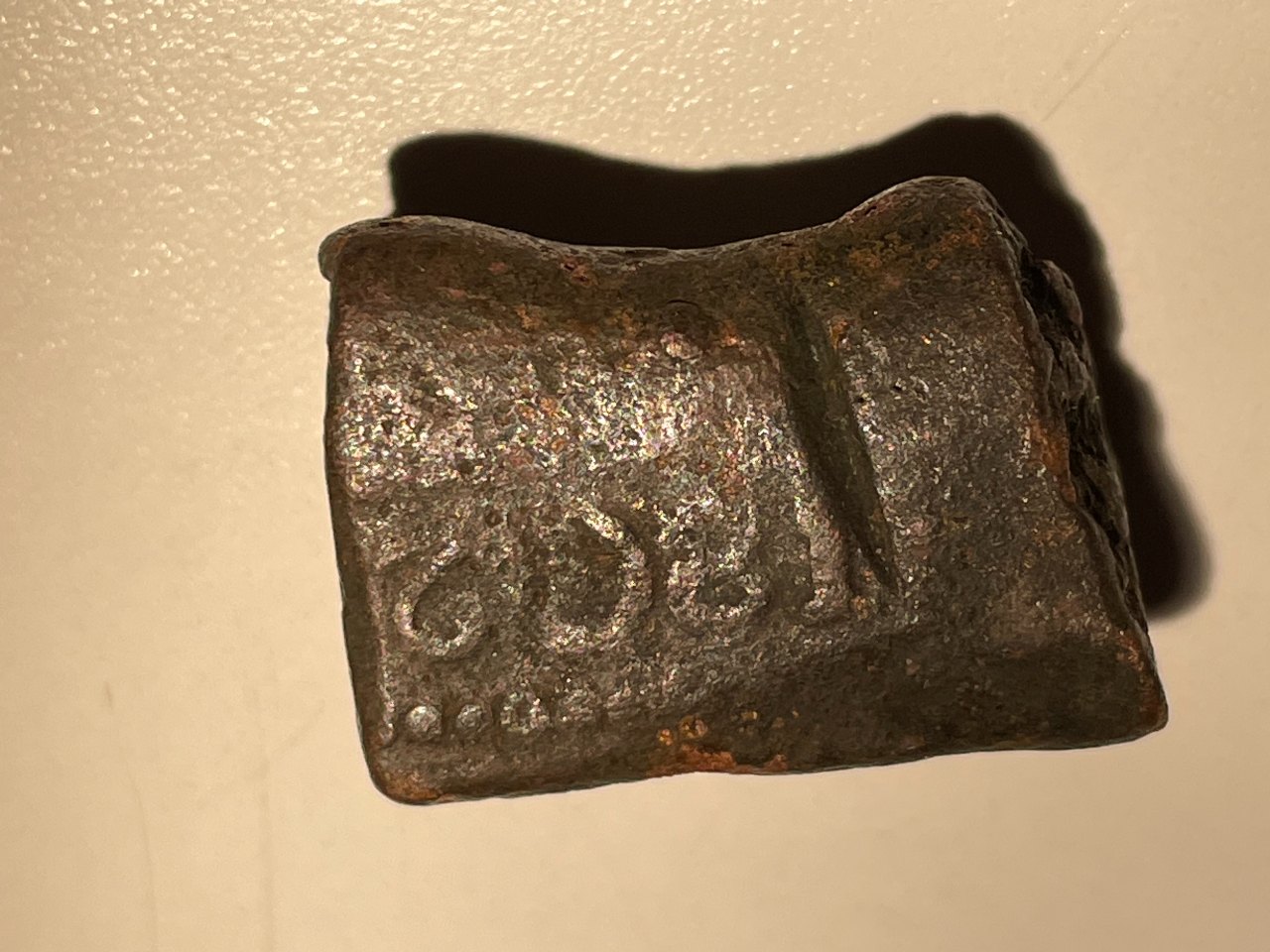
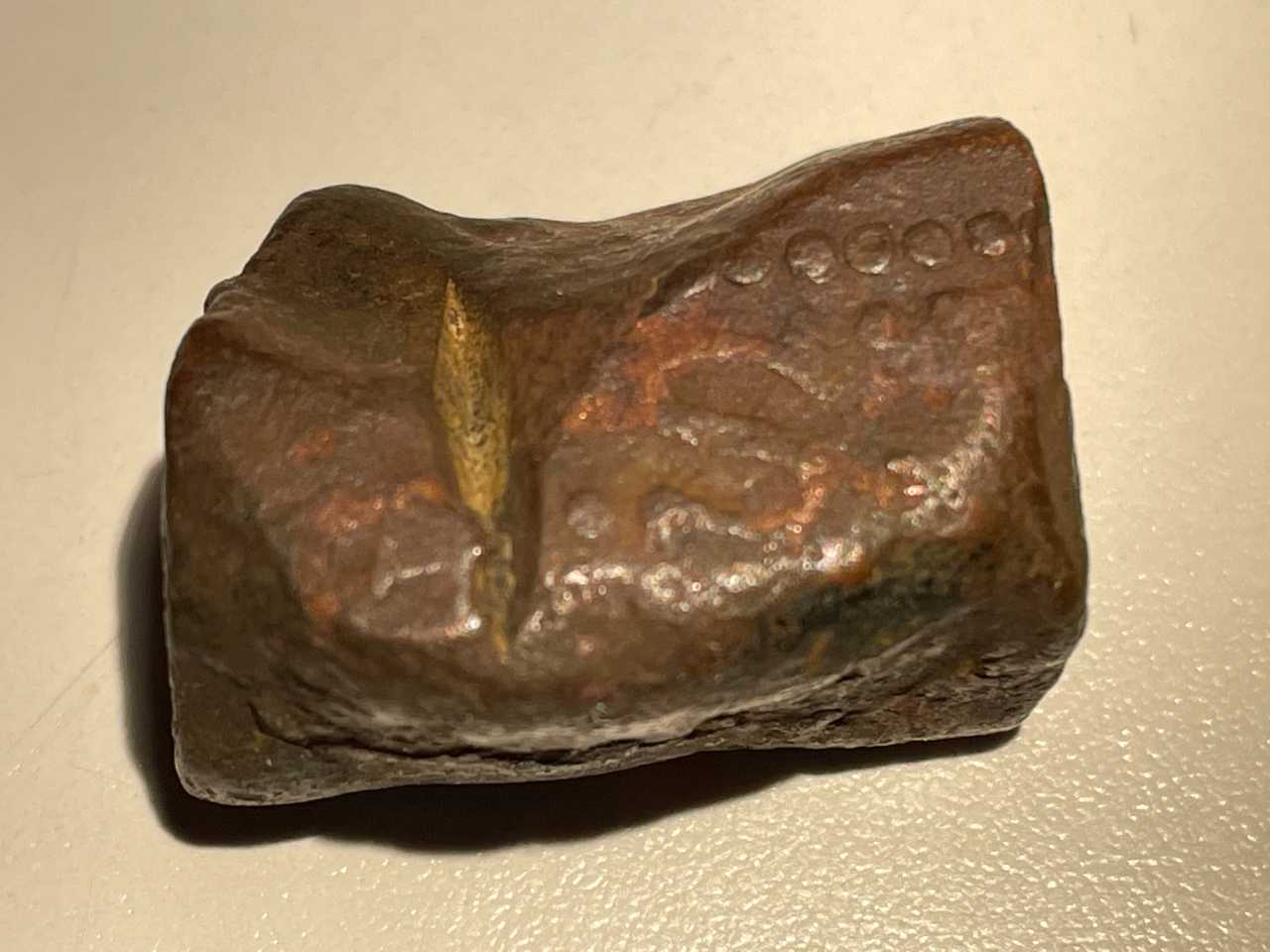
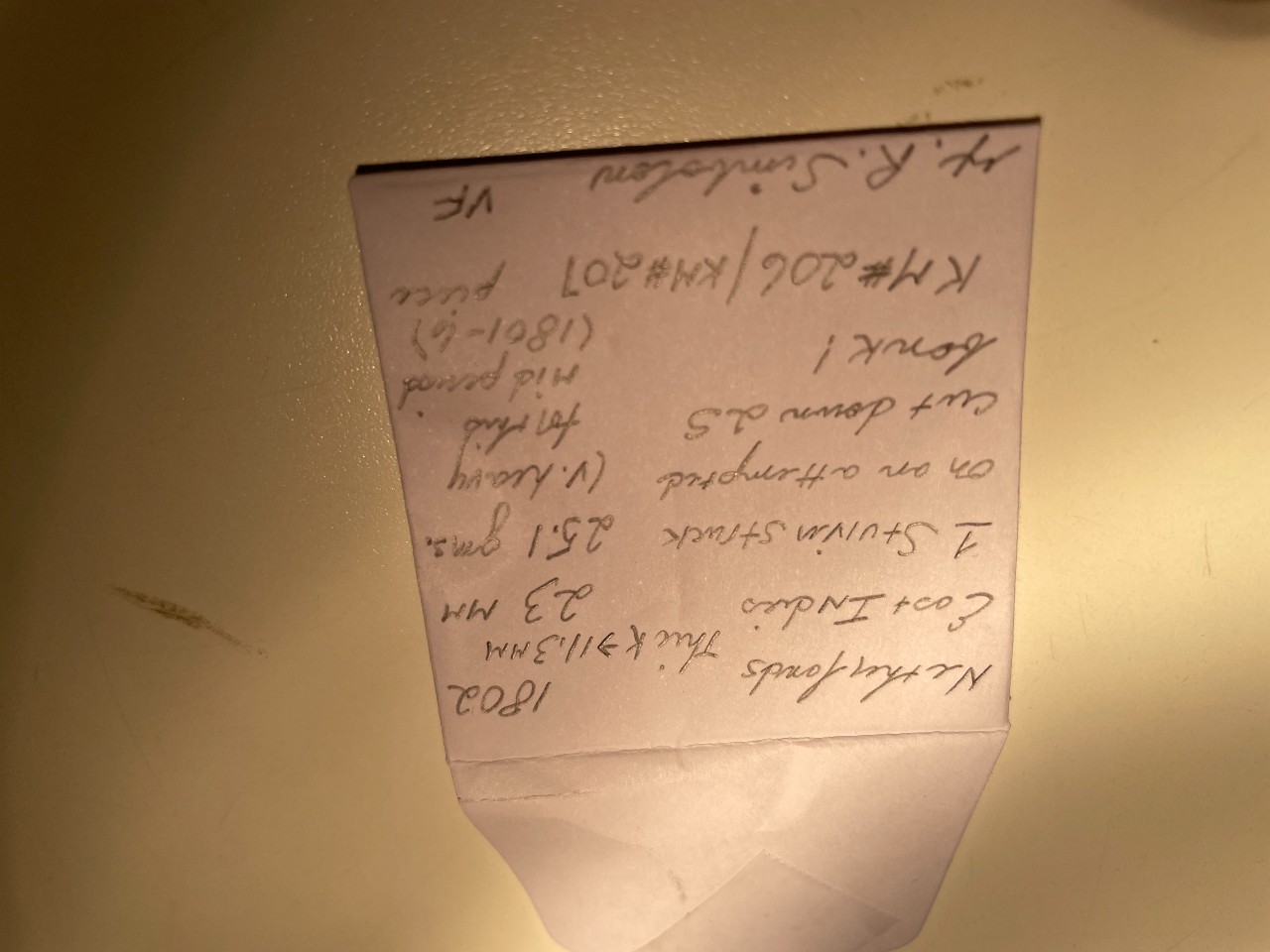
6. Miscut 1S on a 2S bonk piece. This piece in the next post shows an attempted cut on a 2S bonk but stamped nevertheless 1S. There are two cuts top & bottom. Not sure if this done or if anyone has information where & how these rods were cut it would be appreciated. This also begs the question from the standard reference lacking in my library - were they cut first and then stamped or vice-versa? Probably cut then stamped since many are off-center or the motifs are coming off the edges - so to speak. Not sure then what was going to be done with this piece of extra copper - I guess use it for 1/2S?
The top 3 images are my flip ticket with metrology information on the attempted cut down 1S on a 2S sized bonk. The last image is one of the 1810 2S fragment pieces - this piece measures 19mm horizontally, 5.8 grams!!! weight and is only 4.6 mm thick. See its size comparison to the 1802 2S sized piece attempted to be cut down to a 1S. It metrology: 23mm, 25.1 grams! JPL
Disclaimer: While a tremendous amount of effort goes into ensuring the accuracy of the information contained in this site, Coin Community assumes no liability for errors. Copyright 2005 - 2026 Coin Community Family- all rights reserved worldwide. Use of any images or content on this website without prior written permission of Coin Community or the original lender is strictly prohibited. Contact Us | Advertise Here | Privacy Policy / Terms of Use