In January and March 1937, companion bills were introduced in the Senate and House of Representatives, respectively, that called for half dollars to be struck "in commemoration of the one-hundredth anniversary of the birth of Grover Cleveland." The Senate bill was introduced by Arthur Harry Moore (D-NJ); the House bill by Frank William Towey, Jr. (D-NJ).
Stephen Grover Cleveland was born in Caldwell, NJ on March 18, 1837; he was the fifth of nine children. His father was the pastor at the First Presbyterian Church in Caldwell. The family moved to Fayetteville, NY in 1841 (Fayetteville is east of Syracuse in north central New York State). Grover grew up and went to school in New York.
It was in New York that Grover worked for a time as in intern in a law firm in Buffalo, passed the New York Bar in 1859 and began his legal career. It was also where he became a politician who built a reputation for "courage. honesty and the absence of partisan or personal designs." He believed that the public placed their trust in an elected official and expected him to serve the public honestly and with integrity, putting what was best for the people ahead of the interests of those in power via (often-corrupt) political machines.
In New York, Cleveland served as an Assistant District Attorney in Erie County, the Sheriff of Erie County, the Mayor of Buffalo and the Governor of New York. In 1884, he was elected President of the US - the first Democrat to be so in the post-Civil War era. He lost the 1888 election, but ran again in 1892 and emerged victorious. To this day, he remains the only person to serve two non-consecutive terms as US President; Cleveland was the 22nd and 24th US President.
Multiple members of Congress stood to recall and honor Grover Cleveland in celebration of the centennial of his birth in 1937, long-time New York Representative added his thoughts on June 14, 1937, he opened his extensive remarks with:
History looks upon Grover Cleveland as a hero because his own political henchmen were incapable of swerving him from his sworn duty, because he did what he knew was right - the upholding of law and order-and the malcontents knew that under his outspoken administration democracy would not tolerate mob rule.The coin bills sought up to 25,000 half dollars of standard specifications, all to bear the date of 1937. The bills specifically called for coins to be struck in Philadelphia, Denver and San Francisco, but the quantity to be struck by each Mint facility was to be determined by the Caldwell Coin Club Committee. (Caldwell is a smallish Borough (<5,000 residents in 1937) in northeast New Jersey).
It was not the first time a coin club was the main driver behind a commemorative coin bill; the Westchester Coin Club (New York) was behind the 1938 New Rochelle, NY half dollar. (Check out my posts about the New Rochelle half dollar via the
Commems Collection link below.)
The Club was very proactive in terms of developing design concepts for its coin, going so far as make sketches created by New Jersey artist Edwin D. Mott available for review. The obverse of the coin was to feature a left-facing portrait of Cleveland, with the reverse depicting the Caldwell manse (pastor's home) of the First Presbyterian Church in Caldwell - Cleveland's birthplace.
Artist Concepts for Grover Cleveland Birth Centennial Half Dollar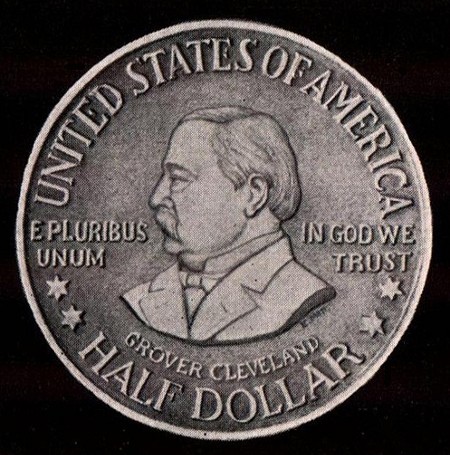
 (Image Credit: Caldwell (NJ) Coin Club via The Numismatist, American Numismatic Association, May 1937. Fair Use, education.)
Cleveland's reputation and legacy were not enough to push the coin proposal forward, however, and neither was reported out of Committee - neither the Committee on Banking and Currency in the Senate, nor the Committee on Coinage, Weights, and Measures in the House sent its bill forward. As a result, the companion bills died for lack of action.
Of course, Cleveland would get his numismatic moment as part of the Presidential $1 Series.
2012 Grover Cleveland Presidential Dollar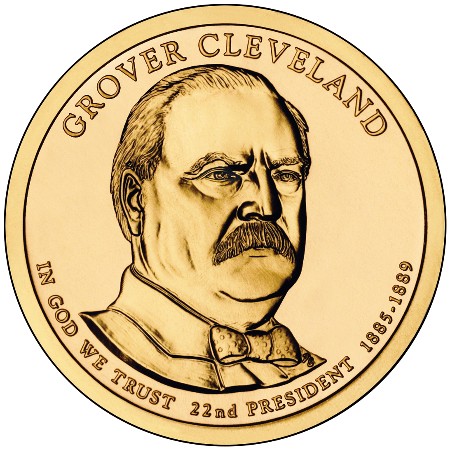
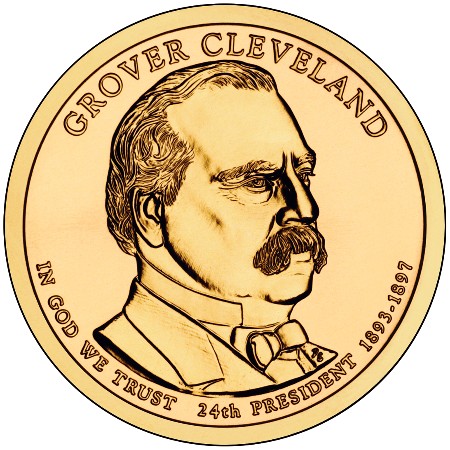 (Image Credit: US Mint, media image.
For more of my topics on commemorative coins and medals, including more What If? stories, see:
Commems Collection.




 Posted 01/13/2023 1:50 pm





