The Knights of Pythias organization was the subject of three commemorative coin bills introduced in the House of Representatives in December 1937, during the 88th Congress. The bills called for 50-cent pieces to be struck "in commemoration of the one hundredth anniversary of the founding of the Knights of Pythias."
The identical bills were introduced, in chronological order, by William Mererson Brock III (R-TN), James Roosevelt (D-CA) - FDR's son - and Harley Orrin Staggers (D-WV).
The Order of the Knights of Pythias was founded by Justus Henry Rathbone in Washington, DC on February 10, 1864. The Order was Fedarally charted as a "fraternal and benevolent" corporation by Congress in 1864; the bill to do so was approved by the President on June 29, 1894.
Justus Henry Rathbone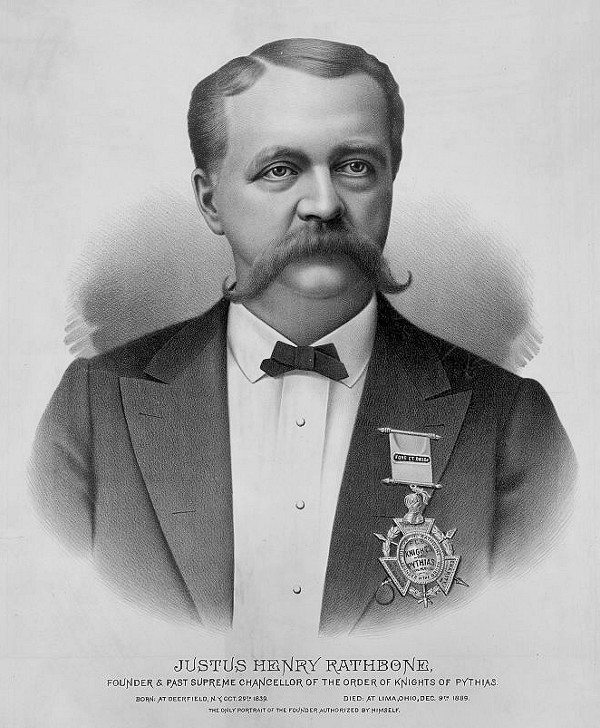 (Image Credit: Library of Congress, Prints and Photographs Division. Public Domain.)
The Order was founded on the lessons and rituals learned through the historical Greek story of Damon and Pythias. From the Knights of Pythias web site:
Damon and Pythias were historical characters living about 412 B.C. They were members The Pythagorean Brotherhood founded [by] Pythagoras the father of Greek philosophy. The Pythagorean Brotherhood required aspiring members to overcome very rigorous tests. Some of these were very similar to the ritualistic work of our order today. The object of the organization was the moral uplifting and purification of society. Strict morality, absolute truthfulness, honor, and integrity were thoroughly inculcated in the minds of its membership. Pythagoras held that the two most excellent things for man were "to speak the truth and to render benefits to each other." However, the outstanding feature of the society was the marvelous friendship and loyalty which bound the brotherhood together with hoops of steel. Damon and Pythias demonstrated these principles in the historical incident which forms the basis of our order.
Damon opposed the rule of the king of Syracuse because he gained the throne through fraudulent means. The Syracuse king then condemned Damon to death for his opposition. Pythias asked that the king grant Damon a stay of execution allowing him to say goodbye to his wife and child. He also volunteered to face execution if Damon did not return. Each was willing to die to save the other's life. Their loyalty to each other, the adventures that beset them, and the outcome of this noble friendship form the basis for one of the most beautiful stories of history as exemplified in our ritual.Damon returned after settling his affairs, and the King was so impressed by Damon's show of friendship and loyalty to Pythias, that he set both men free!
The three identical bills each called for a whopping 10 million (!) silver half dollars of standard specifications that would feature a design developed by the Order of the Knights of Pythias in conjunction with the National Oystic Eibrosis Research Foundation. All coins struck were to feature a date of 1964, regardless of when struck; each of the bills specified that coining authority was to expire one year after enactment. Orders for coins had to be for a minimum of 25,000 coins at a time.
At different times in its history, the Order has selected a lead charity for which to focus much of its attention. At the time of the coin bills, the National Cystic Fibrosis Association was its lead charity. In the years since, the Order, on a national level, has given its focus to the Special Olympics and American Cancer Society; many local chapers continue to engage with the Cystic Fibrosis organization in their area.
Per the bills, a minimum of 95% of net proceeds from sales of the coins was to be donated to the National Cystic Fibrosis Research Foundation. Had 10 million coins been sold, the Foundation would have likely have received in excess of $4 million (assuming a selling price of $1.00 per coin, if the issue price would have been set at $1.50, the donation to the Foundation could have exceeded $9 million). In 2022 terms, the donation would be in the range of $37 to $85 million - impressive amounts!
Alas, none of the bills proceeded past being referred to the House Committee on Banking and Currency - the Knights would have to raise funds for the Cystic Fibrosis Research Foundation through other means - which they did. The Knights of Pythias half dollar proposals pre-dated the modern US Commemorative Coin series which finds Congress more receptive to coins for service organizations - e.g., March of Dimes, Boys Town, Lions Club International
I wonder if the coin request had been switched to a medal request and the number of minted pieces sought had been revised to a more medal-friendly figure, if it would have garnered a better reception? Today, we can only wonder...
For more of my topics on commemorative coins and medals, including more What If? stories, see:
Commems Collection.







 Posted 01/14/2023 12:13 pm


