Senator Patrick Anthony McCarran (D-NV) introduced a bill in the Senate in June 1937 that called for silver coins to be struck "in commemoration of the Seventy-fifth anniversary of the admission of the State of Nevada to the Union." Nevada was admitted as the 36th State on October 31, 1864.
The area of present-day Nevada was originally inhabited by Native American tribes - primarily Paiute, Shoshone and Washoe - before coming under Spanish control and becoming, first, a part of New Spain, then Mexico (after it gained its independence from Spain). After the US emerged victorious in the Mexican-American War (1848), the area was transferred to the US and was incorporated in the US as the Utah Territory. The Nevada Territory was carved from western Utah Territory in 1861 and Nevada was admitted to the Union as a State just three years later in 1864. (After it was admitted as a State, Nevada was expanded to the east with land from the Utah Territory and at its southern border with land previously part of the Arizona Territory.)
Nevada Territory (Initial Borders) - 1861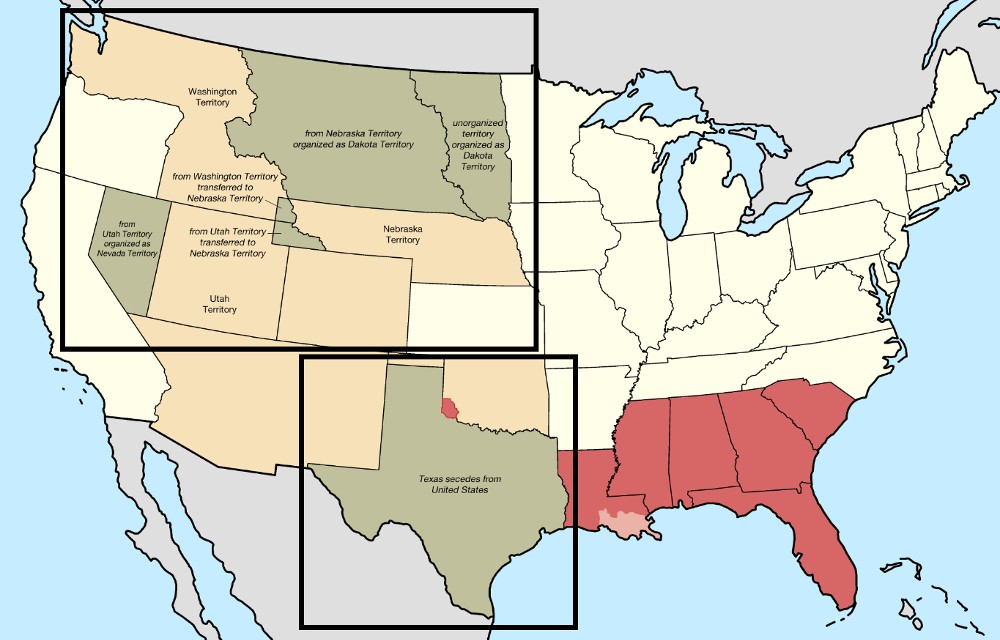 (Image Credit: Golbez, CC BY-SA 4.0 https://creativecommons.org/licenses/by-sa/4.0, via Wikimedia Commons.)State of Nevada (Final Borders)- 1867
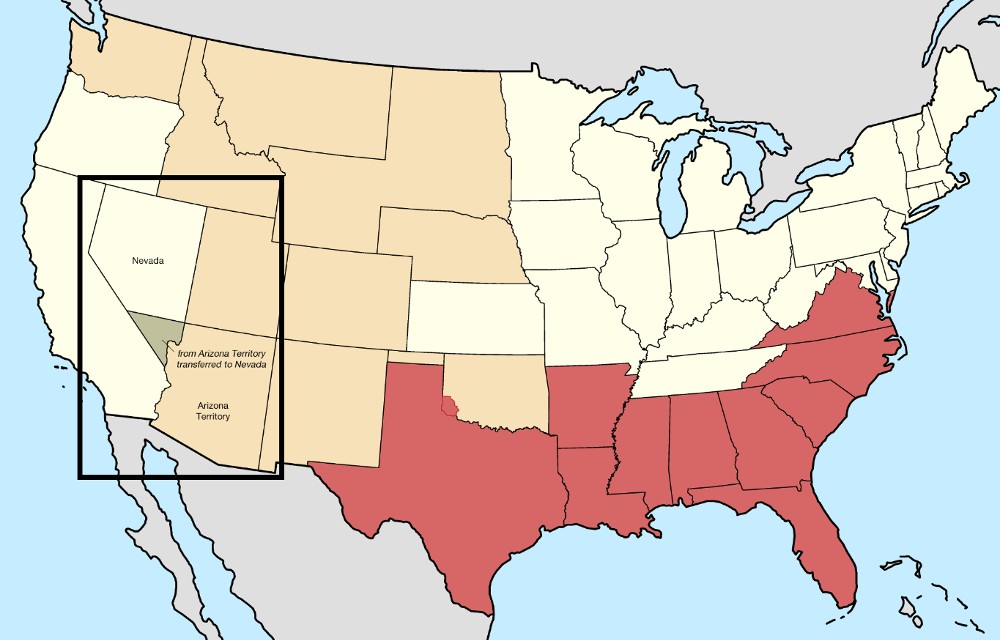 (Image Credit: Golbez, CC BY-SA 4.0 https://creativecommons.org/licenses/by-sa/4.0, via Wikimedia Commons.)
The discovery of a large deposit of silver in the Virginia City area in 1858-59 (at the time, located within the Utah Territory) and the resultant economic impact on the area spurred the area's rapid population growth - with miners leading the way. The economic growth was one factor that led to the establishment of the Nevada Territory and, ultimately, the residents of Nevada Territory seeking Statehood.
Some argue, however, that political need was the more significant factor in the area's quicker-than-typical journey to Statehood.
One political factor was ensuring that Nevada did not become a member of the Confederacy and provide ideologic and/or economic support to it.
Also, history makes clear the fact that Abraham Lincoln was not facing an easy re-election in 1864 (though by Election Day, recent Union victories over the Confederacy had turned things strongly in Lincoln's favor - most notably at the Battle of Atlanta on July 22, 1864). It was believed by supporters of Lincoln that Nevada - as a State - could help Lincoln get re-elected, add needed support in Congress for his post-Civil War Reconstruction plans and help get the Lincoln-supported 13th Amendment to the US Constitution, abolishing slavery, approved in Congress.
An interesting note connected to Nevada's quick trip to Statehood: The entire Nevada Constitution - once agreed to by the delegates assembled in Carson City in July 1864 - was sent to Washington, DC via telegram vs. overland mail to speed the process. It was the longest telegram ever sent to that point - 16,453 words - and cost $4,303.27 - the equivalent of ~$83,000 in 2023 - think about that the next time you complain about overnight mail delivery costs! 
The bill's coin request includes a few unusual provisions, and, IMO, features language that is open to interpretation. For example, it specified that a single US Mint facility was to be used to strike "not to exceed $100,000 in silver dollars and 50-cent pieces of standard [specifications]." Does this mean $100,000 is the limit for some combination of silver dollar and half dollar coins? OR Does it mean $100,000 worth of each denomination - i.e., 100,000 silver dollars and 200,000 half dollars.
It also states that the coins were to feature "a special appropriate single design to be fixed by the Director of the Mint." Does this mean that each denomination was to be struck in only one design? OR Was the same design to be used for both denominations?
All coins struck were to feature the date 1939, with The Nevadans being designated as the coin's sponsor and the only group that could place orders for the coins. Net proceeds from sales of the coins were to go toward helping to defray the 75th Anniversary celebration events organized by The Nevadans.
The bill was never reported by the Senate Committee on Banking and Currency - Nevada did not get its Statehood commemorative coins and its bill's language was never clarified.
Though there were no 1939 coins, the US Mint did strike a commemorative silver medal for Nevada's Statehood Centennial in 1964, and the Post Office Department issued a commemorative stamp for the Centennial anniversary. I'm planning a future post for the medal.
For more of my topics on commemorative coins and medals, including more What If? stories, see:
Commems Collection.







 Posted 01/16/2023 07:41 am


