| Author |
 Replies: 15 / Views: 1,511 Replies: 15 / Views: 1,511 |
|
|
CCF Master Historian of USA Commemoratives
 United States
12497 Posts |
Borrowing a phrase from Canada's coinage, I herein present a brief survey of "Godless" classic-era US commemorative coins - i.e., those that do not include the now-standard "In God We Trust" motto as part of their design. The situation in Canada came about when engravers at the Royal Mint in London accidentally left off the Latin phrase "Dei Gratia" (Latin for "By the Grace of God") on the dies to be used for 1911 Canadian coinage. Even though the omission was noticed, and work on new dies had begun, a dwindling coinage inventory forced Canada to strike and issue 1911 coins without the "Dei Gratia" phrase. It was an immediate issue for many Canadians, and the coins began to be referred to as "Godless." New dies, with the phrase restored, were delivered and were used beginning in 1912. The "Godless" circulation coins of 1911 remain popular issues among coin collectors. The motto "In God We Trust" first appeared on the US two-cent coin of 1864. As no law was put in place to require it, the motto's use on US coins in the years that followed was inconsistent, appearing on some but not all. The initial issues of the US commemorative coin series did not feature the motto; it makes its first appearance on the 1915 Half Dollar and Gold Quintuple Eagle coins struck for the Panama-Pacific International Exposition (the program's Gold Dollar and Gold Quarter Eagle do not include the motto). It began to be used, intermittently at first, on US commemorative coins going forward. The inclusion of "In God We Trust" on US coins and paper money was not mandated by law until July 1955. At that time, the US Congress authorized and President Dwight David Eisenhower approved the bill calling for inclusion of the motto on all new US coins and paper money. It had become a long-standing tradition on US coinage by that time, and was featured on all then-current US circulating coins. Here's an illustarted survey of US commemorative coins that do not include the "In God We Trust" motto: 1892-93 World's Columbian Exposition - Columbus Half Dollar  1893 World's Columbian Exposition - Isabella Quarter 1893 World's Columbian Exposition - Isabella Quarter  1900 Lafayette Memorial Dollar 1900 Lafayette Memorial Dollar  1903 Louisiana Purchase Exposition Gold Dollars - Jefferson & McKinley Types 1903 Louisiana Purchase Exposition Gold Dollars - Jefferson & McKinley Types    1904-05 Lewis & Clark Exposition Gold Dollars 1904-05 Lewis & Clark Exposition Gold Dollars  1915 Panama-Pacific International Exposition - Gold Dollar and Gold Quarter Eagle 1915 Panama-Pacific International Exposition - Gold Dollar and Gold Quarter Eagle  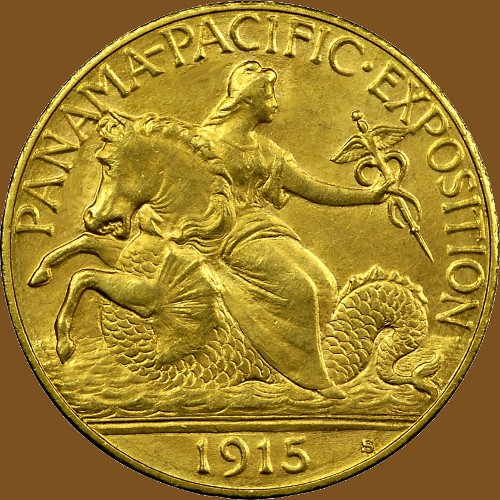 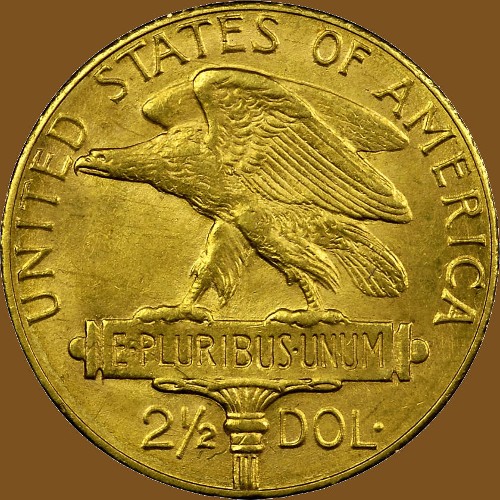 1916-17 William McKinley Birthplace Memorial Gold Dollars 1916-17 William McKinley Birthplace Memorial Gold Dollars  1921 Missouri Statehood Centennial Half Dollar 1921 Missouri Statehood Centennial Half Dollar  The motto "In God We Trust" became a standard element of US commemorative coins and was included on all coins dated 1922 and later - 30+ years before it became a legal requirement!. Collecting history one coin or medal at a time! (c) commems. All rights reserved.
Edited by commems
01/19/2023 6:05 pm
|
|
|
|
Bedrock of the Community
United States
94367 Posts |
Interesting backstory, thanks.
|
|
Moderator
United States
15852 Posts |
I enjoy the creative variety that resulted from the design freedom available prior to the legislative mandate of certain phrases on our coins. The limited size of a coins fields forces choices and by requiring "IGWT' (in addition to LIBERTY and E PLURIBUS UNUM) we have eliminated a lot of expressive freedom from the artists who design our coinage. Interesting to note from your survey - only the 1915 Panama Pacific quarter eagle contains the legend E PLURIBUS UNUM. When did that become a legal requirement? Or perhaps it's not?  Take a look at my other hobby ... http://www.jk-dk.art |
|
Pillar of the Community
United States
1173 Posts |
Interesting story, thanks for sharing.
|
|
CCF Master Historian of USA Commemoratives
 United States
12497 Posts |
Quote:
Interesting to note from your survey - only the 1915 Panama Pacific quarter eagle contains the legend E PLURIBUS UNUM. When did that become a legal requirement? Or perhaps it's not?
Section 18 of the Coinage Act of 1873 specified that US coins were to include the "E Pluribus Unum" motto - it also specifed that "Liberty" and "United States of America" were to appear. The inclusion of "In God We Trust" was an allowable option per the Act, but not mandated. The Panama-Pacific International Exposition Quarter Eagle was the first US commemorative coin to include "E Pluribus Unum." . Collecting history one coin or medal at a time! (c) commems. All rights reserved.
|
|
Bedrock of the Community
 United States
12907 Posts |
I personally feel that E Pluribus Unum (Out of Many, One) is more appropriate on coins than IGWT but that's just me. At the very least on the edge-incused dollar coins, IGWT should be on the edge and the date and mint mark on one of the faces instead of vice versa.
EPU does not appear on Shield cents, but it [EPU] does on all the Memorial, Centennial, and Wheat cents I've checked.
Thanks for the history and photos from your collection, commems! I really like those Pan-Pac ones.
Edited by CelticKnot
01/20/2023 08:56 am
|
|
CCF Master Historian of USA Commemoratives
United States
12497 Posts |
Quote:
EPU does not appear on Shield cents Have a closer look at the top segment of the shield.  Quote:
Thanks for the history... My pleasure! Collecting history one coin or medal at a time! (c) commems. All rights reserved.
Edited by commems
01/20/2023 08:28 am
|
|
Bedrock of the Community
United States
12907 Posts |
Quote:Have a closer look at the top segment of the shield. Thanks, I knew that must be incorrect. I was looking just at the fields. Whoops!  Edited by CelticKnot
01/20/2023 10:29 am
|
|
Pillar of the Community
United States
2365 Posts |
|
|
CCF Master Historian of USA Commemoratives
United States
12497 Posts |
Quote:
No mandate for Commens? No. Commemorative coins were not specifically referenced in the Coinage Act of 1873 (too early for commemorative coins to be top of mind), and, as each commemorative coin was authorized/approved by separate legislation, certain liberties were taken with included design elements. Conformity with most circulation coinage standards happened among the commemorative coin issues in the 1930s - the long-standing - but unwritten - rule of "no depiction of living persons" was set aside a few times in the series, however, during the 1920s and 1930s. Collecting history one coin or medal at a time! (c) commems. All rights reserved.
|
|
Pillar of the Community
United States
2365 Posts |
Thanks commems! Makes sense to me! :-)
|
|
Moderator
United States
194606 Posts |
Very interesting!  I agree, the mottos take up precious space that could be use for design elements. If I could chose one to ditch, IGWT would be it. In my opinion, EPU is the more logical an appropriate motto. |
|
Pillar of the Community
United States
3768 Posts |
Thanks for the backstory, commems! Quote:
If I could chose one to ditch, IGWT would be it. In my opinion, EPU is the more logical and appropriate motto. Agreed, jbuck. Member of SPMC, FCCB, ANA and ANS. My U.S. Classic Commemorative Complete Set: https://www.NGCcoin.com/registry/co...sets/278741/ |
|
CCF Master Historian of USA Commemoratives
United States
12497 Posts |
@All: Thanks for the engagement and support - always appreciated!
I agree with others, Liberty and E Pluribus Unum are keepers - IGWT is the least critical to our nation's identity.
Collecting history one coin or medal at a time! (c) commems. All rights reserved.
|
|
Bedrock of the Community
United States
12907 Posts |
Since it became the national motto in 1956, courts have always upheld the use of the motto even though many have argued that it is a violation of the Establishment Clause of the First Amendment (separation of church and state).
|
|
Moderator
United States
194606 Posts |
Indeed, but probably best we end that discussion right there. As my wife often says of me, "He has opinions... and he will hurt your feelings."  |
| |
Replies: 15 / Views: 1,511 |
|










 Posted 01/20/2023 06:06 am


