| Author |
 Replies: 27 / Views: 2,416 Replies: 27 / Views: 2,416 |
|
New Member
United States
7 Posts |
I have an 18th century powder horn with a copper Brasher doubloon on the plug. It has been there a long time. Can anyone help me as I am not a coin collector. It may be some kind of copy. Al 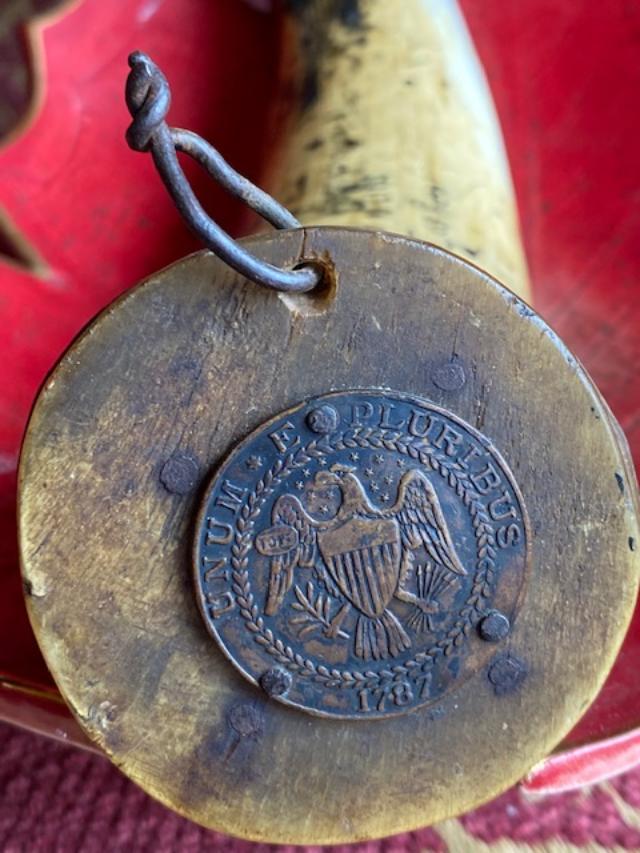 |
|
|
|
Moderator
 United States
195763 Posts |
 to the Community! |
|
Bedrock of the Community
United States
12057 Posts |
Some kind of replica made for that use since it's obviously not gold. You can look where the cartouche is on the right wing of the eagle, and see what it has there instead of the "EB" monogram Also highly doubtful of 18th c. origins, most 18th c. powder horns did not have nailed tops (the sides were nailed) -- the top was usually a fit wooden plug. The loop of modern wire through the drilled hole is also period-incorrect, examples I have seen usually have a center attachment knob through which rawhide or tendon was looped and strung out to the pointed end. The flat top rounded nails don't look right either for 18th c., should be rose top or raised hand-cut nails, square or rounded-square. These look too small and too uniform in diameter. Of course, this could also be a modified plug, or a previous repair job. I can't see the rest of the horn, which may in fact be 18th c., only the plug. Still a neat conversation item. Member ANA - EAC - TNA - SSDC - CCT #890 "Most of the things worth doing in the world had been declared impossible before they were done." -- Louis D. Brandeis Edited by paralyse
03/13/2023 5:56 pm
|
|
Pillar of the Community
United States
2365 Posts |
If that powder horn is definitely genuine (Revolutionary War Era ish), you might very well have a Copper Brasher Doubloon there. That said, you need to do some serious research on this potentially high value piece.! You could find someone who specializes in items of that era and willing to take the time to authenticate the Doubloon. I would NOT remove the coin until you have bonafide, hands-on research from someone who has the historical knowledge of both items - the powder horn and the Doubloon. It's possible that you have not only a beautiful antiquity but, Brasher's mark to go along with it. I hope this makes sense to you. There are many replica's to be aware of. The nails are telling me that this is potentially real even though they don't appear to be rose head nails. It would be great if you had some sort of provenance to go with this!!! I've spent most of my life dabbling in antiques but, mostly Civil War Era. Good luck! Here's some good historical reading material if you haven't done so yet. https://coins.nd.edu/colcoin/colcoi...r.intro.htmlparalyse makes some good points as well. I'm not tempted to authenticate either item based upon a photograph. Edited by dsking
03/13/2023 6:13 pm
|
|
Bedrock of the Community
United States
11966 Posts |
Quote:
you might very well have a Copper Brasher Doubloon there. The Dobloon was a 2 Escudos gold coin worth about 4 Spanish dollars or 32 Reales, as a so-called "Spanish Dollar" was a coin denominated at 8 Reales. There is no such thing as a copper Dobloon. The coin's engraving and the 'EB' countermark are crudely done. The copy looks like it dates at around the same time as when the horn was produced, as the patina of the horn and the replica medal seem consistent, but I know nothing about powder horns. IN NECESSARIIS UNITAS - IN DUBIIS LIBERTAS - IN OMNIBUS CARITAS THE MAN IN THE ARENA, Theodore Roosevelt at the Sorbonne Paris on April 23, 1910: " It is not the critic who counts; not the man who points out how the strong man stumbles or where the doer of deeds could have done better. The credit belongs to the man who is actually in the arena, whose face is marred by dust and sweat and blood, who strives valiantly, who errs and comes up short again and again, because there is no effort without error or shortcoming, but who knows the great enthusiasms, the great devotions, who spends himself in a worthy cause; who, at the best, knows, in the end, the triumph of high achievement, and who, at the worst, if he fails, at least he fails while daring greatly, so that his place shall never be with those cold and timid souls who knew neither victory nor defeat." My coin website: https://fairfaxcoins.com |
|
Pillar of the Community
United States
2365 Posts |
Edited by dsking
03/13/2023 6:50 pm
|
|
Pillar of the Community
United States
2365 Posts |
Additionally: Weight: 167.8 g (10.87 grams) Diameter: 29.2 mm Reverse die alignment: 170° of Robinson's reproduction.
It's worth a shot!
Edited by dsking
03/13/2023 6:56 pm
|
|
Bedrock of the Community
United States
11966 Posts |
The actual Brasher Doubloon wasn't made by the Spanish but by Ephraim Brasher. Brasher created a few copper coins but none were called Doubloons. A Copper Brasher Doubloon was never made, and the Brasher Doubloon was actually a double Doubloon of 8 Escudos or $16. Copies of the Brasher Doubloon exist in copper and likely many other metals.
IN NECESSARIIS UNITAS - IN DUBIIS LIBERTAS - IN OMNIBUS CARITAS THE MAN IN THE ARENA, Theodore Roosevelt at the Sorbonne Paris on April 23, 1910: " It is not the critic who counts; not the man who points out how the strong man stumbles or where the doer of deeds could have done better. The credit belongs to the man who is actually in the arena, whose face is marred by dust and sweat and blood, who strives valiantly, who errs and comes up short again and again, because there is no effort without error or shortcoming, but who knows the great enthusiasms, the great devotions, who spends himself in a worthy cause; who, at the best, knows, in the end, the triumph of high achievement, and who, at the worst, if he fails, at least he fails while daring greatly, so that his place shall never be with those cold and timid souls who knew neither victory nor defeat." My coin website: https://fairfaxcoins.com |
|
Pillar of the Community
United States
2365 Posts |
The articles explain what I'm trying to say.
|
|
New Member
 United States
7 Posts |
Thanks for the replies. The horn came from a picker from Maine. It is marked "Medad Hill at Goshen" on the body. He was an 18th century musket/fowler maker and also a Committee of Safety musket maker.
The coin is about 30 mm in diameter. The cartouche has EB in it.
Al
|
|
New Member
United States
7 Posts |
The inscription on the horn actually reads "Medad Hills at Goshen"
Al
|
|
Pillar of the Community
United States
4233 Posts |
Pictures of the entire horn and the inscription might help somebody. I'm a little suspicious of a gunsmith also engraving a powder horn but I don't know anything about these.
|
|
Valued Member
United States
378 Posts |
|
|
Bedrock of the Community
United States
12057 Posts |
It's entirely possible that it might be a reproduction or restrike. But then you have the issue of a date mismatch -- the originals were only struck in gold, and the most common restrike was not produced until the Civil War as @numismaticstudent noted above; the originals were not struck in New York until 1787, 10 years after the "revolutionary war", and are so rare that I question whether a contemporary Connecticut gunsmith would have even known of their existence, much less had any reason to obtain a copy of one and then deemed it to have significance enough to affix to a powder-horn stopper.
However, there were only 50 of the restrikes issued, and a quick comparison of one of the brass or copper restrikes will highlight the stark difference in quality -- the restrikes are mushy and look almost like a caricature of the original issues - they were prepared from new dies that were engraved at Jos. Merriam's workshop in Boston.. The coin on your horn is much too sharply struck and detailed, which to me suggests that it is a modern copy made with modern techniques not available in the 19th or 18th centuries.
The Medad Hills reference makes it quite a bit more interesting since Hills is the brother of John Hills and the son of Benoni Hills, also well-known gunsmiths and Connecticut Patriots.
The three Hills brothers and their father Benoni are widely considered some of the best Colonial-era gunsmiths and firearms that can be linked to them with provenance are mostly museum pieces or sell for a ton of money when they do come up for private sale. The name carries as much weight as Hawken, Ferree or the Henrys of the same era, just to name a couple, and later, Sharps, Remington, Winchester and Colt. He did sometimes sign "at Goshen" on known examples of his work. If this horn was made by or engraved by Medad Hills it is worth quite a bit of money and there are quite a few museums that would pursue it avidly. It sounds like you are qualified to make such a distinction.
However, the inclusion of the "doubloon" still throws me off. It is just too out of place and incongruent. Ultimately your best bet would be to have the coin inspected by a specialist in the Brasher coins and their restrikes.
Member ANA - EAC - TNA - SSDC - CCT #890 "Most of the things worth doing in the world had been declared impossible before they were done." -- Louis D. Brandeis Edited by paralyse
03/14/2023 1:46 pm
|
|
New Member
United States
7 Posts |
I am an American Revolutionary War arms collector and not a coin collector.
But I can tell you that some powder horns from the French and Indian war and the Revolution have some of the finest scrimshaw engraving, often as good as banknote engraving. So plain horns were not really as much the norm in that era as may be thought. I think the horn was originally made and then, sometime after that, the coin was added. But, we'll probably never know. I just would like to know if the coin may have been added a long time ago or in the last fifty years.
Al
|
|
Bedrock of the Community
United States
12057 Posts |
I would tend to agree with that assessment. I would be more inclined to think it's an older item that's been modified with a modern fake copy of a Brasher doubloon.
I updated my original post for clarification.
I enjoy black powder and antique firearms in general, but have neither the means nor the space to buy and display them (I spend all my money on coins!) so I can only dream about owning anything related from the 18th century.
Member ANA - EAC - TNA - SSDC - CCT #890 "Most of the things worth doing in the world had been declared impossible before they were done." -- Louis D. Brandeis Edited by paralyse
03/14/2023 1:45 pm
|
| |
Replies: 27 / Views: 2,416 |








 Posted 03/13/2023 5:47 pm


