|
This page may contain links that result in small commissions to keep this free site up and running.

Welcome Guest! Registering and/or logging in will remove the anchor (bottom) ads and the security checks. It's Free!
To participate in the forum you must log in or register. | Author |
 Replies: 31 / Views: 3,670 Replies: 31 / Views: 3,670 |
|
Pillar of the Community
 Sweden
2124 Posts |
The Roman general Marcus Cassianius Latinius Postumus served under emperor Gallienus, and was responsible for the defense of the border along the river Rhine. After spending many years in Gaul to uphold the defense against attacking Germanic tribes, Gallienus left together with a large part of the army to deal with problems in the East. Postumus successfully repelled the Germanic tribes that took the opportunity to renew their attacks. In 260, he is declared emperor by his troops. (This is a super short version of a long sequence of events, the details of which can be easily found online.) Postumus establishes what becomes known as the Gallic Empire. It lasts 260-274 and when as largest, it covered Gaul, Spain, Britain, and Raetia (today's southern Germany and surroundings). Postumus was killed by his own troops in 269, when he refused them to sack the city of Mainz after having put down a rebellion. He was succeeded by a number of more short-lived Gallic emperors, until Aurelian defeats the usurper empire in 274. Postumus has a very rich coinage, featuring a wide range of motifs, not least many different deities. Besides Roman gods and goddesses, Greek, Oriental, Egyptian, and Germanic deities figure on his coins. I thought I could show a few from my collection - antoniniani, mostly. Postumus coined the whole range of denominations from as to aureus, but the antoniniani are the ones most readily available and they also have a very varied range of motifs. I invite you to show your Postumus coins too!I will show one coin per post and try to give some background to the choice of motif. Some of it is pure guesswork (not by me, but by people better equipped at guessing  ), since there really isn't any documentation from the time and few archeological records to support one view or another. We mostly have only the coins themselves. There isn't even consensus about where minting took place - RIC states Lugdunum (Lyon) as the main mint, but more recent research points to Colonia Agrippina (Cologne) and/or Treveri (Trier) as the mints used by Postumus. It is an important and interesting question, but I will not engage in it in this thread. That is also the reason I will not state place of mint for the coins I show. When it comes to fineness and weight, it is generally accepted that Postumus improved the antoninianus coinage compared to the previous emperors and compared to that of Gallienus, who continued to run the rest of the empire. There is some evidence pointing to a slight increase in weight and a decrease in fineness during Postumus's rule, but I will not go into that. The average weight of his antoniniani is around 3.2 g, with at least 1.2 g variation upwards and downwards. The fineness is 10-20 % silver content. (The Gallic emperors who succeeded Postumus reduced both weight and fineness of their antoniniani considerably.) Dating is also a bit conjectural. I use the dates provided in L'Empire Gaulois by Parisot et al, editions Les Chevau-legers, 2011. Don't take them as absolute truths. But let's get started. Here is the first coin, one of the earliest minted by Postumus: Antoninianus, 260-261. Billon, 3.43 g, 23 mm. RIC V Postumus 64. 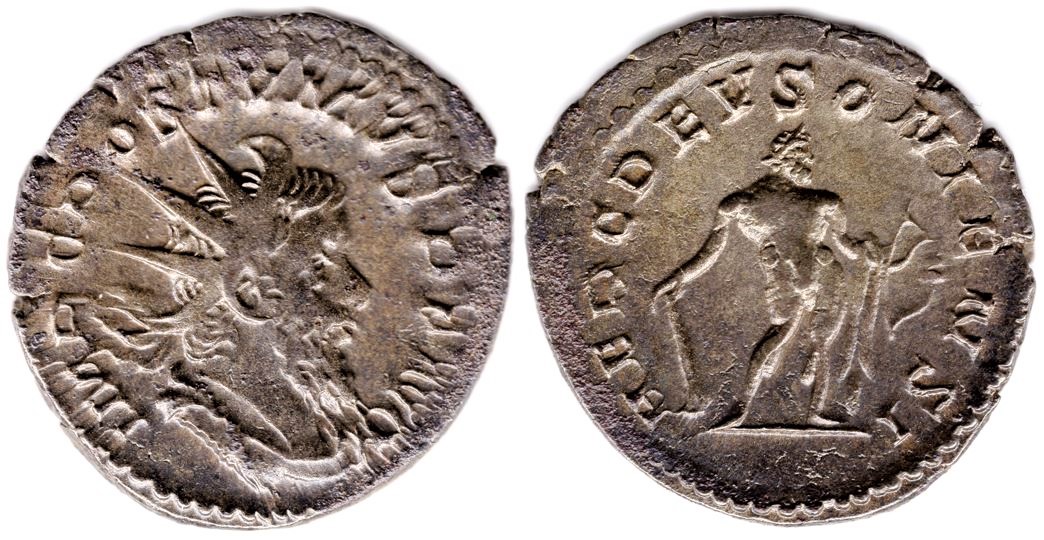 Obverse: IMP C POSTVMVS P F AVG (Imperator Cæsar Postumus Pius Felix Augustus). Postumus with radiate crown. All the antoniniani I show have this obverse. Reverse: HERC DEVSONIENSI (Herculi Deusoniensi / To Deusonian Hercules). Hercules with his club, holding bow and skin of the Nemean lion. Hercules is a favorite of Postumus and appears in several series of his coins. (One of particular interest is a series depicting the twelve labors of Hercules, a rare series which I would love to have.) The Greek Bronze Age superhero Heracles was adopted by the Romans as Hercules and was a popular companion on coins by several emperors. The "Deusonian Hercules" featured here might be a local adaptation of the deity in a place named Deusone. Where that is is not entirely clear - today's Diessen or Doesburg in the Netherlands are two possibilities. And why that place figures on Postumus's coins is also unclear. Was it his birthplace, the place where he was proclaimed emperor, or where he used to go fishing during his vacation  ? We don't know. |
|
|
|
Pillar of the Community
United Kingdom
1607 Posts |
Nice write up erafjel.  |
|
Pillar of the Community
United States
7067 Posts |
Very interesting and informative post. Looking forward to the updates.  |
|
Pillar of the Community
United States
5014 Posts |
I enjoyed your post erafjel, I was pretty rusty on my Postumus history. That's a great Hercules reverse on your coin. I only have a couple of Postumus coins, here is the first one I picked up.  Postumus Billon Antoninianus (260-269 AD) Postumus Billon Antoninianus (260-269 AD)Obv: IMP C POSTVMVS P F AVG, radiate, draped and cuirassed bust right. Rev: ORIENS AVG / P (in field), Sol left, with right hand raised and holding whip in left hand, cloak flies out behind. 3.6 g, 20 mm. RIC 316 |
|
Pillar of the Community
United Kingdom
1168 Posts |
A most interesting and enjoyable read, @erafjel. A superb coin too, with an extremely impressive Heracles. I look forward to the updates in what will be a very informative thread I'm sure.  |
|
Pillar of the Community
 Sweden
2124 Posts |
Thank you everyone, for those nice and encouraging words! And thank you @chrsmat71, for showing us that nice Oriens Augusti! The river Rhine was on the border between Rome and Germania. To be able to defend the Roman territory against the barbarians on the other side of the Rhine, a river navy was essential. It was needed to effectively dispatch troops and patrol the long border. That a ship shows up on a coin of Postumus is thus not strange. Archeological finds in Mainz (along the Rhine) of the remains of Roman ships that look just like the galley on the coin below support the existence of a river navy. Antoninianus, 260-261. Billon, 3.46 g, 22 mm. RIC V Postumus 73. 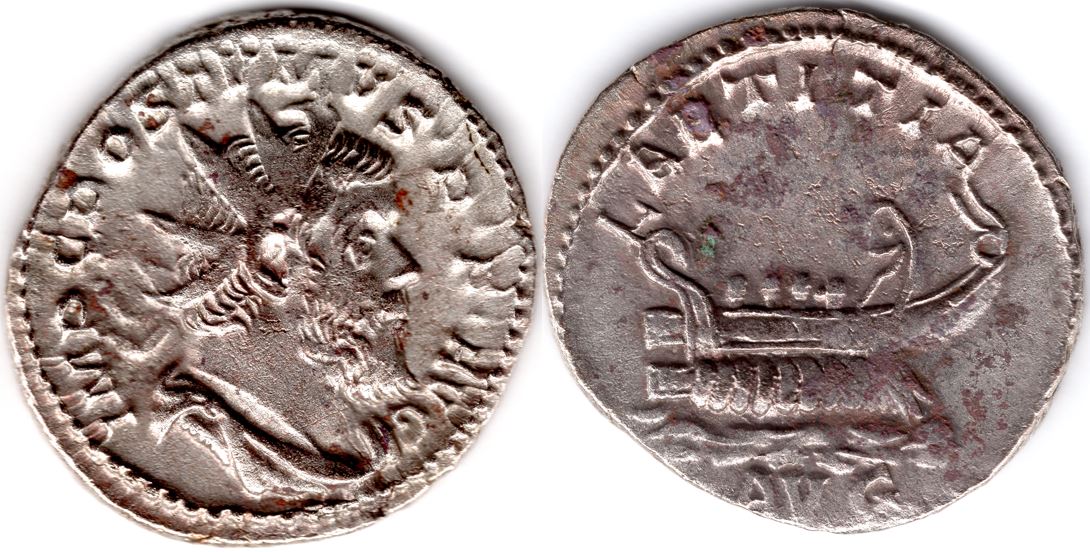 Obverse: IMP C POSTVMVS P F AVG. Reverse: LAETITIA AVG (Lætitia Augusti / Joy of the Emperor). Galley. So what does the inscription about the joyful emperor have to do with the galley? Maybe he enjoyed fishing after all . More serious interpretations include celebrating the return from a successful naval expedition (on the Rhine or, some speculate, to Britain), or just expressing Postumus's joy of having a navy (and confirming his appreciation of that to the navymen). |
|
Pillar of the Community
United Kingdom
1168 Posts |
Another interesting coin and write-up. It's also nice to see a full depiction of a galley on a coin, instead of just the bow or the stern. |
|
Pillar of the Community
United States
5014 Posts |
Another very cool reverse type, what a neat little galley...and I don't think I knew about the laetitia reverse type..also nice. Here's my last coin to add the the thread, a ragged little ant also with a pretty cool reverse, this is my only coin depicting Nemesis, neat type..even if she has a crab hand.  Postumus Antoninianus, 260-269 AD Postumus Antoninianus, 260-269 AD O:Obv: IMP C POSTVMVS P F AVG, radiate, draped and cuirassed bust right. R: Rev: IMP X COS V, Nemesis with palm branch in left hand. 20 mm, 3.3g. |
|
Pillar of the Community
Sweden
2124 Posts |
Nemesis - nice! That is a type I would like to see in my collection. Hercules is perhaps the most long-lived and prominent of ancient heroes, who's fame and reputation has been used by rulers and nations to lend some glory to themselves. Many Roman emperors liked to associate themselves with Hercules, and he became popular anew among European renaissance kings. The French revolutionaries picked him up as a patron in the 1790s, and minted large silver coins with Hercules in full figure. He figures on coins of many other countries as well, and he still shows up on commemorative euro coins now and then (especially from France, who still has a keen eye for him). Antoninianus, 260-261. Billon, 4.09 g, 23 mm. RIC V Postumus 67. 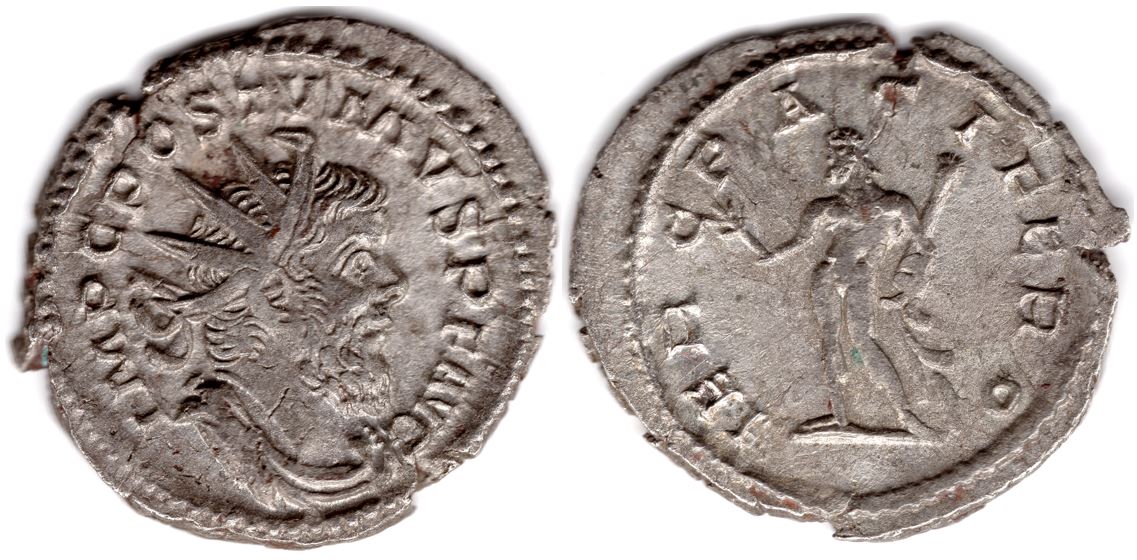 Obverse: IMP C POSTVMVS P F AVG. Reverse: HERC PACIFERO (Herculi Pacifero / To Hercules the Peacemaker). Hercules with his club, holding olive-branch and lion skin. Another Hercules by Postumus, this time as a peacemaker as shown by the olive-branch. But I guess the club is useful too, in case anyone wants to question the need for peace . This coin may celebrate Postumus's successful defense of Gaul against the Germanic tribes. With the help of his buddy Hercules, of course, and with him on his side maintaining the peace is assured. |
|
Pillar of the Community
Sweden
2124 Posts |
Postumus took up minting of double sestertii, a denomination that had been out of use for a decade after Trajan Decius minted them for a short while. Like for the antoniniani, a radiate crown indicates double value. Both sestertii and double sestertii were widely forged and minting ceased after only a couple of years (whether because of the forgeries or because the copper was better used for antoniniani production is an open question). Double sestertius, 261. Bronze, 22.6 g, 34 mm. RIC V Postumus 123. 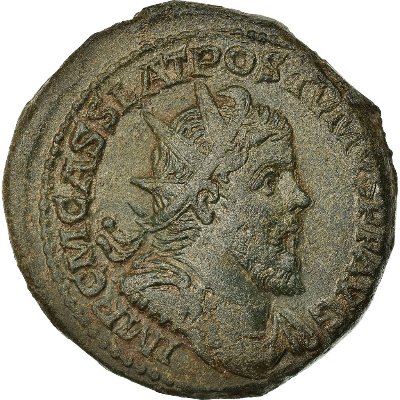  Obverse: IMP C M CASS LAT POSTVMVS P F AVG (Imperator Cæsar Marcus Cassius Latinius Postumus Pius Felix Augustus). Postumus with radiate crown. Reverse: FIDES MILITVM (Loyalty of the soldiers). Fides, holding two ensigns. Fides, the goddess of fidelity and loyalty, figures here to assure people that the army is strong and protects them. Any outside users should be assured that thanks to the Roman army, Gaul is not an easy target. And any soldiers using the coin can see it as a reminder of their oath of fidelity to the emperor. A multi purpose coin. |
|
Pillar of the Community
Sweden
2124 Posts |
Antoninianus, 262. Billon, 3.27 g, 21 mm. RIC V Postumus 76.  Obverse: IMP C POSTVMVS P F AVG. Reverse: NEPTVNO REDVCI (To Neptune who brings back). Neptune, with trident and dolphin. Neptune was of course also on Postumus's side. God of sea (and rivers), he was great to have along on naval expeditions. The trident is his classic attribute, so are dolphins (although the die cutter might never have seen one). The meaning of the inscription NEPTVNO REDVCI seems a bit uncertain, there are variations in how it is translated and how exactly it should be interpreted. "To Neptune the Returner" is another variety. The way I read it is that with Neptune on your side, a safe return from the sea/river voyage is assured. |
|
Pillar of the Community
Sweden
2124 Posts |
Antoninianus, 263-265. Billon, 2.21 g, 20 mm. RIC V Postumus 57. 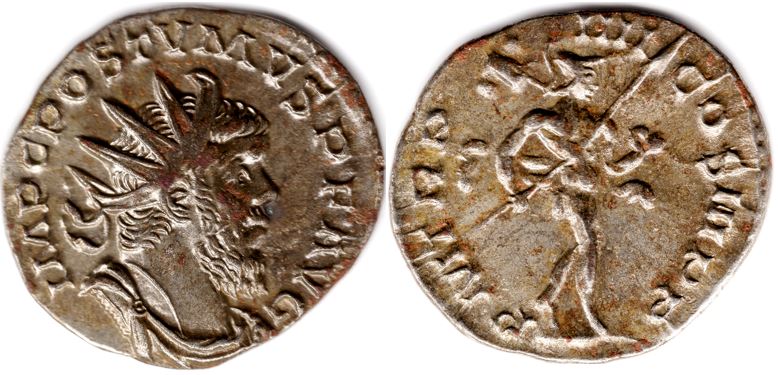 Obverse: IMP C POSTVMVS P F AVG. Reverse: P M TR P IIII COS III P P (Pontifex Maximus Tribunicia Potestate IIII Consul III Pater Patriæ / Supreme Pontiff, Holder of Tribunal Power for the 4th time, Consul for the 3rd time, Father of his country). Mars, with spear and trophy. That the Roman god of war, Mars, is on every successful emperor's side goes without saying. Still, he is of course honored with numerous coins. Mars is too well known to need a presentation, the reverse can instead be used to list the numerous titles that Postumus has collected. |
|
Pillar of the Community
Sweden
2124 Posts |
Antoninianus, 263-265. Billon, 3.89 g, 22 mm. RIC V Postumus 80. 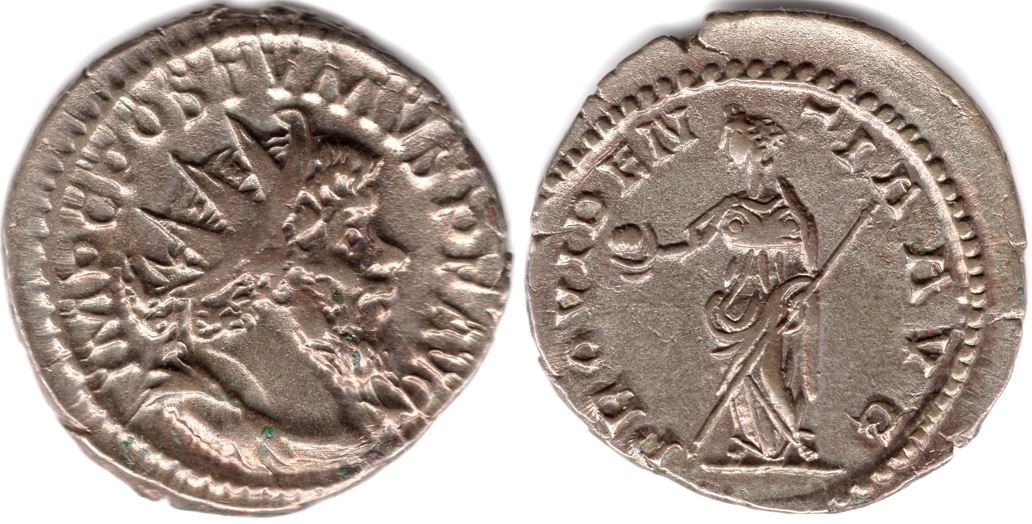 Obverse: IMP C POSTVMVS P F AVG. Reverse: PROVIDENTIA AVG (The foresight of the emperor). Providentia, with globe and sceptre. Providentia, goddess of foresight and provision. Those are excellent virtues of an emperor, virtues he will live up to with a little help from the gods. Seen from another angle, one can say that the coin shows the divine bestowal on the emperor of the symbols of power: The globe and the sceptre. By the foresight of the gods, Postumus has been made emperor, for the benefit of the Romans and to the terror of their enemies! |
|
Pillar of the Community
Sweden
2124 Posts |
Antoninianus, 263-265. Billon, 3.53 g, 21 mm. RIC V Postumus 75. 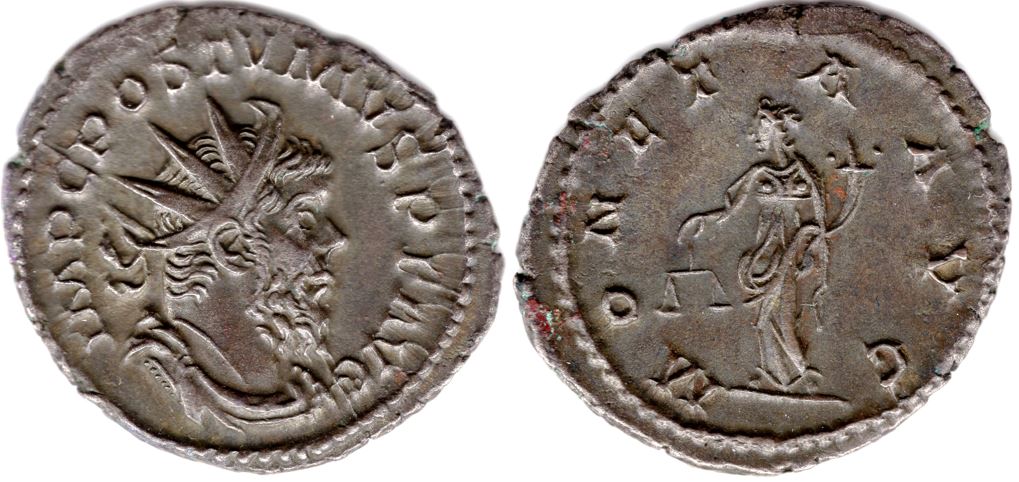 Obverse: IMP C POSTVMVS P F AVG. Reverse: MONETA AVG (The emperor's mint). Moneta, holding scales and cornucopia. Moneta was the epithet of the goddess Juno in her capacity as protector of money. The cornucopia/horn of plenty is a hint of fortunes, the scales the prime tool for quality assurance of the money. In Republican times, coins were minted at the temple of Juno Moneta in the city of Rome and so "Moneta" also came to mean mint (and, eventually, money). The reason for showing Moneta on coins might have been to mark the opening of a new officina at one of the mints, or maybe just to point out the good coinage that Postumus provided. |
|
Pillar of the Community
United States
7067 Posts |
Just getting caught up with the posts. Quite an interesting variety of reverses. That double sestertius, at 34 mm, must be really impressive in hand. |
|
Pillar of the Community
United Kingdom
2121 Posts |
A very interesting thread from an under-rated collecting area. I do not focus on Postumus but have managed to obtain a few in my years of collecting. Here are a few reverses not already covered in this thread. Obv:- IMP C POSTVMVS P F AVG, Radiate, draped and cuirassed bust right Rev:- IOVI PROPVGNATORI, Jupiter walking left, head turned right, hurling thunderbolt. Reference- RIC 72. RSC 155a 3.49 gms, 23.07mm. 180 degrees  Obv:- IMP C POSTVMVS P F AVG, Radiate, draped and cuirassed bust right Rev:- PACATOR ORBIS, Radiate, draped bust of Sol right. Minted in Trier. A.D. 269 Reference- RIC 317 3.25g. 19.41 mm. 0 degrees 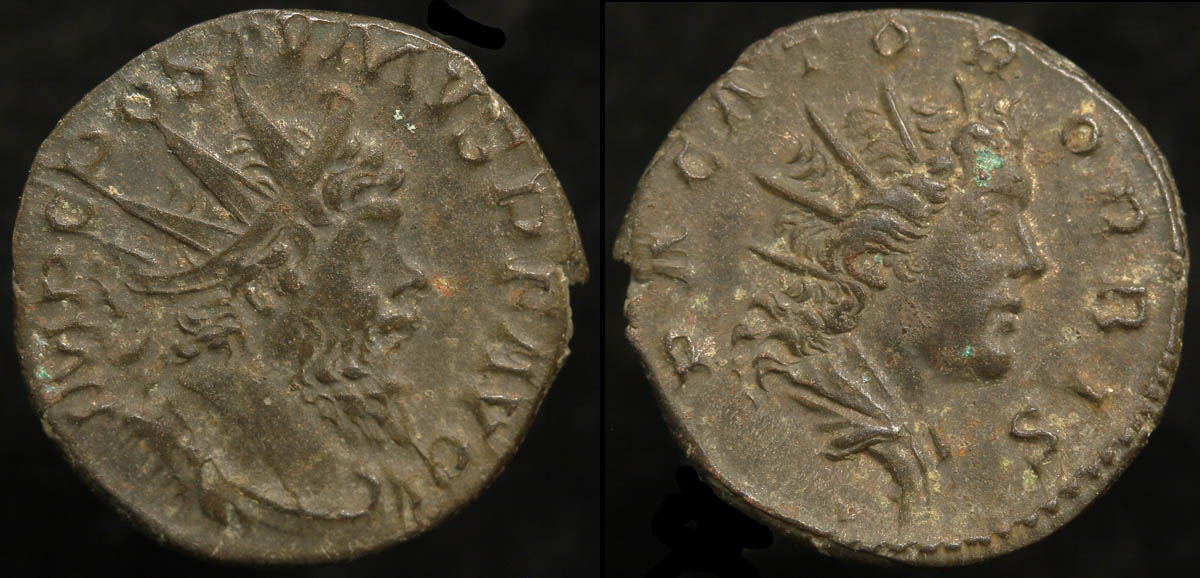 Obv:- IMP C POSTVMVS P F AVG, Radiate, draped and cuirassed bust right Rev:- VIRTVS AVG, Emperor (sometimes referred to as Mars) advancing right, holding spear and shield, small captive to right. Minted in Cologne. A.D. 266 Reference- RIC 331; Elmer 291; AGK (corr.) 103; Cunetio 2427. All examples I have been able to find come from the same die pair  |
| |
Replies: 31 / Views: 3,670 |
To participate in the forum you must log in or register.
Disclaimer: While a tremendous amount of effort goes into ensuring the accuracy of the information contained in this site, Coin Community assumes no liability for errors. Copyright 2005 - 2026 Coin Community Family- all rights reserved worldwide. Use of any images or content on this website without prior written permission of Coin Community or the original lender is strictly prohibited.
Contact Us | Advertise Here | Privacy Policy / Terms of Use
|
| Coin Community Forum |
© 2005 - 2026 Coin Community Forums |
| It took 0.38 seconds to rattle this change. |
 |
|
| |
| |




 Posted 04/23/2023 5:42 pm


