Coin Community Family of Web Sites Join Thousands of Coin, Bullion, & Money Collectors
Royal Canadian Mint products, Canadian, Polish, American, and world coins and banknotes. Specializing in Modern Numismatics Royal Estate Auctions - $1 Coin AuctionsVancouvers #1 Coin and Paper Money Dealer Coin, Banknote and Medal Collectors's Online Mall Join Thousands of Coin, Bullion, & Money Collectors 300,000 items to help build your collection!


Username:
Password:
Save Password
Forgot your Password?


This page may contain links that result in small commissions to keep this free site up and running.

Welcome Guest! Registering and/or logging in will remove the anchor (bottom) ads. It's Free!

Ottoman Coin Or Something Else? | Imitations

To participate in the forum you must log in or register.
Author Previous TopicReplies: 4 / Views: 1,614Next Topic  
Valued Member

Canada
53 Posts
 Posted 03/16/2009  10:29 pm Show Profile   Bookmark this topic Add arok to your friends list Get a Link to this Message Number of Subscribers
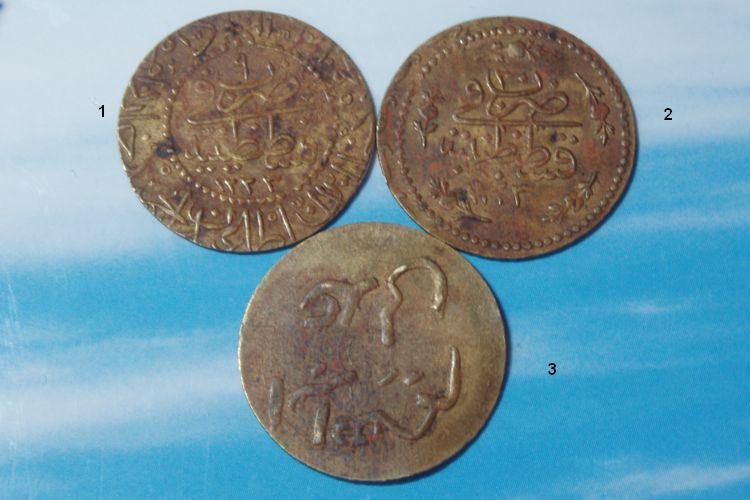
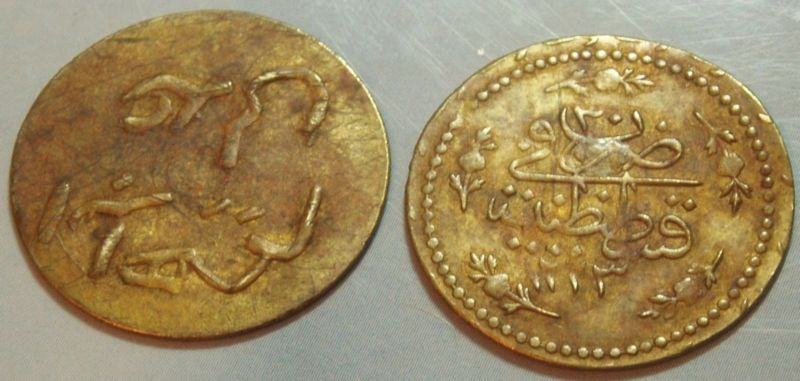
Could anybody help me to identify this item, please?
As far as I understand, the face side looks like Ottoman Empire 1223AH/20 Mahmud II (Adli) coin. Probably 3 qirsh, but smaller size. And I am totally confused with the reverse.
My friend has three items like this. They look to be identical.
Any ideas, what could it be?


Image: Ottoman-Coin-Or-Something-Else?-|-Imitations OttomanCoini.jpg
62.39 KB
Edited by Sap
04/09/2009 09:03 am
Moderator
Learn More...
Sap's Avatar
Australia
16845 Posts
 Posted 03/18/2009  01:26 am  Show Profile   Bookmark this reply Add Sap to your friends list Get a Link to this Reply
I'd guess it's a reproduction, not a real coin. Imitation gold jewellery coins (normally made of brass) are used for decorative purposes in Turkey and the Middle East (think "belly dancers"). Such reproductions normally come with holes, ready for wearing.
Don't say "infinitely" when you mean "very"; otherwise, you'll have no word left when you want to talk about something really infinite. - C. S. Lewis
Valued Member
Canada
53 Posts
 Posted 03/19/2009  08:22 am  Show Profile   Bookmark this reply Add arok to your friends list Get a Link to this Reply
It sounds like a reasonable explanation. This one does not have a hole however...
Valued Member
Canada
53 Posts
 Posted 03/26/2009  9:49 pm  Show Profile   Bookmark this reply Add arok to your friends list Get a Link to this Reply
My friend actually found another very similar item -

Image: Ottoman-Coin-Or-Something-Else?-|-Imitations erme01.jpg
56.89ÿKB
The material and the size look the same. Reverse (3) with unusual Arabic inscription (Ibrahim Adli, as my friend with Arabic language skills reads it) is also the same. But the side which matches Ottoman coins pattern is different. It is apparently from 1223AH/9 (1).
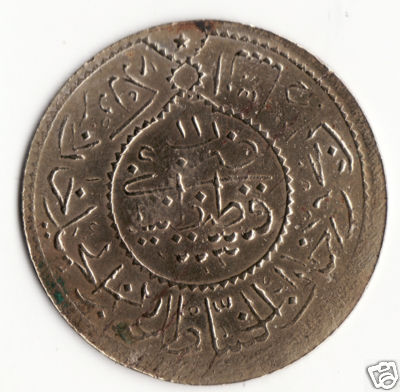
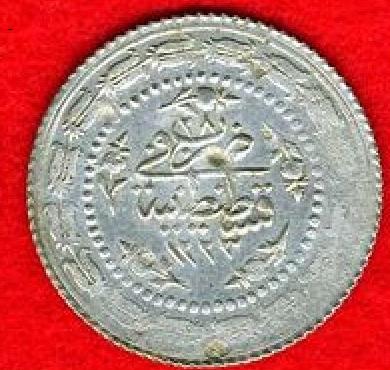
The strange thing is that I have never been able to find any Ottoman coins of those two years anywhere on-line. I mean 1223AH/9 (1) and 1223AH/20 (2). I found two very similar but from 1223AH/11 and 1223AH/28 correspondingly -

Image: Ottoman-Coin-Or-Something-Else?-|-Imitations OttomanInet1.jpg
39.06ÿKB

Image: Ottoman-Coin-Or-Something-Else?-|-Imitations OttomanF.jpg
37.42ÿKB
Does anybody have any pictures of Ottoman coins for these years?
Anyway, when I compare my friend's items with what I found on-line, it seems that they are re-cut to smaller size. So, maybe the part, which use to be with hole, disappeared as a result .
Besides, my friend reads inscription on the coin-like side (1,2) as Konstantinus. This means that these coin (or original prototype) was minted in what is currently Istanbul, does not it?
Edited by arok
03/28/2009 12:52 pm
Moderator
Learn More...
Sap's Avatar
Australia
16845 Posts
 Posted 04/09/2009  09:02 am  Show Profile   Bookmark this reply Add Sap to your friends list Get a Link to this Reply

Quote:
Besides, my friend reads inscription on the coin-like side (1,2) as Konstantinus. This means that these coin (or original prototype) was minted in what is currently Istanbul, does not it?

Yes, both coins say "struck in Constantinople" in Arabic, just like regular Ottoman Turkish coins do. But these "coins" are clearly not real gold, judging by the staining, and the Ottomans didn't issue any brass coins.

Coinage of the Ottoman Empire during of the reign of Mehmed II is very confusing, with numerous coinage reforms occuring, sometimes in overlapping periods. In Year 9, two gold coin series were being issued: the old gold rumi (which looked like this, and the new gold rumi, which looked like this. Your pic number 1 actually looks very similar to the example shown in the Krause coin catalogue for the 2 rumi altin coin, which is also dated Year 9, although the lettering on yours is cruder.

In Year 20, two different gold coin series were being issued: the old gold aldi which looked like this, and the new gold aldi, which looked like this.
Don't say "infinitely" when you mean "very"; otherwise, you'll have no word left when you want to talk about something really infinite. - C. S. Lewis
  Previous TopicReplies: 4 / Views: 1,614Next Topic  

To participate in the forum you must log in or register.


Disclaimer: While a tremendous amount of effort goes into ensuring the accuracy of the information contained in this site, Coin Community assumes no liability for errors. Copyright 2005 - 2026 Coin Community Family- all rights reserved worldwide. Use of any images or content on this website without prior written permission of Coin Community or the original lender is strictly prohibited.
Contact Us  |  Advertise Here  |  Privacy Policy / Terms of Use

Coin Community Forum © 2005 - 2026 Coin Community Forums
It took 0.29 seconds to rattle this change. Forums