| Author |
 Replies: 23 / Views: 3,603 Replies: 23 / Views: 3,603 |
|
Pillar of the Community
 Sweden
2124 Posts |
This is a companion thread to my thread The Rise and Fall of the Indochinese Piastre. While that thread deals with the silver piastres of Indochina and their fractions, this thread is oriented towards the low denomination copper (mostly) coins. The piastres described in my parallel thread represent the monetary high end of the financial landscape in French Indochina. At the high end we have merchants, traders, and government institutions moving hundreds or thousands of silver piastres between cities and across borders. That end is very different from the low end, where we have peasants and farm workers, servants, shop clerks and the like, people who rarely or never see even a single piastre (at least if we stay in the 19th century). Their economy was that of the cash coins, tied together in ligatures for all but the tiniest transactions. The high and low end were like two separate economies, not independent, but not tightly connected either. There was no fixed exchange rate between cash coins and piastres, it could vary from 300 to several thousand cash coins for one piastre. Both economies are interesting from different perspectives and each has its own monetary history. Because of that, I run separate threads for the two. If you are interested in the coinage of French Indochina, do follow both.  In this thread then, I will discuss the small denominations, the cash coins and French Indochinese cents (centièmes), from the mid 1800s to the end of World War 2. Coins and banknotes shown are from my collection. Like my other thread on the piastre, this is not primarily intended as a "Post Your ..." thread. But like I do there, I welcome contributions from anyone who has Indochinese small change to show! Post #1: Cash To The People
or
The SquareSapèque, French Cochinchina, 1879. Bronze, 2.0 g, 20 mm. 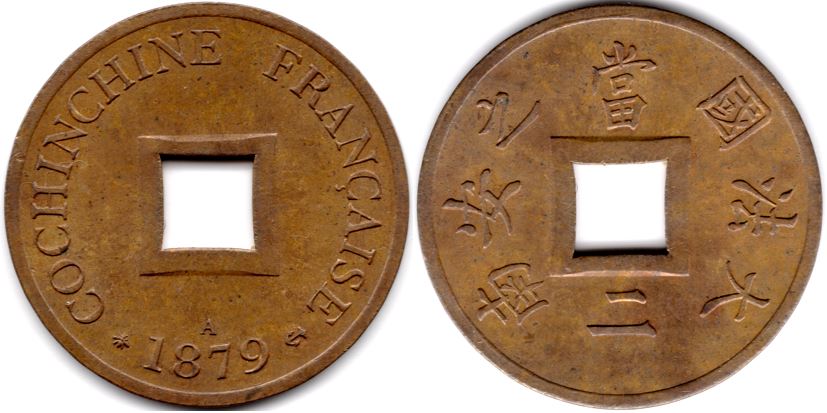 Sapèque Sapèque is French for cash coin (see Note 1). In 1879 the French authorities introduced their own sapèques, or cash coins, in the recently established colony of French Cochinchina. It is valued as 2/1000 of a piastre (the piastre de commerce introduced by the French at the same time, or equally of a Spanish dollar or Mexican peso). The value is stated in Chinese only (see Note 2): Top and bottom character on the reverse means "value two". The remaining characters are read counter-clockwise from 5 o'clock to 7 o'clock and translate literally (but in slightly different order) to "Great Country France, Annam Part" (see Note 3 and Note 4). The coin was minted in Paris and shipped to Cochinchina. The introduction of the sapèque followed after fruitless efforts to introduce French small change in the colony (efforts that I will describe in a forthcoming post). Cash coins were the regular every day currency that had been used in Vietnam for more than a millenium and they were part of every day life for anyone who had to do even the smallest transaction. They would not easily be replaced by something else just because it seemed better and more practical in the eyes of the French. The indigenous coinsI will say more about the original cash coins in my next post, but for the time being let's just have a quick look at a contemporary Vietnamese cash coin. 10 van, Vietnam/Dai Nam, emperor Thàn Thái, 1888-1907. Copper alloy, 4.4 g, 27 mm. 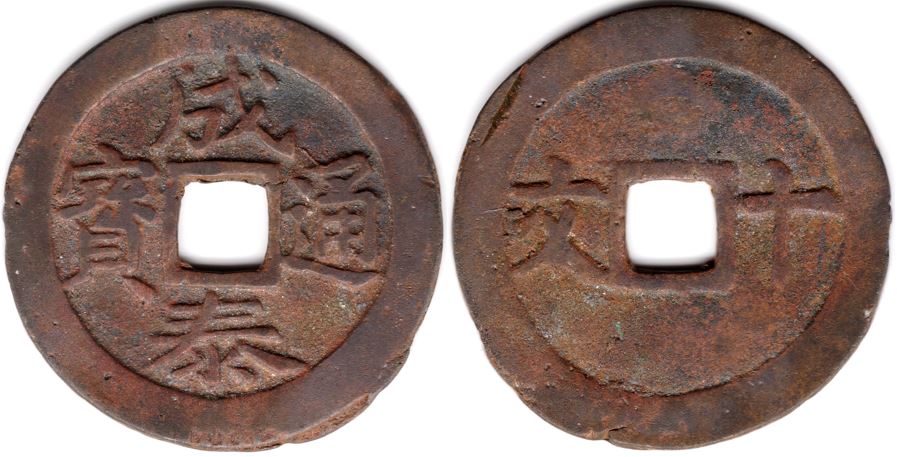 This cast copper alloy cash coin weighs 4.4 g and has the value 10 van (see Note 5), or 10 cash if you like. The 10 van is a larger denomination, ordinary cash coins had a value of one or a few van. The obverse states the emperor's name (vertically) and that this is "circulating currency" ( thông bao, horizontally). The reverse states the value, 10 van. All with Chinese characters. Already here we see an important difference between the high end and low end economies. The high end economy was successively taken over by the French when they took control over French Cochinchina. The traditional indigenous Vietnamese minting of silver and gold coins and ingots declined and was gone by 1900, except for ceremonial issues. Cash coins, however, were permitted and continued to be cast locally in Vietnam until the 1930s. Otherwise minting of colonial coins - piastres as well as sapèques - was mainly done in France, by Monnaie de Paris. The reasons for a French cash coinSo why did France bother to mint "French" cash coins, if they anyway permitted local manufacture of those? There were several reasons: Firstly, the French presence stirred an increase in the economic activity, both high and low ends, and the limited capacity (and perhaps incentive) of the Vietnamese imperial cash mints resulted in a lack of the small change needed for the everyday small scale business. Secondly, the local cash coins were of inferior quality, often made of brittle zinc that easily broke and corroded. Bringing the fruits of civilization to the locals, in the form of struck coins of superior quality might well have been a reason. And thirdly, ideally France preferred to have total control of the economy, both high and low. That the low end was permitted to have a co-existence of local cast coins was probably a concession to the resistance towards the foreign French coins. Whatever the reasons, one must give it to the French that they took the task of providing a good version of the cash coin seriously. Quality-wise, struck instead of cast, durable bronze instead of copper alloys of varying quality (or zinc). Local adaptation with denomination in Chinese/Vietnamese, certainly important to gain acceptance among the targeted users, who did not speak French. And, last but not least, a square hole just like the traditional cash coins. This last thing was something the French were particularly proud of, especially as the British in the decade before had attempted to replace Chinese cash coins with their own struck version in Hong Kong. They settled for a circular hole in a square marking, as shown below: 1 mil, Hong Kong, 1863. Bronze, 1.0 g, 15 mm. 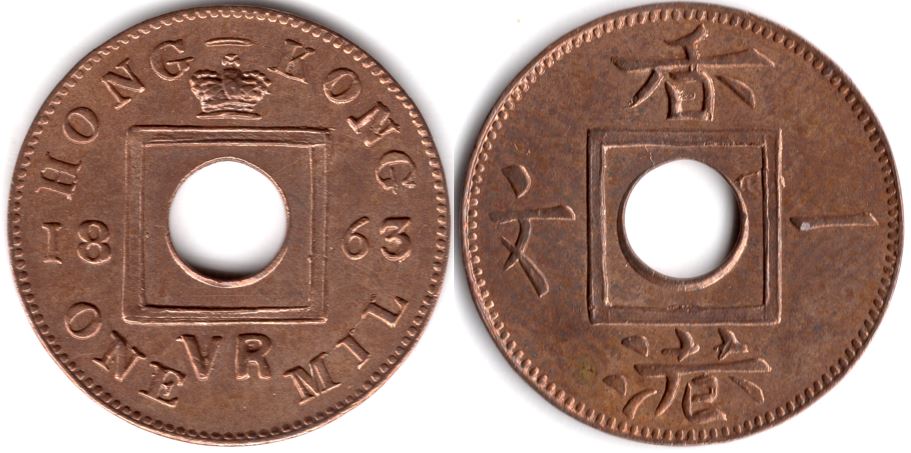 This is a tiny coin! The denomination is 1 mil, that is, 1/1000 of a dollar (Spanish or Mexican). The reverse states, in Chinese, "Hong Kong" and "1 wen" ("1 cash" in Chinese). Making a square hole in a struck coin so that it aligns with the design is not trivial. While the British proud themselves with having made the first struck cash coin (the one above), the French do not quite think it counts. The first real struck cash coin, with a square hole, was of course the 1879 Cochinchina sapèque. Despite all the efforts by the French, the struck sapèques were only accepted with reluctance. The Vietnamese preferred their cash coins of the old well-known type. France continued to strike the sapèque until 1902. Next timeIn my next post, I will write a bit about the Vietnamese cash coins before the French arrival, before moving on to later decades in subsequent posts. NotesNote 1: "Sapèque" is possibly derived from Malay sa pek, which I think means "one pack [of cash coins]" (someone knowledgeable in Malay can perhaps confirm or correct?). Why that and not, for instance, the Vietnamese dông tiên or Chinese tóng qián was chosen as inspiration, I don't know. Note 2: Although the characters are Chinese, the language is Vietnamese. The two characters for the value on the coin are read dáng nhi in Vietnamese ( dang èr in pinyin Chinese). For the counter-clockwise characters around the rim: dai pháp quôc chi annam in Vietnamese ( dà fàguó zhi annán in Chinese). Chinese characters were commonly in use to write Vietnamese until the 1920s. Note 3: This should be interpreted as meaning that Annam is part of greater/extended France. The French view of colonies as extensions of the motherland prevails still today. A travel from Paris to French Guiana in South America is thus a domestic trip, from the French point of view. Note 4: Translating from Chinese can be tricky, especially if you don't know the language  . A literal translation may sometimes need a bit of interpretation to make sense. Fortunately I have a good friend of Chinese origin, who has kindly helped me do that for this and other objects I present here. Note 5: The denomination van was in use from the late 19th century until World War 2. It is probably derived from Chinese wen, the currency unit sometimes used to denote the smallest value for Chinese cash coins. LITERATUREThe suggestions at the end of post #1 in the piastre thread apply to small change as well. |
|
|
|
Moderator
 United States
194816 Posts |
Another fascinating topic!  |
|
Valued Member
United States
238 Posts |
I enjoyed both articles - thanks and I look forward to more!
|
|
Pillar of the Community
 Sweden
2124 Posts |
Post #2:Cast Coppers and Brittle Zincs
or
The Words
or
Tu Dúc or Not Tu Dúc, That Is the QuestionThe monetary landscape in what eventually became French Indochina was quite varied in the early 19th century. As described in the piastre thread, foreign silver coins were used for trade, but Vietnam, Cambodia and Laos each also had their own currency and type of coins or other means of payment for the larger local transactions. Vietnam had gold and silver tiêns, Cambodia silver ticals, the Lao kingdoms used a range of silver coins and ingots, as well as copper and iron bars. Cash coins were used (and made) in Vietnam, used to some extent in Cambodia (which was under Vietnamese influence), but not much in Laos.  French Indochina.Source: Wikimedia Commons (with some locations added) under the Creative Commons Attribution 3.0 Unported licenseThe Vietnamese cash coins French Indochina.Source: Wikimedia Commons (with some locations added) under the Creative Commons Attribution 3.0 Unported licenseThe Vietnamese cash coinsBut in Vietnam, or Dai Nam as the country called itself from 1832, the holed cash coins dominated everyday business. A single cash coin was not worth much; a cup of tea or a slice of bread at most. For any substantial purchases, one needed a whole lot of coins, hundreds perhaps. That is where the center hole came in handy: A string was pulled through the coins and tied together, and there you had a ligature - your purchasing power neatly lined up and possible to carry around. Below are two Vietnamese cash coins from the era of emperor Tu Dúc, that is, the period during which France expanded its colonial empire in Indochina. The emperor's name is written vertically, horizontally (right to left) it says thông bao, "circulating currency". All with Chinese characters, as on all Vietnamese cash coins (see Note 2 in post #1). While many cash coins were produced in the imperial capital Hue, production was also outsourced to private entrepreneurs across the country. Forgeries (often low weight) were common. Zinc cash coin, Vietnam/Dai Nam, emperor Tu Dúc, 1848-71. 2.3 g, 24 mm. 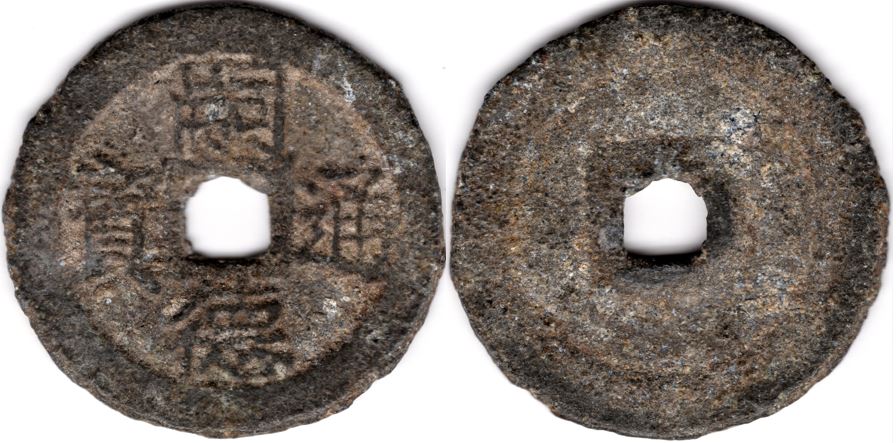 Copper alloy cash coin, Vietnam/Dai Nam, emperor Tu Dúc, 1848-68. Copper alloy cash coin, Vietnam/Dai Nam, emperor Tu Dúc, 1848-68. 2.4 g, 22 mm. 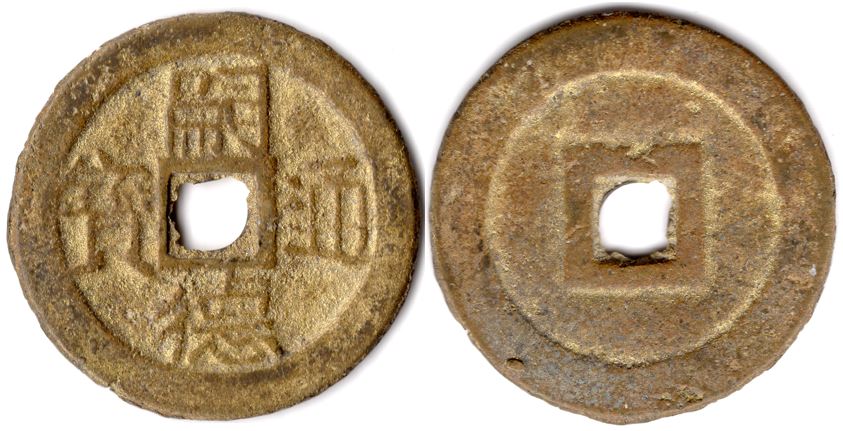 19th century Vietnamese cash coins are made either of zinc or of a copper alloy (copper with varying and sometimes quite large amounts of tin or zinc, thus resulting in bronze and brass of varying quality - here I will just call it "copper"). Copper is scarce in Vietnam, while zinc deposits are rich. Zinc is a brittle metal that breaks and corrodes easily, leading to that many zinc cash coins eventually "self-destructed". Consequently, the more durable copper cash coins were valued higher than their zinc counterparts. The exchange rate was regulated by the government and as a general rule it increased during the 19th century. Around 1820 it was two zinc cash coins on one copper cash coin, towards the end of the century it was normally 6-7 zincs per copper (at times it was as high as 10). A ligature (Vietnamese: quán) in the late 1800s had 100 copper cash coins or 600 zinc cash coins. Both were valued the same (but the zinc ligature of course weighed about 6 times as much: about 1.4 kg vs ¼ kg, or 3 lb vs ½ lb). 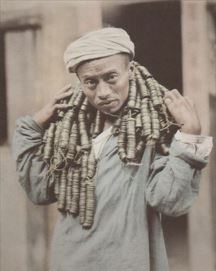 Sichuanese man with 13,500 cash coins in ligatures.Source: Wikimedia Commons, public domain Sichuanese man with 13,500 cash coins in ligatures.Source: Wikimedia Commons, public domainOne ligature corresponded roughly to one French franc at the time of the French conquest. On occasion the colonial authorities, or army, needed to transport large sums of money in the local currency. With cash coins being the only option, that was a logistical challenge. 1,000 francs in zinc ligatures - copper cash coins were always scarce - weighed nearly one and a half ton. And at arrival, after transport on an artillery van, a substantial part of the ligatures and coins could have broken ... Towards the Spanish dollar/Mexican peso, and later the Indochinese piastre, the exchange rate varied over time and place. It was basically a function of supply of and demand for piastres respectively cash coins. A quite normal rate over the years - all the way into the 1930s - was 5-7 ligatures per dollar/piastre. At times it was as low as 3 or as high as 10. The denominations - van and phânThe zinc cash coin above had the value 1 van. That probably has its origin in the corresponding Chinese cash coin denomination wen. The copper cash coin above had a value of 2-4 van, depending on time period. The denomination is usually stated only on larger cash coins, as for the 10 van coin in my previous post. Sometimes one sees phân used as denomination for Vietnamese cash coins. Phân was a weight unit (about 0.38 g; see Note 1) and was earlier sometimes used as denomination for cash coins, specifying their weight. A common size in the early 19th century was 7 phân, later 6 phân was more common (that is the weight of the two cash coins shown above). The words - dông and thôngThen we have dông and thông. "Maybe same word, just different spellings ...?" a casual Western observer (like me  ) might think. No, even though they both occur in conjunction with cash coins (see Note 2). The Vietnamese name (at least one name) for cash coin is dông tiên, which means "copper money". And on the dông tiên it says thông bao, which, as we have seen, in this case could be translated as "circulating currency" (see Note 3). The emperor - Tu DúcEmperor Tu Dúc (see Note 4), who's coins are shown above, had the misfortune of reigning during the period of the French colonial expansion in Indochina. The French were not his only problem. Cholera, locusts, crop failures, droughts, floodings, famine, Chinese pirates, and rebellions ravaged the country ... perhaps these were signs from the gods that Tu Dúc's Heavenly Mandate was questionable, some wondered? After all, he had bypassed his older brother in the line of succession, and when the brother quarrelled too much about that, he had him executed (or forced to commit suicide). Fratricide was not an imperial virtue. Also, he was too lenient against the Christians, according to the court Mandarins (much too harsh, according to the French). The legitimacy of his emperorship could be questioned. Regardless of all this, he managed to navigate somewhat successfully between domestic hostile forces, French expansionism, and Chinese claims to supremacy. The Treaties of Saigon in 1862 and 1874 gave respite in the struggle against the French as well as their protection, in exchange for land cessions. At his death in 1883, he was still emperor, although in name only. 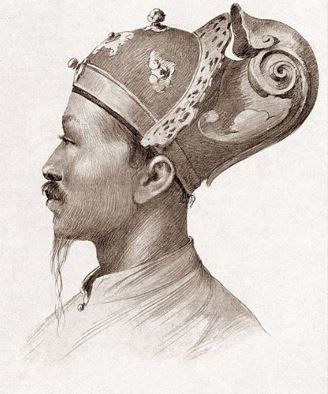 Emperor Tu Dúc.Source: Wikimedia Commons under the Creative Commons Attribution-Share Alike 4.0 International licenseNext time Emperor Tu Dúc.Source: Wikimedia Commons under the Creative Commons Attribution-Share Alike 4.0 International licenseNext timeIn my next post, I will look at the first attempts by the French to introduce a colonial currency. That is, before they decided to make their own machine struck cash coins, the lovely sàpeque I showed in my first post. NotesNote 1: The word phân also doubled, or tripled, as a small length and area unit. Note 2: As will be discussed in the piastre thread, dông later came to be used as the Vietnamese name for piastre (and it is the name of the present Vietnamese currency). Note 3: An exact translation is difficult, as both words are direct loans from Chinese, where they have several meanings. Bao can be also be translated to "treasure" or "valuable" for instance. Note 4: The name Tu Dúc was strictly speaking the name of the era of his reign, which lasted 1848-1883. That is the name used on his coins. He was born into the Nguyên dynasty in 1829 as Nguyên Phúc Thì, and was also called Nguyên Phúc Hông Nâm. After his death, he got the dynastic name or "temple name" Duc Tông and also the posthumous name Thê thiên Hanh vân Chí thành Dat hiêu Thê kiên Dôn nhân Khiêm cung Minh luoc Duê van Anh Hoàng de. I will just call him Tu Dúc here.
|
|
Valued Member
United States
238 Posts |
Another great read on both threads - looking forward to the next ones. Thanks!
|
|
Pillar of the Community
Sweden
2124 Posts |
Post #3: Arrival Of The French
or
The Coin King1 centime, France, 1875. Holed in 1878 for use in French Cochinchina. Bronze, 0.9 g, 15 mm. 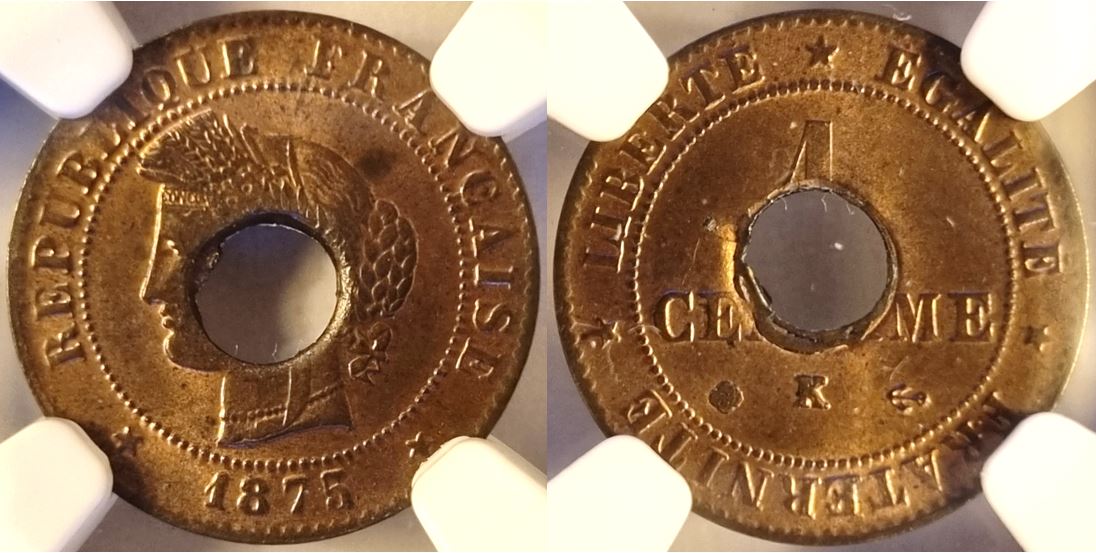 Report from imperial agent Lau và Nghe, 10-2-Tu Dúc 31. Location: Saigon arsenal, commendant's office. Report from imperial agent Lau và Nghe, 10-2-Tu Dúc 31. Location: Saigon arsenal, commendant's office.
Transcript of conversation, 9 in the morning. Lieutenant Duval arrives at the office.
Commendant (sitting at his desk): Entrez!
Lieutenant (salutes): Mon capitaine! We have a problem!
C: As usual then ... yes, what is it, Duval?
L: The natives, sir. They do not like the centimes.
C: The centimes?
L. Yes, the French centime coins the admiralty shipped last month to help out with the lack of sapèques that the merchants keep complaining about. The natives do not want to use them.
C: Oh? Why not?
L: They don't think they look like real money, sir ... they only trust their sapèques, it seems. And then it is the ligatures.
C: Ah, those primitive ligatures - wasn't the idea that they soon would see the benefits of not having to string up all their money and start using purses, like civilized peoples?
L: That idea doesn't seem to catch on, sir. They want their coins holed.
C: Hm. Well. We are here to bring the fruits of civilization to the Annamites, but perhaps we have to do it stepwise. I have an idea.
L : Yes, mon capitaine?
C: We do have one million 1 centime coins in store. And we do have, if I remember correctly, equipment to punch holes in metal here at the arsenal?
L: Yes, sir ... a manual punch, that is correct.
C: So, if they want holes, let us give them holes! Surely they will prefer the superior French bronze over those ever disintegrating sapèques. A pity to deface our lovely Marianne, but, we all have to make sacrifices in the glorious struggle to bring French virtues to a thirsting population! Make it happen, Duval!
L: Well, it is Ceres, sir, but yes sir.
C: Ceres, hm? Dismissed, Duval!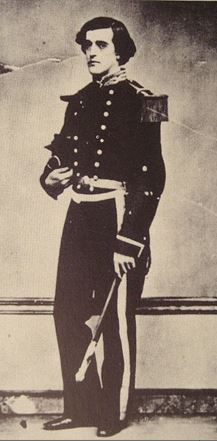 Not lieutenant Duval, but another French naval lieutenant in Cochinchina (see Note 1).Source: Wikimedia Commons, public domain (cropped)Report from imperial agent Lau và Nghe, 5-4-Tu Dúc 31. Location: Saigon arsenal, commendant's office. Not lieutenant Duval, but another French naval lieutenant in Cochinchina (see Note 1).Source: Wikimedia Commons, public domain (cropped)Report from imperial agent Lau và Nghe, 5-4-Tu Dúc 31. Location: Saigon arsenal, commendant's office.
Transcript of conversation, 3 in the afternoon. Lieutenant Duval arrives at the office, his right arm in a mitella.
Commendant (standing at the bookshelf): Entrez, Duval.
Lieutenant (salutes): Mon capitaine! We have a problem!
C: Do we ever have anything else ... yes, Duval, what is it this time? Oh, what has happened to your arm?
L: Well, sir, we took turns at the punch, sir. When it was my turn, I wanted to show the boys how it should be done, and I think I overdid it a bit. Thank you for asking.
C: Ah, the punched Marianne centimes, I see. A success, I presume. But what was the problem?
L: Eh, well, Ceres, sir. And, ahem, the problem, sir, is about the punched centimes. The natives do not like them.
C: Really? What is it now then?
L: Well, sir - does that boy have nothing else to do than broom the floor in here? He seems to be here all the time.
C: Don't worry, he's harmless. He doesn't understand a word we say. He just has a liking to keep my office clean. Kind but simple minded. You can speak freely.
L: So, the natives now think we are trying to cheat them by withholding some of the copper in the coins. They do not accept the punched centimes.
C: Trying to cheat them ... but we did it for them, Duval!
L: Yes, sir. They don't seem to appreciate that, sir.
C (head in hand, mumbling): I want to go home ... the food is strange here too ...
L: Sir?
C: Dismissed, Duval.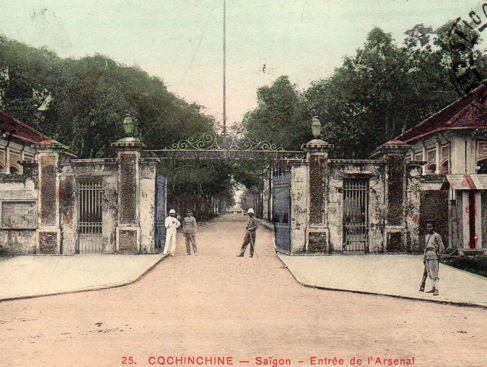 The Saigon Arsenal.Source: gramiz/Geneanet (cropped) The Saigon Arsenal.Source: gramiz/Geneanet (cropped)The two reports above from the Imperial Vietnamese Intelligence Service (see Note 2) are of course fictitious . But perhaps discussions went something like this at the French Naval headquarter in the Saigon arsenal, that spring of 1878 (see Note 3). Together with other French small change, one million 1 centime coins (featuring Ceres, the goddess of agriculture), minted in Bordeaux (mint mark 'K') in 1875, had been shipped to Saigon. The plan was to introduce the French coins in Cochinchina as a replacement for the cash coins, which were always in short supply. As discussed in the next section, the French may have had reason to think that would work, but the Vietnamese thought otherwise. They did not want to accept the French coins, despite the lack of indigenous cash coins. An attempt to meet the local demands for holed coins was made by punching a hole in 10,000 of the 1 centime coins at the arsenal's workshops. The holed coins were assigned a value of 1/500 Spanish dollar or peso, slightly better than the 1/600 that was common for copper cash coins. But, as experienced by our fictitious lieutenant Duval and his commendant, the effort only resulted in the locals feeling they were cheated of some of the copper in the coins, and again they refused. The holed centimes were retracted (see Note 4), and eventually the struck sapèques arrived the following year (see post #1). The Cambodian precedentIn 1863, the year after the colony of French Cochinchina was established, king Norodom of Cambodia requested France to establish a protectorate over the kingdom. The country had been under constant pressure from Siam (today's Thailand) and Vietnam during the 19th century, and France happily took the opportunity to extend their influence in the region by helping the Cambodian king. While both Siamese and Vietnamese money circulated in Cambodia, the country also had comparatively modern coinage equipment of its own. Modern presses were imported from Great Britain in 1852 and used to mint small series of silver tical coins (sometimes called prak bat; see Note 5). That was decades ahead of its neighbors, so once under French protection, it was natural for the king to turn to France to continue minting modern coins. The first was probably the Cambodian piastre discussed in post #2 in the piastre thread. In 1875 a French firm was contracted to mint a range of coins for Cambodia, using the French franc system. The "Cambodian franc" was minted in denominations of 1, 5 and 10 centimes in bronze and from 25 centimes to 4 francs in silver. A Belgian firm was commissioned for the bronze coins, and they in turn probably used the Heaton mint in Birmingham for the production (documentation is scanty). 10 centimes, Cambodia, "1860" (actual minting 1875-92). Bronze, 9.9 g, 30 mm. 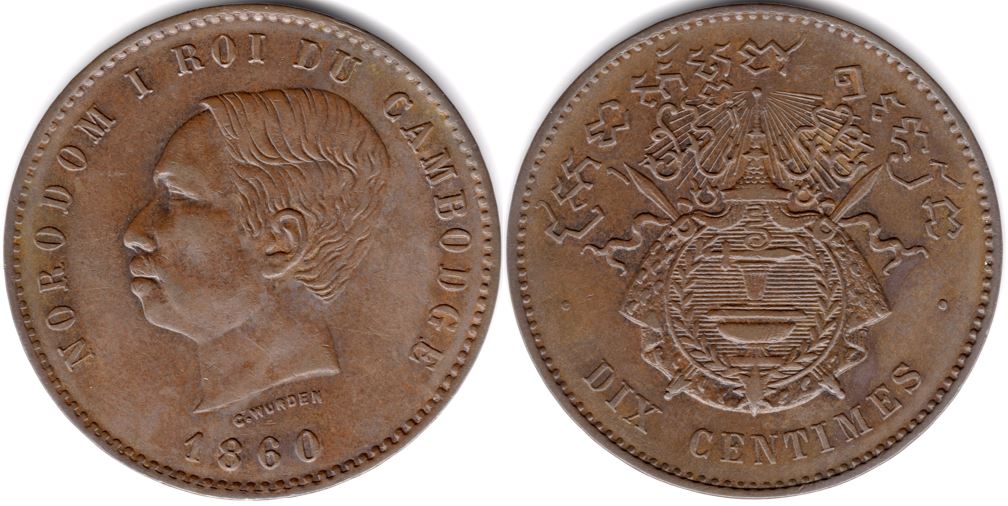 The obverse shows king Norodom I, who ruled Cambodia 1860-1904. The year 1860 is the year of his accession, not of the minting, which took place during a number of years 1875-92. The reverse shows the denomination DIX CENTIMES, the royal coat of arms, and at the top in Khmer script: Country of Cambodia, 1 tiên. The word tiên we have seen before in conjunction with cash coins and here it means 10 (copper) cash coins. The Cambodian franc was at par with the French franc and one franc was equal to 100 copper cash coins (or 600 zinc cash coins). The Frenchified currency was well received in Cambodia and in particular the bronze denominations were minted in large quantities. That may have led the French authorities to believe it would work equally well to introduce French currency in Vietnam, even without taking the way over a "Vietnamese franc". But use of cash coins was more firmly rooted in Vietnam; in Cambodia, several currencies had circulated, cash coins being just one of them. Also, the cash coins used in Cambodia were mostly Vietnamese (Chinese cash coins worked too), so there was no element of national pride associated with them (except possibly a negative feeling, since Vietnam was not always a friendly neighbor). Next timeWe move into the 1880s and from French Cochinchina to the larger colony of French Indochina. NotesNote 1: The photo (from the 1860s) shows naval lieutenant Francis Garnier, who after several remarkable actions in the colony was killed in action in 1873. He even got a Vietnamese nickname: Ngac Nhi, which means "Amazing". Note 2: Whether such a service existed, I do not know. The "10-2-Tu Dúc 31" is the date: The 10th day of the 2nd month in the 31st regnal year of emperor Tu Dúc. Note 3: It was the French Navy that was in charge of the colonial expansion. The governors of French Cochinchina were for the first two decades until 1879 all marine officers, mostly admirals (except one, who was an army general). Administration of the French colonies was (most of the time) subordinate to the Ministry of the Navy until 1894. Note 4: It is unclear what exactly happened to the 10,000 holed coins. According to some sources they were melted for the copper, according to others they found their way to coin dealers and collectors already then. Genuine specimens have a characteristic, imperfect shape on the hole due to the punch apparatus used. I prefer my coins raw, but with the obvious risk for falsification present here, this one is slabbed by NGC. Note 5: Prak is the Khmer word for silver. Bat is borrowed from Thai baht, which is originally a weight unit, and the name of the present Thai currency. Tical is the Khmer name for the baht weight unit.
|
|
Pillar of the Community
Sweden
2124 Posts |
Post #4: French Expansion
or
A New Coin1 centième, French Indochina, 1888. Bronze, 10.0 g, 31 mm. 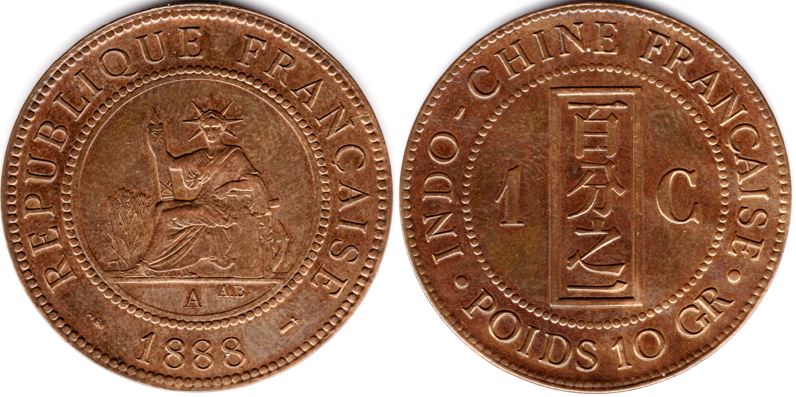 The French sapèque (see post #1) weighed 2 g, so the 1 centième, worth 5 times as much, weighed 10 g. That is clearly stated on the reverse, just as on the silver piastre and its fractions. Weight mattered, also for copper and bronze. With its 31 mm it is slightly larger than the ½ piastre (see post #3 in the piastre thread) although it is lighter. The obverse design is an adaptation of the Great Seal of France, the same as on the piastres. The reverse states the denomination "1 C", which is also what the Chinese characters say, although in a different way: "Hundred part of one". The "one" is of course one piastre (there were 100 centièmes on 1 piastre). Like all French Indochinese coins at this time, it is minted in Paris. Weight, size and design composition of the obverse is, by the way, the same as for contemporary French 10 centimes coins. France expanded its colonial holdings to include the rest of Vietnam and formed French Indochina out of Vietnam and Cambodia in 1887 (later adding also Laos). Minting continued with the same designs for all the coins, substituting Indo-Chine for Cochinchine in the inscriptions (see Note 1). There were 1/5 centième (the sapèque), 1 c, 10 c, 20 c, 50 c and 1 piastre coins. The 1/5 c and 1 c coins were in bronze, the higher denominations in silver. Only the bronze coins had inscriptions in Chinese/Vietnamese (see Note 2 in post #1). Higher denominations, from 10 c and upwards, were apparently considered recognizable by the size for anyone not able to read the Western numbers. Worth noting is that coins for French Indochina, with the inscription Indo-Chine Française, were issued from 1885, two years before the formal formation of the colony. The establishment of the colony was far from trouble free. The death of emperor Tu Dúc in 1883 was followed by a struggle for power between his relatives, who rapidly eliminated each other one after the other until the fourth one, Hàm Nghi, took the throne in 1884. When he rebelled against the French and took to the mountains to conduct guerilla warfare, France replaced him with the 21 year old Dông Khánh, nephew of Tu Dúc. 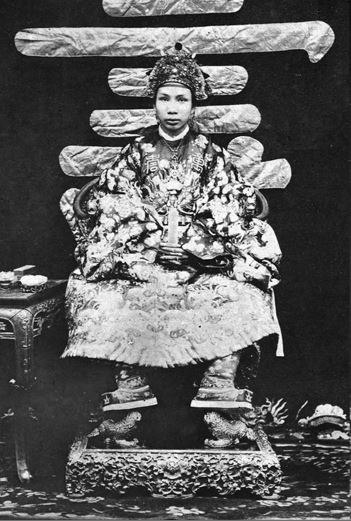 Young emperor Dông Khánh.Source: manhhai/flickr under the Creative Commons Attribution-NonCommercial 2.0 Generic license Young emperor Dông Khánh.Source: manhhai/flickr under the Creative Commons Attribution-NonCommercial 2.0 Generic licenseBy 1885 France had also victored over China in the Sino-French War over Tonkin. And through the whole 1870s and 1880s the well organized Black Flags rebel army (Fr: Pavillons noirs) had harassed the French and fought against them together with the Chinese; after the war, they continued to be a nuisance for many years after. 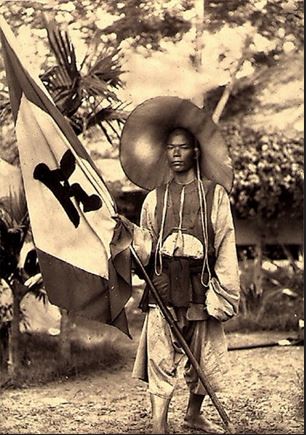 A Black Flags soldier, holding an army flag (see Note 2).Source: Wikimedia Commons, public domain. A Black Flags soldier, holding an army flag (see Note 2).Source: Wikimedia Commons, public domain.The expansion of French dominion in Indochina happened gradually and met considerable resistance. Issuing coins that stated "French Indochina" as if it was already in existence, was one way to plant the idea of French hegemony. Helping trade and businesses was also a measure to influence the Vietnamese to have a more positive attitude to France. One could say that by 1885, France had in practice control over most of what was to become French Indochina, so the formation two years later was more a formality that established the fact de jure. Next timeOnly one coin this time, but my next post will feature three coins to illustrate the development in the 1890s, as well as a possible consequence in the homeland France. NotesNote 1: The spelling of Indo-Chine with a hyphen and Cochinchine without one has a semantic explanation. The original meaning of Indo-China (the common English spelling in the early 19th century) was the area between India and China, a somewhat diffuse area comprising several countries. French Indo-China then, was the French part of that larger area. Cochinchina on the other hand was a specific region in the south of Vietnam, therefor written as a single word. French uses the same logic as English (in this case ). However, as time went by and the area lost its (from a foreign point of view seeming) homogeneity and was replaced by countries with fairly well-defined borders, the spelling Indochina/Indochine successively replaced Indo-China/Indo-Chine. Indochina became the specific region comprised by French Indochina, and as such lost its hyphen. The change took place gradually, with the spelling Indochine appearing in French documents in the early 20th century, on banknotes in the 1920s and on coins in the late 1930s. Note 2: The character on the flag, lìng, means command or order and appeared on many Black Flags flags. It is probably intended to symbolize military power and leadership.
Edited by erafjel
05/07/2023 5:39 pm
|
|
Pillar of the Community
United States
8038 Posts |
|
|
Pillar of the Community
Sweden
2124 Posts |
Good that you point that out, @tdziemia. There is widespread confusion (and I have seen it often enough to become blind to it ). So, to be clear about it: sapèque is not a denomination. It is a coin type, any cash coin type in fact. The French translation for "Chinese cash coin" is "sapèque chinoise". The Chinese character "two" on the 1879 sapèque I show at the top of this thread refers to the value of the sapèque: 2/1000 of a piastre or peso or Spanish dollar. Quote:
On Numista, the English and French sides normally are in harmony on what to call a coin, but not on this one: ...
Ironically, the French side has it wrong. Yeah. |
|
Pillar of the Community
Sweden
2124 Posts |
Post #5: End Of Sapèques
or
The Holey Coins PrevailSapèque, French Indochina, 1897. Bronze, 2.0 g, 20 mm. 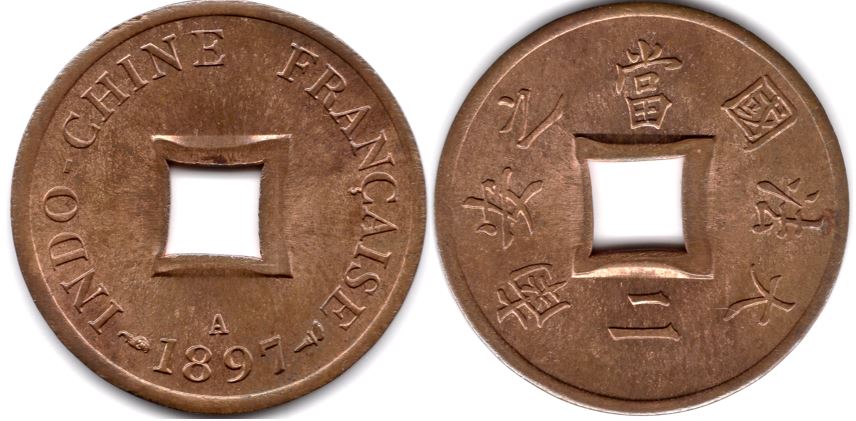 France continued to mint the sapèques until 1902, identical to the original Cochinchina design except for substituting Indo-Chine for Cochinchine in the inscription. Even the Chinese character inscription - which translates to "Great Country France, Annam Part" (see Note 3 in post #1) - was kept, although it referred only to Annam (i.e., Vietnam), even though both Cambodia and Laos were part of its circulation area. The struck sapèque never really struck a chord with the locals, despite its undoubted superiority in design and durability compared to the indigenous cash coins. The Vietnamese court continued to cast cash coins of the old type, although by this time almost exclusively in copper alloys (usually brass made of copper and a substantial proportion of zinc). The 10 van coin shown in post #1 is an example of those. 1 centième, French Indochina, 1900. Bronze, 7.5 g, 27.5 mm. 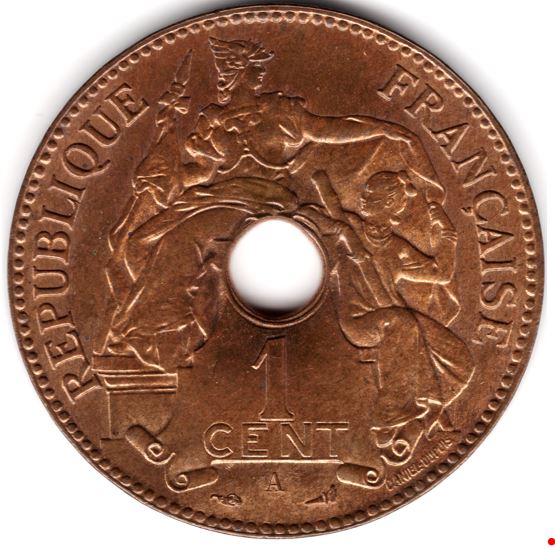 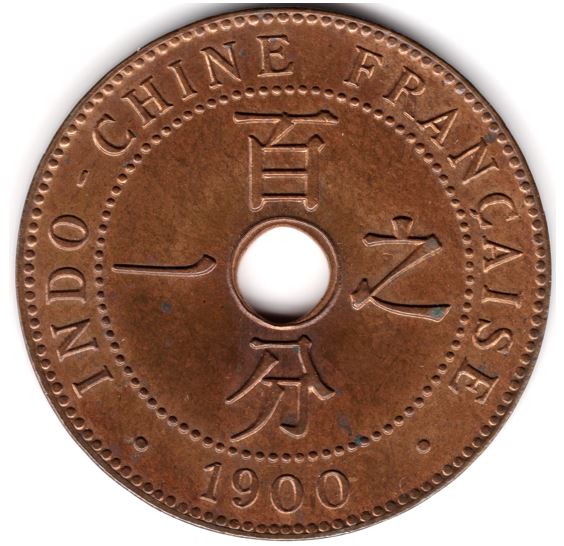 The old type of 1 centième coin (shown in the previous post #4) was replaced by a new design in 1896. It was a bit smaller, weighed only 72 % of its predecessor (the weight was no longer stated on the coin). The Chinese/Vietnamese inscription on the reverse was the same, just arranged differently. The obverse, however, had a new motif. The stern looking Republic with its spiked crown was replaced by a somewhat more lenient Republic with a winged Phrygian cap instead, and holding a (probably French) flag. Below her sits a lady who should clearly represent Annam/Vietnam, holding a bamboo stick (?). Lady Republic (i.e., France) holds her cape in a protective gesture over Annam. It is really a mishmash of symbols - national, cultural, commercial - but the overall message is quite clear: Proud but benevolent France has arrived to share its civilizational feats with a needy Indochina. The motif is very close to the one shown on the contemporary 1 piastre banknote shown in post #5 in the piastre thread. And, it has got a hole! Albeit a round one, but a hole. One of the earliest "Western" coins with an original hole (not counting Western minted coins that mimic cash coins, like the early Hong Kong mils and, of course, the French sapèques). Absolutely inspired by the "holey" Indochinese and Chinese cash coins. Almost two decades later, the idea was mature enough to reach France itself. In 1914, the first French coins with a center hole were issued. In part to save material for the war needs, although the patterns for holed coins came already 1913, one year before the outbreak of World War 1. No doubt the idea came from the Indochinese coins - after all, it was the Paris mint that minted those - even though that link is not stated anywhere in the documentation. Both French and Indochinese coins kept the holed designs until World War 2. 25 centimes, France, 1914. Nickel, 5.0 g, 24 mm. 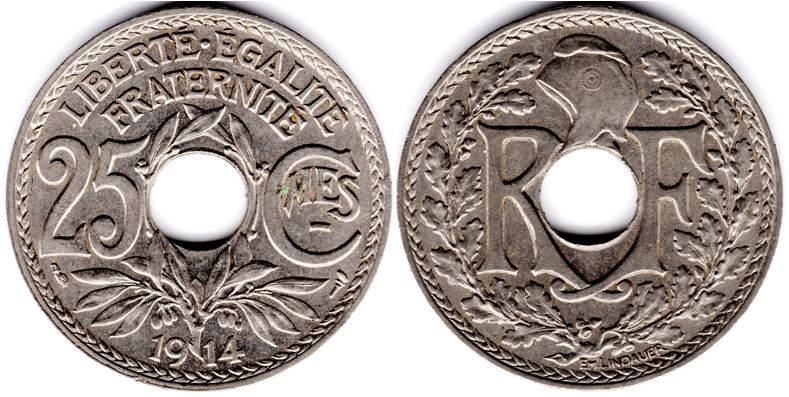 Next time Next timeA new century and a surprise return.
|
|
Moderator
United States
194816 Posts |
Fascinating. |
|
Pillar of the Community
United States
2643 Posts |
I guess I can say this is my best junkbox find ($0.15-.20) 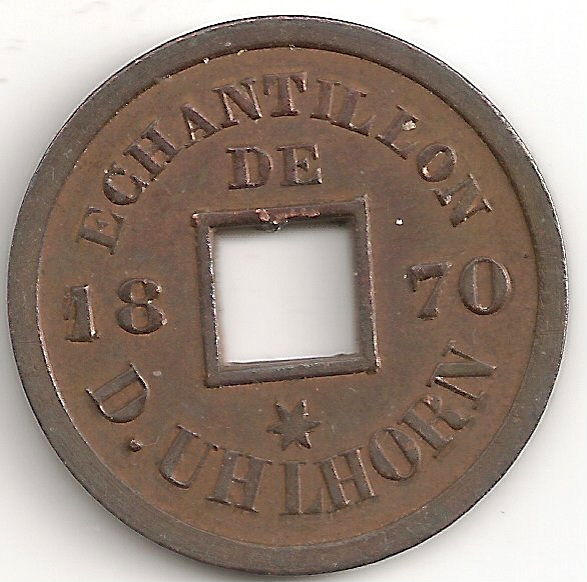 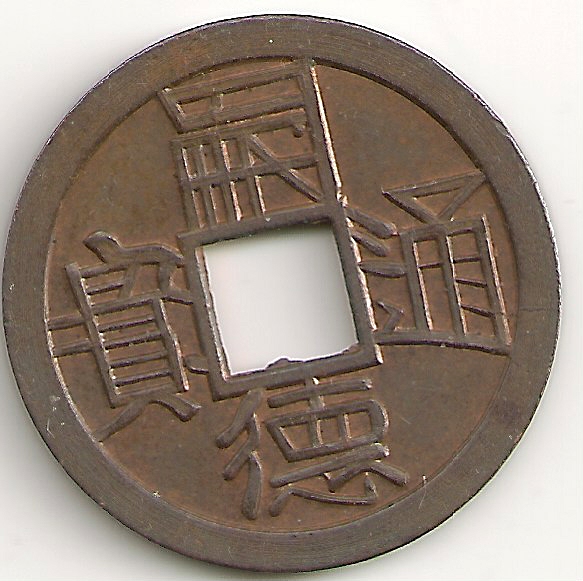 PCGS identifies it as an authentic French Cochin Chinese essai -- graded SP 63 BN. |
|
Pillar of the Community
Sweden
2124 Posts |
|
|
Moderator
United States
194816 Posts |
Quote:
I guess I can say this is my best junkbox find ($0.15-.20) Outstanding!  |
|
Pillar of the Community
Sweden
2124 Posts |
Post #6: The Return Of The Sapèque
or
"You Minted How Many Coins?"1/600 piastre, Tonkin, 1905. Zinc, 2.7 g, 25 mm.  The sapèque was dead ... and yet not quite. Minting of the bronze sapèque ended in 1902 and the need for cash coins had to be met by indigenous cast cash coins and the existing stocks of struck sapèques. That was far from sufficient and there was a severe lack of cash coins. Since there was no fixed exchange rate towards the piastre, the rate decreased: From the normal 6-8 ligatures (each with 100 copper or 600 zinc coins), the rate fell to 3-4 per piastre. Tonkin, the northernmost region in Vietnam, with a border to China and with many Chinese immigrants, was the most densely populated region in Indochina at the time. It was the economic hot spot of Indochina and the lack of small change for everyday business was particularly noticeable. Local merchants pressured the authorities to do something about the situation. The French authorities, burned by the experiences of striking sapèques, hesitated. Eventually though, they gave in, but only for Tonkin, which had a special status as a protectorate and was separately administrated from the rest of Annam/Vietnam (which was something the Vietnamese emperor did not fully agree on). Tonkin has rich zinc deposits, and in an attempt to connect with the tradition of zinc cash coins, it was decided to mint a new sapèque in pure zinc. Hopefully that, together with the traditional square hole, would be met with appreciation by the discerning locals. It was minted in Paris and assigned a value of 1/600 piastre (that is, the ordinary rate of copper cash coins to one piastre before the problems). Interestingly the denomination was stated with Chinese characters only: "Six hundred part of one". The coin was minted in 1905 only, but in that single year 60 million coins were minted! Unfortunately, this French sapèque was met with the same aversion as the previous attempt to mint a "good" cash coin. That was despite the desperate need for precisely this type of currency, and despite that the French authorities had declared the zinc sapèque to be legal tender and thus accepted for payments to the colonial authorities (a status the indigenous cash coins never had). Why was that? Two reasons: Firstly, the fixed rate of 1/600 to the piastre was problematic. The locals knew that the rate of cash coins to the piastre was variable, even highly variable at times. That meant that they did not know what the Tonkin sapèque's value was in cash coins, which was what ordinary people measured value in. The risk of losing out on a bad transaction made them reluctant to accept the new coin. Secondly, the old aversion against the French was still there. That may have become more pronounced by the inscription on the coin: "Protectorate of Tonkin" may have seemed neutral, it was a coin for Tonkin after all. In the eyes of some Vietnamese it was a provocation since it underlined the French hegemony over Tonkin, a fact that was never fully accepted by the Vietnamese emperor. Only about a tenth of the 60 million coins ever left the Hanoi treasury. Even though zinc deteriorates easily and many of the more than 50 million never circulated coins more or less self-destructed, these coins are not hard to find in near excellent condition. Next timeWe look at how the indigenous cash coins stubbornly live on and how France stubbornly sticks to its Republican symbols.
|
|
Pillar of the Community
Sweden
2124 Posts |
Post #7: Old Habits Die Hard
or
The Empire Strikes CoinsWhile the French controlled the piastre based high end economy and made their best attempts at the low end economy with various sapèques and other culturally appropriated small change, the traditional casting of cash coins went on in parallel. It was under the control of the Vietnamese imperial court and had been performed continuously during the whole colonial period. Even though the brittle pure zinc had been abandoned, the traditional method of casting was maintained (alloying copper with zinc into brass). I can guess this was a link to the pre-colonial past and therefor the traditional cash coins were cherished by the local population. The capacity of the imperial mints was limited though and did not meet the demand. 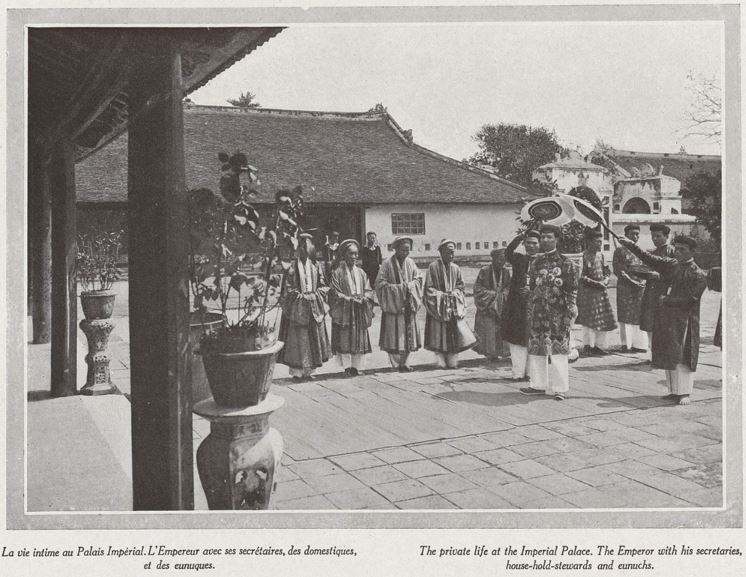 Emperor Khai Dinh and his court.Source: manhhai/flickr, public domain Emperor Khai Dinh and his court.Source: manhhai/flickr, public domainThe French authorities decided to alleviate the situation by producing cash coins with modern methods, by striking instead of casting. The struck coins were modeled after the existing cast cash coins that emperor Khai Dinh had produced earlier and considered to have a value of 6 old zinc cash coins (or 6 van). The Chinese/Vietnamese text says "Khai Dinh - circulating currency". Like the cast coins, the struck cash coins were considered local Vietnamese currency and without the status of legal tender. To what degree the emperor was informed or involved in the project is unclear. Struck cash coin, Vietnam/Dai Nam, emperor Khai Dinh, 1921-22. Brass, 2.5 g, 22 mm. 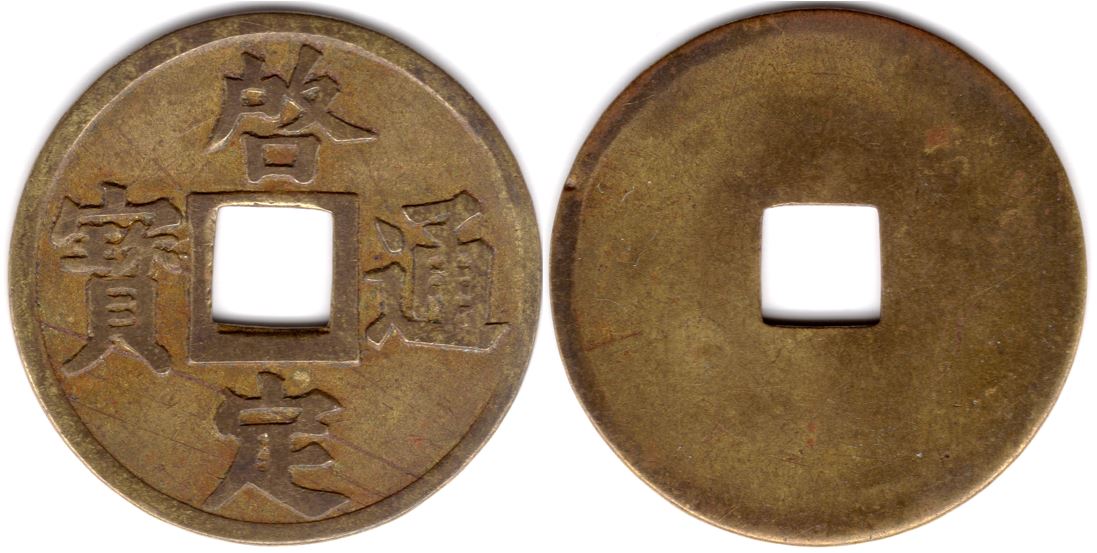 Unlike the colonial coins, these were not to be minted in Paris. Since there was no modern minting equipment available locally, a local mechanical workshop was contracted to produce 200 million coins. The Societe de constructions mecaniques in Haiphong had large facilities where they constructed and produced, among other things, steam engines, cars, and even locomotives. What equipment they used to strike the coins is not known. 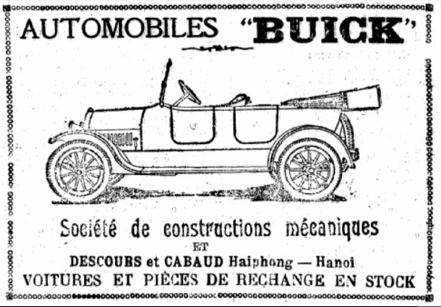 A 1918 advertisement for the mechanical workshop that struck the cash coins.Source: Les entreprises coloniales françaises A 1918 advertisement for the mechanical workshop that struck the cash coins.Source: Les entreprises coloniales françaisesAgain, the sensitive locals recognized the coins as not being quite right and not quite what they were used to. Only with hesitancy did they accept the coins, to begin with. Later however, in the 1930s, it was reported that the struck Khai Dinh coins were in full circulation and apparently readily accepted. 5 centièmes, French Indochina, 1925. Copper-nickel, 5.0 g, 24 mm.   In 1923 a new denomination was introduced: 5 cent(ième)s. Its design was in total contrast to the struck cash coin, with a classical French Marianne in a Phrygian cap, above two cornucopias from which various foodstuffs pour forth. It looks very Republican French, and is very similar to earlier 25 centimes French coins - also holed, with the same size and weight, and in fact it has the same engraver (A. Patey). There is even a ribbon with the Republican motto LIBERTe eGALITe FRATERNITe - "Liberty Equality Fraternity". As bringers of freedom and equality the French were perhaps not perceived by all Vietnamese. I also wonder if the cornucopias symbolize bringing riches to or taking riches from Indochina ... The reverse shows rice, at least that was something recognizable. There was no fixed exchange rate for cash coins vs the piastre, but the typical rate was 6 ligatures (= 600 brass cash coins) per piastre. Thus there would go 30 cash coins on the 5 cents coin. A 5 cents coin at this time would be enough to buy ½-1 kg (1-2 lb) of rice. Next timeWe move along, into the 1930s.
|
| |
Replies: 23 / Views: 3,603 |
To participate in the forum you must log in or register.
Disclaimer: While a tremendous amount of effort goes into ensuring the accuracy of the information contained in this site, Coin Community assumes no liability for errors. Copyright 2005 - 2026 Coin Community Family- all rights reserved worldwide. Use of any images or content on this website without prior written permission of Coin Community or the original lender is strictly prohibited.
Contact Us | Advertise Here | Privacy Policy / Terms of Use
|
| Coin Community Forum |
© 2005 - 2026 Coin Community Forums |
| It took 0.63 seconds to rattle this change. |
 |
|







 Posted 05/04/2023 5:02 pm





