In July 1955, William Homer Thornberry (D-TX) introduced a bill in the House of Representatives that called for the striking of medals "in commemoration of the one hundred and twentieth anniversary of the signing of the Texas Declaration of Independence and the Battles of the Alamo, Goliad, and San Jacinto in the year 1836." A bill fairly similar in purpose to the Texas Independence Centennial Half Dollar bill introduced 20+ years before, though for a different sponsor.
The bill was joined by a companion bill introduced in the Senate by Marion Price Daniel (D-TX) on behalf of himself and Lyndon Baines Johnson (D-TX) - the future US Vice President and President.
Two thousand medals were to be struck for the Texas Heritage Association, Inc. The bills specified the size of the medals - 1-5/16" in diameter - but did not include an expiration date for striking/ordering the medals. With the small quantiy to be authorized, however, it does not appear that a multi-year issue was envisioned by the Heritage Association.
Each of the bills was referred to its chamber's Committee on Banking and Currency. The bill was first reported by the House Committee, which reported the bill favorably, without amendment and with a recommendation to pass.
When brought up for consideration in the House, Representative Joseph William Martin (R-MA) raised the question of whether the US Mint should be in the business of striking such medals and competing with private industry; he added his recollection that the House had previously decided that such medals should be discontinued. (An odd position considering the Treasury's lpng-standing support of commemorative medals vs. commemorative coins! I wonder if Martin was confusing the issue of commemorative coins with medals?) Once it was confirmed that the US Treasury had no objections to the bill, Martin withdrew his reservation of objection and the bill proceeded without further debate/objection. It was passed via Unanimous Consent.
The House bill was sent on to the Senate, where it was referred to its Committee on Banking and Currency. The bill was reported favorably with a recommendation to pass. When it was brought up for consideration in the Senate, Samuel James Ervin, Jr. (D-NC) requested that a statement from Lyndon Baines Johnson (D-TX), the Senate Majority Leader, be entered into the record - there was no objection:
"Next year Texans will join in celebrating the 120th anniversary of the signing of the Texas declaration of Independence, and the Battles of the Alamo, Goliad, and San Jacinto.
"H. R. 7244 provides for the striking of commemorative medals in connection with that celebration.
"The proposed legislation would authorize the Treasury Department to manufacture for and sell to the Texas Heritage Foundation 2,000 of these medals. The bill also proposes to authorize the manufacture and sale by the mint to the public of bronze duplicates of this medal upon authorization by the Texas Heritage Foundation.
"The Texas Heritage Foundation ls a nonprofit patriotic organization sponsored by many of the leading citizens of my State. It is a potent force in creating among Texans a pride in the Texas tradition and a deeper knowledge of the historic events that have gone into the making of that tradition.
"Passage of H. R. 7244 is recommended by the Treasury Department. I urge that favorable action be taken on the measure as a means of helping to insure a successful and memorable celebration next year of events that gave birth to Texas as an American Republic."Following the statement's insertion, the bill was passed by the Senate without debate. It was examined and signed in both chambers then sent on to the President for final approval. The bill was signed into Public Law by President Dwight David Eisenhower on August 9, 1955 while at his farm in Gettysburg, PA.
The obverse of the medal depicts a one-story building (meeting place of the Texas Constitution Convention of 1836) above the inscription "TEXAS BIRTHPLACE" and the names of four prominent figures from Texas history: (Stephen F.) AUSTIN, (Sam) HOUSTON, (George) CHILDRESS and (Richard) ELLIS. An inscription below the names provides the location of the structure, "WASHINGTON-ON-THE-BRAZOS" along with the date "MARCH 2, 1836." It was on that date that the Constitution Convention, meeting in Washington-on-the-Brazos. approved the Texas Constitution that was largely written by George Childress; Richard Ellis served as the Convention President. The Constitution was Texas' Declaration of Independence. The inscription "THE DECLARATION OF INDEPENDENCE OF THE REPUBLIC OF TEXAS -- 120th ANNIVERSARY" encircles at the rim.
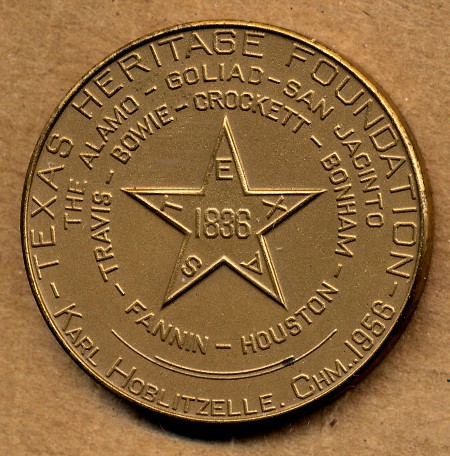
The medal's reverse presents a simple, inscription-heavy design with a single, five-pointed star (the
Lone Star) with "1836" at its center and either "T" "E" "X" "A" or "S" in one of its points. The names (William Barret) TRAVIS, (Jim) BOWIE, (Davy) CROCKETT, (James Butler) BONHAM, (James Walker) FANNIN and (Sam) HOUSTON are presented, encircling the Star, with "THE ALAMO - GOLIAD - SAN JACINTO" (the battle names) above the men's names. At the top is "TEXAS HERITAGE FOUNDATION" with "KARL HOBLITZEL, CHM. 1956" seen at the bottom rim. Hoblitzel was the Chairman of the Texas Heritage Foundation at the time.
The medal's design was the work of Louis Lenz of Houston, TX. Lenz was a civil engineer by training, and was an avid and well-known collector of Texana. Despite not being an "artist," he was tapped to design the Foundation's medal. IMO, his simple, literal design
did not create a new highwater mark for medallic art. Lenz was born in Yorktown, TX in December 1885; he died in Houston in May 1967.
1956 Texas 120th Anniversary of Independence Medal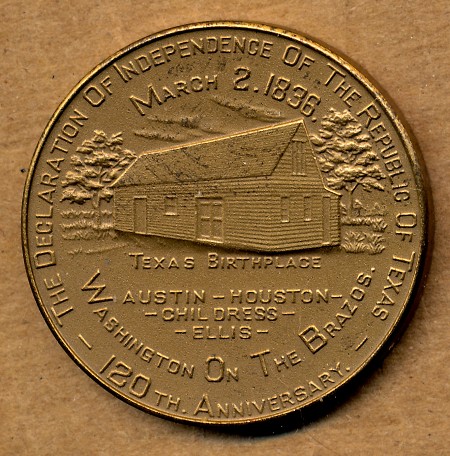
For other of my topics on commemorative coins and medals, see:
Commems Collection.







 Posted 05/10/2023 2:38 pm





