| Author |
 Replies: 10 / Views: 5,361 Replies: 10 / Views: 5,361 |
|
|
Valued Member
United States
95 Posts |
Here is an off the wall question with no real answer...Whats the survival rate of old coins? Like how many 1877 indian heads do you think are still around? Over 850,000 were made but do you think maybe 50,000 are still around? Or is it more like 5,000 or 500?
|
|
|
|
Bedrock of the Community
United States
10982 Posts |
Field population estimates are available for all U.S. coinage by type and year. While no one knows the exact numbers, the estimates make for interesting reading. A great book to buy is "A Guide Book of United States Type Coins". It's an Official Red Book by Whitman Publishing authored by Q. David Bowers and includes field population estimates for all U.S. series'. Specific estimates by date for the IHC series can be found in "A Guide Book of Flying Eagle and Indian Head cents" by Richard Snow but I don't own that book and another member will need to chime in and answer the question on 1877 IHC. |
|
Bedrock of the Community
United States
10045 Posts |
On this subject of 1877 mintage, here's an interesting quote from Rick Snow's attribution guide for this year. Quote:If you leaf through this book, you'll notice that the typical die can strike about 200,000 coins. For a mintage of 4 times that amount we should see many more obverse and reverse dies. For circulations strikes, the Mint Report for 1878 states that 3 obverse dies and 6 reverse dies were made in 1877, but only 2 obverse dies and 1 reverse die were actually used. The remaining reverse dies were used in 1878. This is important, as one must ask where are the other coins? If they were struck with 1877 dates, we should find at least one example from a different reverse die. If the Mint Report is correct, and there is no reason to doubt it, then there is one obverse die used that we have not yet seen. It would be expected that if a new die was made for the 1877 issue it would have been a Bold N die. Since all 1877 Indian cents except for Proofs are struck from a pre-1870 Shallow N die, it seems that there is a huge amount of coins missing. Perhaps some of the reported mintage (of 852,500) are 1876 dated coins. This is unusual for this era, but not out of the question. If a large quantity of newly struck 1877 Indian cents, perhaps the Bold N reverses were struck, and subsequently destroyed, we would certainly have some record of it. This is the biggest mystery in the Indian cent series. (I have edited a few spots to fix a couple typos) |
|
Pillar of the Community
United States
2604 Posts |
A search on ebay reveals about 45 (1877 -replica -copy) 1877. Multiply that by 52 weeks, you get 2340, some of which may be re-sells of the same coin. How many of these are counterfeit, I do not know. I'd estimate that there are at least 50 times this many in existence- maybe 100,000. Population reports at the four big certifying companies (ANACS, ICG, PCGS, NGC), also give you some idea, but it is possible that their numbers are the the same coin being resubmitted multiple times to same or different grading agencies, so I think those numbers are artifically high. |
|
Valued Member
 United States
95 Posts |
Yeah 100K seems like alot. that would be like one in 8 still around. I dont know of many things 132 years old that have a 15% survival rate. But then again who knows.
|
|
Bedrock of the Community
United States
17884 Posts |
Quote:
If the Mint Report is correct, and there is no reason to doubt it, then there is one obverse die used that we have not yet seen. Oops, the mint records say the third obv die was MADE, it does NOT say that it was USED. But the use of only a single reverse die does cause problems. It is very unlikely a single die would have been able to strike 800+K coins without showing extreme wear or cracking up. I'm more familiar with coin survival rates from the early 1800's than the late 1800's, but in the early 1800's they tended to run from 1% to 3% with the higher rates for those years which were "popular", first years of issue or such, or issues which were known to be rare. After 1857 when coin collecting became much more popular I would think survival rates probably increased slightly for the rarer dates but I would be surprized if it reached 10%. |
|
Valued Member
United States
95 Posts |
Ok I have an 1857 large cent. So lets say 3% of coins from that era survived. That means there are less than 10 thousand of the coin that I own and its worth 60 bucks? (Of course I have a large date and thats a whole different matter but lets stick to the small date for arguments sake) It seems like it would carry a higher premium.
|
|
Pillar of the Community
United States
2604 Posts |
Johnny: I would guess that being the last year of the series that the 1857 was saved in large amounts and even though is low mintage, it is readily available. I would guess 10% or more survive for that date
|
|
Bedrock of the Community
United States
10045 Posts |
1857 is indeed an interesting year because the Flying Eagle cents were also issued.  That year, there was a massive campaign to get people to turn in their large cents in exchange for the FE type. By then, the large cents were unpopular in use and there was an ensuing huge response to get exchange the old for the new smaller cents. Interesting to note how the Mint in Philadelphia would not give out silver coin in exchange for large cents--copper coinage still occupied a lower monetary rung--banks and merchants would refuse these coins in large quantities. One sad outcome of this exchange program was that many large cents/half cents went into the melter--no doubt some issued the first year by the Mint. |
|
Bedrock of the Community
United States
20753 Posts |
I would think that no one really has any idea at all of how many of any coin is in existance. Of course the exceptions are the ones where only one or 5 were made. And even then I suspect that too could be in error.
My reasoning is that it is impossible to know how many coins of any kind have been melted down for the metal. How many were made into jewlery. How many were thrown in Rivers, Lakes, Oceans, Ponds, Streams and just old fashing wishing wells. How many were placed on RR tracks by kids, how many are still in jars, cans, boxes, vases, etc in people's homes. How many are hoarded by coin dealers in coin shops or their homes. How many have been sent to other countries for numerous reasons. How many have been counterfeited. How many have been melted or excessively disfigured in chem labs. Think about those machines that flatten them and/or make something like a bent piece of something. Used to be considered good luck to place a coin on the area where concrete is to be poured. How many coins are sitting in bags or rolls in banks, loan companies, credit unions or Federal Researve locations. Coins on ships sunk at sea for numerous reasons. Did I forget any item?
And don't forget Annie Oakly shooting at them.
This to me is why no one could possibly know how many of any coin is in existance.
|
|
Bedrock of the Community
United States
10045 Posts |
Quote:
Did I forget any item? Carl, good list!  I suspect a lot happens to coins where records are incomplete or lost. I also wonder at the number of coins melted for strategic metals during wartime--such as nickel used in alloying with steel for artillery, or copper used for cartridge casings. Then there are (almost) whole mintages lost to fire, such as this 1917 Fenig minted for the German occupation of Poland--where the Stuttgart mint burned in 1917. Sap found this rare coin in Australia. 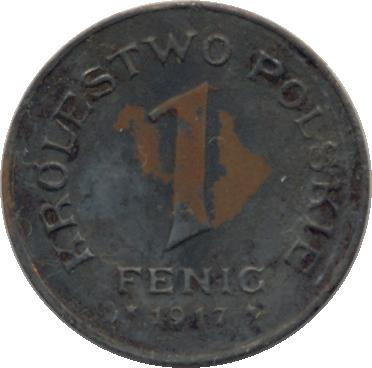 |
| |
Replies: 10 / Views: 5,361 |
|







 Posted 03/17/2009 9:49 pm


