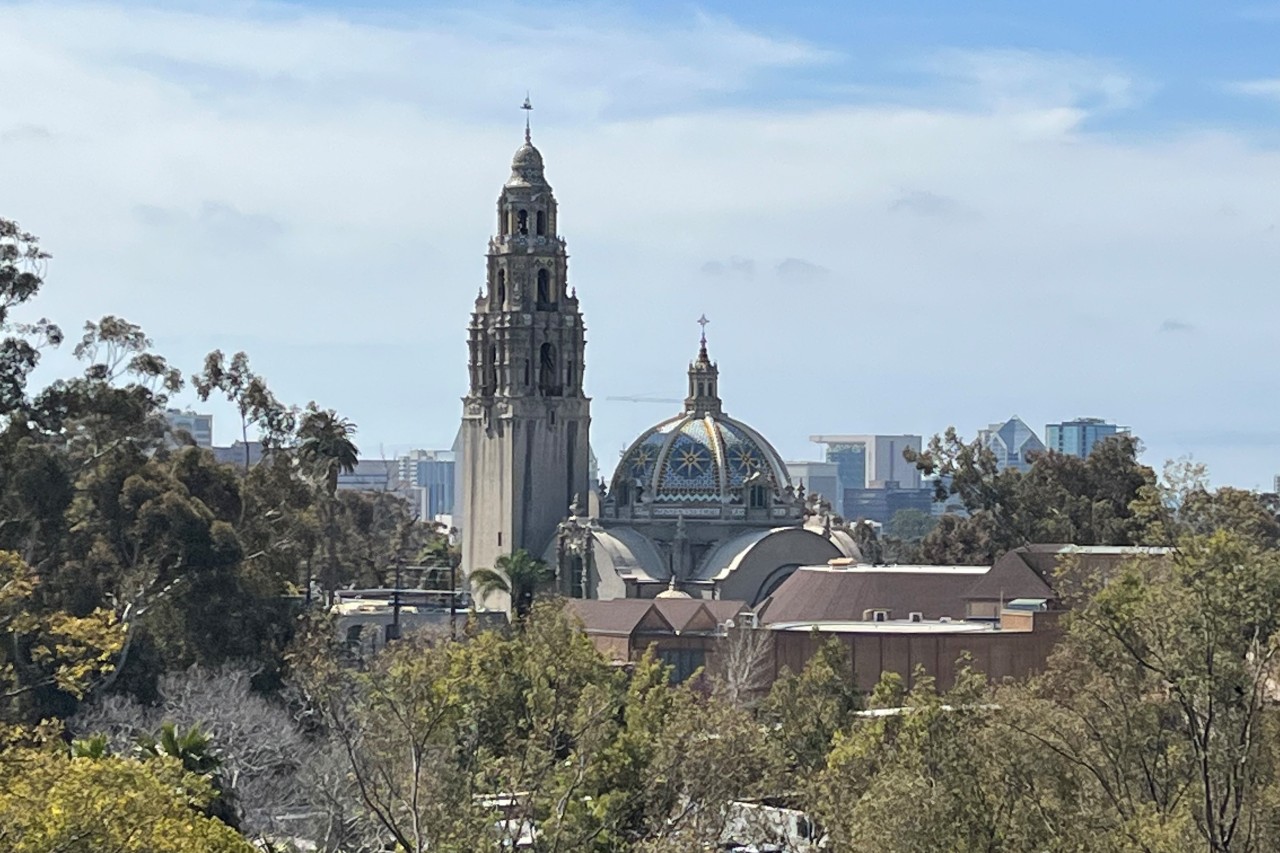
The Panama-California Exposition was held in Balboa Park, San Diego, California from January 1, 1915 through December 31, 1916 - operating for the full 1915 and 1916 calendar years - plus January 1 through March 31, 1917 at a noticeably-reduced level.
The Panama-California Exposition was staged to celebrate the completion of the Panama Canal and to promote San Diego as a prime port of call for ships transiting the canal - San Diego would be the first US port encountered by ships traveling north after passing through the canal from the east. (San Diego had developed a "First Port" campaign to make its case for its unsuccessful bid to host the Panama-Pacific International Exposition vs. San Francisco.) In terms of California Expositions that celebrated the completion and opening of the Panama Canal, the 1915-16 Panama-California Exposition in San Diego was definitely smaller in size and lesser in ultimate fame vs. San Francisco's Panama-Pacific International Exposition, but it was nevertheless successful on multiple levels.
The Exposition grounds were constructed at Balboa Park. The prevailing style of the Exposition's structures was "Spanish Colonial Revival" which has inspired California and Southwestern US architecural design ever since. The style incorporates elements from Spanish missions and Mediterranean homes: terra-cotta clay tile roofs (often reddish-brown in color), white stucco walls, rounded arches, carved wood doors, balconies, columns and decorative window covers. Atypical of many other Expositions of the time, many of the buildings constructed for the Exposition were meant to continue to serve new roles after the Exposition closed. As a result, several have been preserved/maintained and remain functional to the present. For example, the California Building/California Tower currently houses the Museum of Man; it was also used the 1935-36 California-Pacific Exposition and is seen on the 1935-36 California-Pacific International Exposition Half Dollar.
California Building and Tower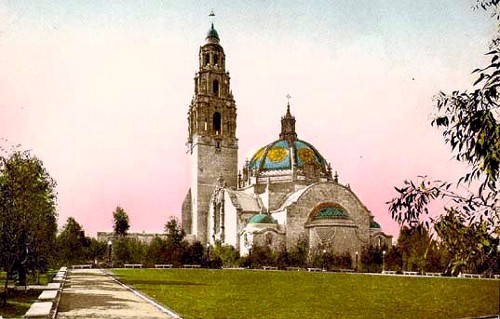 (Image Credit: San Diego History Center. Fair use, education.)
Another remaining structure is the Organ Pavilion; it was a major attraction of the Exposition. The Pavilion housed/houses the world's largest outdoor pipe organ and was used to present daily organ concerts. In addition to being the site of many of the Exposition's major musical events/concerts (singers of varied styles), the Pavillion was also host to multiple addresses by noted figures such as William Jennings Bryan and President Theodore Roosevelt.
Side Note: Free concerts at the Pavilion continued after the Exposition closed, and continue to the present. Check out https://www.spreckelsorgan.org/ for more.Organ Pavilion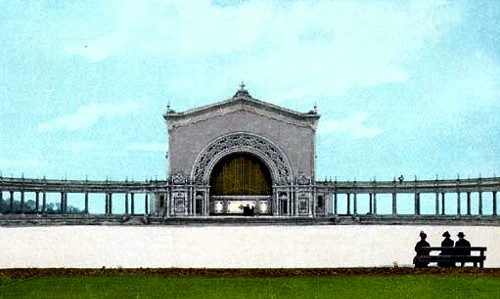 (Image Credit: San Diego History Center. Fair use, education.)
 A big difference between the Pan-Cal and Pan-Pac Expositions was the international component - at least in 1915. The 1915 Panama-Pacific
International Exposition involved exhibits from more than 30 countries while the Panama-California Exposition was focused much more domestically - its international participation included just Brazil and Japan in 1915. For its 1916 season, the Panama-California Exposition received a number of exhibits from international participants after the Panama-Pacific International Exposition closed. In 1916, the newly-designated Panama-California
International Exposition, enjoyed participation from more than a dozen foreign countries, including Canada, France, Germany, Italy, the Netherlands, Russia and Switzerland; Brazil and Japan continued their participation.
As "standard" for such events, the Panama-California Exposition included an entertainment area - it was called "The Isthmus." The area featured a variety of entertainment options for visitors, including a vaudeville show, rides, games, an ostrich farm, animal attractions and an exhibit featuring a replica of the Panama Canal. It also included a variety of food concessions.
Visitors at the Exposition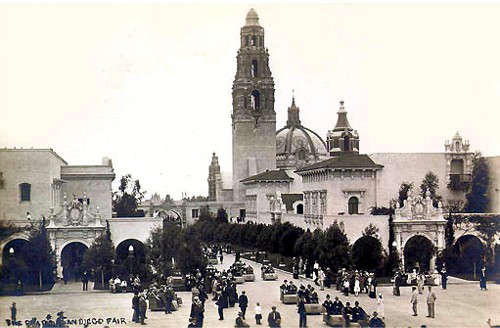 (Image Credit: San Diego History Center. Fair use, education.)
The Exposition attracted over 2 million guests during its run (some sources suggest 3+ million), and generated a small profit which was donated to the San Diego Museum (today, the culturally-aware Museum of Us).
From a numismatic perspective, SF's Panama-Pacific International Exposition was definitely the winner, with its program of five US commemorative coins, including two Gold Quintuple Eagles ($50) - one round, one octagonal - but the California-Pacific International Exposition was not numismatically forgotten by the US Congress - souvenir medals for the Exposition were authorized.
The Exposition's Official Medal, struck at the Mint exhibit on the Exposition grounds, was designed by C K Berryman, a cartoonist for the
Washington Evening Star; Berryman's designs were engraved by
Charles Barber. The medals were struck in silver, bronze and gilt (gold-plated bronze).
The obverse of the medal depicts a standing "Uncle Sam" figure holding a pick axe in his right hand (resting on his right shoulder) and a shovel in his left hand - tools symbolic of digging the Panama Canal. Behind "Uncle Sam" are seen portions of North, Central and South America; the shovel he is holding extends across the Panamanian isthmus and is meant to represent the location of the Panama Canal. The inscription "PANAMA CALIFORNIA EXPOSITION SAN DIEGO 1915 (1916)" encircles the center elements near the rim.
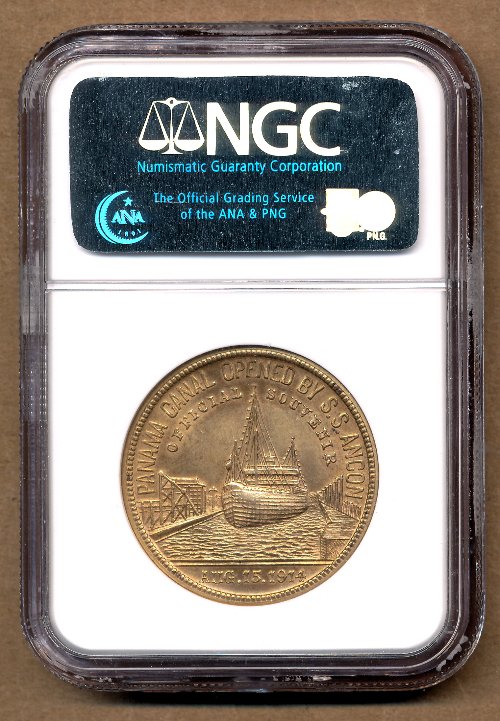
Note: The medal was struck in 1915 and 1916; the year of striking was featured on the obverse of the medal. Thus, two design varieties of the medal exist in addition to the use of multiple metals.The medal's reverse design presents the SS
Ancon moving through the Panama Canal. In arches above the ship, two inscriptions are seen: "PANAMA CANAL OPENED BY S. S. ANCON" and "OFFICIAL SOUVENIR".
Here's my gilt (gold-plated bronze) version of the 1915 medal:
1915 California-Pacific International Exposition Official Medal - Gilt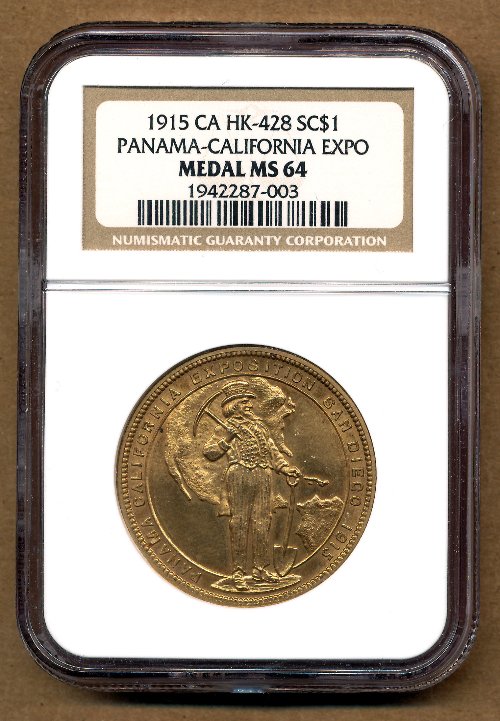
For other of my posts about commemorative coins and medals, including other US Mint-struck Exposition medals, check out:
Commems CollectionIf you'd like to"dig deep" into the Panama-California Exposition, I recommend the web site of the San Diego History Center:
-
Panama-California ExpositionIt provides wonderful details about the Exposition that are well beyond my scope here.








 Posted 06/19/2023 06:09 am