Most Celtic coins have designs imitative of ancient Greek coins - specifically, the
gold staters of Philip II of Macedonia, with a portrait of Apollo on one side and a chariot on the other. They were issued by Celtic tribes on the fringes of civilization, from the Danube River across to France. As time wore on, this same design was copied, and copied, and copied again, until very little of the original design remained. The Celtic die-cutters then began to modify the designs with distinctively Celtic motifs, like giving the horse a human face.
The coins were originally gold, and generally the gold got lower and lower fineness with time, until they were reduced to base-silver coins. There doesn't appear to be too much gold in this coin, if any, so it's probably a very late-period coin, dating from just before the Roman conquest of France. I have a similar piece:
Image Insert: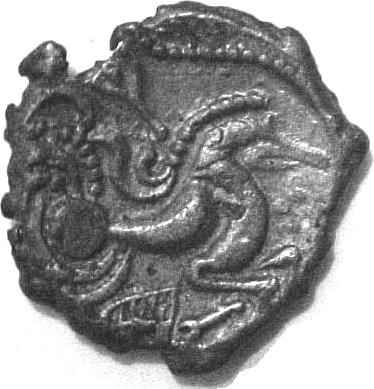
In short, the reverse image might be described as "insect-like", but I think it's a coincidence - I don't think the original artist actually intended it to depict an insect.
There are ancient coins that depict insects - most famously, the "bee coins" of Ephesus, like
this one.
Don't say "infinitely" when you mean "very"; otherwise, you'll have no word left when you want to talk about something really infinite. - C. S. Lewis










 Posted 03/26/2009 9:31 pm


