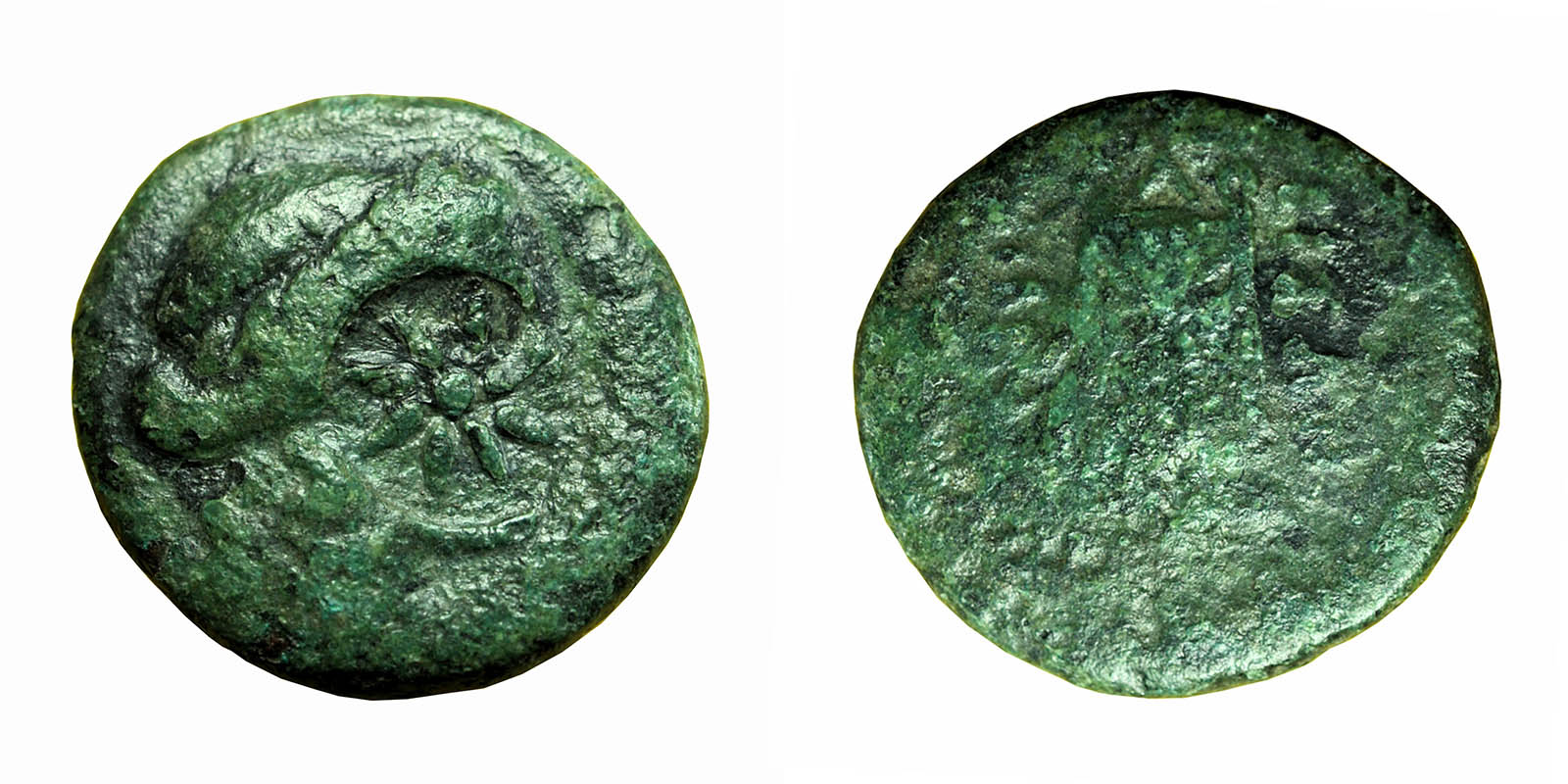
After reading of how little is known about the coinage of Bisanthe in Thrace I was surprised to find two coins in the same auction recently, but I can find no mention of the Dionysos/grape bunch coin on ACSearch. After finding no reference to the coins in the CCF search I thought I'd share them here.
From pleiades stoa; Initial Provenance: Barrington Atlas: BAtlas 52 B3 Bisanthe/Rhaidestos.
Bisanthe was a great city in ancient Thrace, on the coast of the Propontis, which had been founded by the Samians. About 400 BC, Bisanthe belonged to the kingdom of the Thracian prince Seuthes II. At a later period its name was changed into Raedestum, Rhaedestum or Rhaideston, or Raedestus, Rhaedestus or Rhaidestos; but when this change took place is unknown.

From snible org; Bisanthe was originally a Samian colony on the northern coast of the Propontis, a few miles west of Perinthus. The few autonomous coins struck at this town seem to have been issued shortly after the death of Lysimachus.
The only information I found on Wildwinds: The Ancient Coinage of Bizanthe. Listed by Moushmov Number.
Bisanthe (near 280 B.C.) (now Rodosto) Autonomous bronze coins.
3194 Demeter's veiled head with wreath of ears, right. Rev. : BIΣANΘHNΩN within wreath of ears. 21 mm.
3195 Apollo's laureate head right. Rev. : The same legend. Tripod. 17 mm.
3196 The same - smaller. 12 mm.
3197 Dionysos's head with ivy wreath right. Rev. : BI. Bunch of grapes. 18 mm.
3198 Athena's helmeted head right; owlet in countermark. Rev. : BIΣAN. Owlet right, holding branch in its claws. 15 mm.
3199 Apollo's laureate head right. Rev. : BIΣAN. Vase with 2 handles (Diota). 10 mm. Plate XVIII 9.
3200 Athena's helmeted head right. Rev. : BIΣAN. Owlet opposite. The rev. is hollow. 10½ mm.
The authority on these coins was the late Edith Schonert-Geiss. Below is an extract regarding her Coin Typology of Bisanthe - Minting System and Typology, found on corpus-nummorum.
Bisanthe (modern-day Rodosto or Tekir-dag), like nearby Perinth, lay on the Propontis River and was founded by the Samians.
1) The city was mentioned in written sources for the first time in 430 BC.
2) It belonged to the Delian-Attic alliance, then to Alexander and the Diadochi. Judging by the city emissions, Bisanthe was relatively autonomous after the time of Lysimachus. However, coins were only emitted in bronze, and only during an apparently homogenous period in the 3rd century BC. A chronological internal structure of the emissions cannot be made, which is why Schonert-Geiss first made an order for weights and divided them into the three groups of Nominal A, B, and C.
3) In her opinion, these should represent the relation 1:2:4 (where 1 coin of Nominal A = 2 coins of Nominal B = 4 coins of Nominal C).
4) To date, these nominal levels have been assigned a total of 14 types, which are named after the iconography present on their obverses and reverses. In several cases, a type comprises only one specimen, which means that their assignment to a nominal can only be done tentatively; only the discovery of more pieces could confirm or refute their assignment. Schonert-Geiss grouped these coins into nominal levels predominantly based on the diameters of the specimens as opposed to their weight;
5) Her assignments for individual cases are therefore still quite debatable. Whether the coins of Bisanthe were issued at the same time or in succession cannot be deduced from the material. It is more likely, however, that the series were produced at the same time.
6) The reasoning behind this is iconographic in nature: The gods Dionysus, Demeter, Zeus, Apollo and Athena were honoured on these coins. Presumably, therefore, not only three types - one per nominal level - were issued, but at least so many that each of the standing deities in Bisanthe was represented on the city coinage.

Bisanthe, Thrace. 280-200 BC.
Obverse: Laureate head of Apollo to right. Reverse: Tripod. Reverse Inscription: ΒΙΣΑΝ-ΘΗΝΩΝ. Bronze. Diameter: 12 mm. Weight: 1.4 gr.
Reference: Schonert-Geiss 29; BMC 2.

Bisanthe, Thrace. 2nd century BC.
Obverse: Wreathed head of Dionysos right. Reverse: Grape bunch on vine with two leaves. Reverse Inscription: B - I. Bronze. Diameter: 11 mm. Weight: 1.8 gr.
Reference: Schonert-Geiss 37; HGC 3.2, 1365.







 Posted 08/25/2023 1:45 pm


 I was lucky this time as my searches did turn up some interesting information about Bisanthe and the coinage. Often the searches are frustratingly fruitless.