| Author |
 Replies: 8 / Views: 1,300 Replies: 8 / Views: 1,300 |
|
|
Bedrock of the Community
 United States
27254 Posts |
This little beauty was in a lot simply described as "Old Foreign Copper Coins". It is most assuredly copper. I believe the date to be 1862, although it and the mint mark are a bit obscured. 1.41 g; 21.45 mm average diameter; 1.14 mm thick. 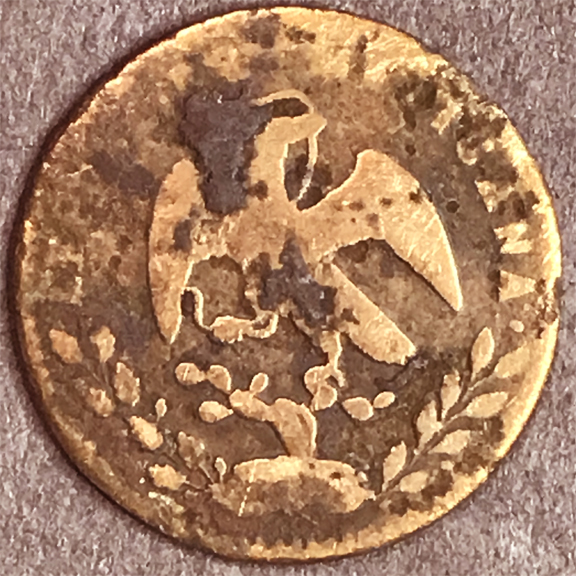 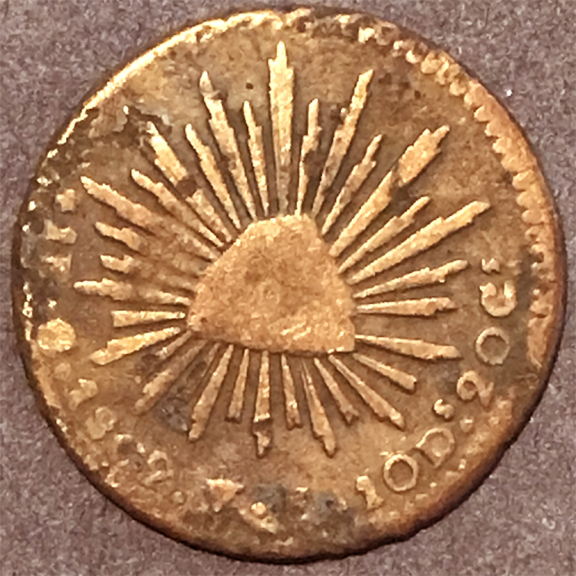 Inordinately fascinated by bits of metal with strange markings and figures
|
|
|
|
Pillar of the Community
United States
1962 Posts |
Yup, as has been discussed on here a few times, lots of these 1860s-date contemp ctft minors... often with Go mintmark as yours has.
Be patient on condition, and try for ones with good remaining silvering.
|
|
Bedrock of the Community
 United States
27254 Posts |
Thanks for the mint, realeswatcher! It was in a lot of coins with several other contemporary counterfeits (European) and some pieces of junk. The auction did not set me back much.
Inordinately fascinated by bits of metal with strange markings and figures
|
|
Pillar of the Community
United States
5362 Posts |
Realeswatcher is absolutely correct. This is one of the most common counterfeits of the 1 Real type I know of. It is Guanajuato but there is more than one assayer combination seen for 1862. Most examples on the market come from a large hoard discovered in the late 1990s in north central Mexico at a refinery that was owned by the Mexican government.
That facility was used to reclaim the silver plating from millions of counterfeit coins taken from circulation. The cores after silver removal were buried in a dump on site. Coins were found in a variety of containers as well as loose. The value of the copper did not warrant melting.
Simply placing these coins in heated mercury and agitating the mix would remove the silver (if present) on the surface of a counterfeit. Based on the condition of many of the salvaged coins - the counterfeits may have been flat filed across both faces to remover the silver for an easier partial recovery first. The filings would contain much more silver by weight than the filed cores. Most of the recovered cores, like this one are in very low grades and after a few thousand of the cores hit the market - the value of the recovered cores plummeted. In this shape it is a $2 curiosity, but in a higher grade with no recovery attempted it is worth a lot more. I only buy something this poor if it is a new date, mint and assayer combination.
Patience is needed. I own several hundred of the salvaged cores from the hoard. But I buy only one low grade example of each.
Every denomination has been recovered in the hoard except the 1/4 Real in silver. That is of course the rarest type overall. The ratio of denominations matches most circulation estimates - 8R are the most common followed by 2R then 1R, 1/2 R and finally 4R types. AS I noted above the silver 1/4 Real counterfeits are all quite rare.
The copper core with electro-deposition silver type are generally referred to as second republic counterfeits because regardless of the date on the coin, these were actually all made after 1867. All of the decimal issues down to 5 Centavos are also seen in the hoard.
The oldest coin I am aware of in the hoard was an 1836 that one of the finders sold to me. It was not affected by mercury emersion since it contained no silver at all. It is a type made after 1836 but before 1850. It seems a bit out of place in the hoard. It may have been simply discarded along with the stripped cores or perhaps the seller added it to my batch since I had advised him, I was looking for the range of dates. The same group also included a 1913 Peso also relatively undamaged. It did seem to have undergone some form of reclamation based on surface pitting, yet it was also out of place alongside the other coins in the hoard. Peso Forte types were very common up to 1908. So regardless of where these two came from, I still use the tentative range of 1836 to 1913 as the start and end dates for the coins in the dump.
The actual period of operation of a recovery facility is a question that I see as far more open. Two factors enter into this. First is the market value of silver which must be high enough to justify the work involved in reclaiming it. The second factor is government stability. Periods of revolution or serious instability cause counterfeiting but during those periods I doubt a reclamation of the sort seen here would be taking place on such an organized level.
While the period of the rule of Antonio Lopez de Santa Anna (1833 to 1854) could be seen as a "relatively stable" period, Santa Anna was a strong man (a dictator) and his rule was not one of traditional adherence to the law or of general innovation in government. His era was far more likely to be one that resulted in counterfeits flooding the markets especially after the US invasion.
After Santa Anna was removed from power there followed a very unstable period of political intrigue. This period from 1854 to 1876 includes many changes of President and the French Empire of Maxmillian. This age of instability would encourage the production of as many if not more counterfeits than the Era of Santa Anna.
Tentatively I believe that the recovery effort should be assigned to the period from 1876 to 1910 the era of Porfiriato - the rule of General Porfirio Diaz. He was noted for his innovation and enforcement of the law. He is the perfect choice for a leader who would have taken the steps needed to remove counterfeits from circulation and to institute a process to recover whatever silver the counterfeit coins contained.
|
|
Bedrock of the Community
United States
27254 Posts |
Swamperbob, thank you for this education in counterfeit 1 reales etc. As you can tell, my knowledge of this area is quite weak. I've ordered a copy of Counterfeit Portrait Eight-Reales: The Un-Real Reales. Can you suggest any other resources in this area? Many thanks!
Inordinately fascinated by bits of metal with strange markings and figures
|
|
Pillar of the Community
United States
1962 Posts |
|
|
Pillar of the Community
United States
1915 Posts |
I was inspired by the title of one of my library books and decided to make a binder placing all my reales that are not real in one place. What is interesting is that I found this OP and enjoyed the replies because I have the same coin. Apart from having the same coin, three more of the same were found on ebay described as bronze. 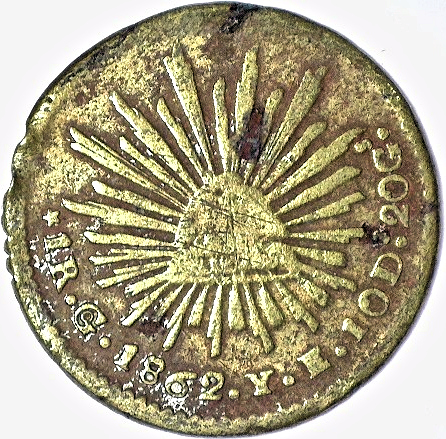 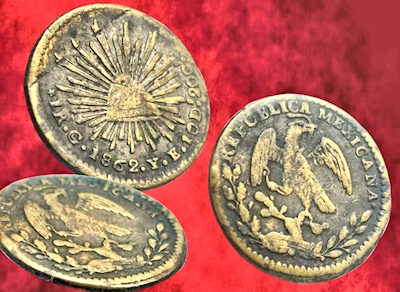 |
|
Pillar of the Community
United States
1915 Posts |
Oh Boy! Sometimes I get so dumb about my hobby and jump the gun.
Here I thought I was buying three coins because that's the way the seller made the listing.
I didn't get three coins like the seller showed- it's just three images of the same coin in different positions.
|
|
Bedrock of the Community
United States
27254 Posts |
Albert, that seller certainly has quite a few double-struck coins. How unusual.
Inordinately fascinated by bits of metal with strange markings and figures
|
| |
Replies: 8 / Views: 1,300 |
|










 Posted 10/20/2023 11:25 pm


