












 Posted 11/15/2023 07:22 am


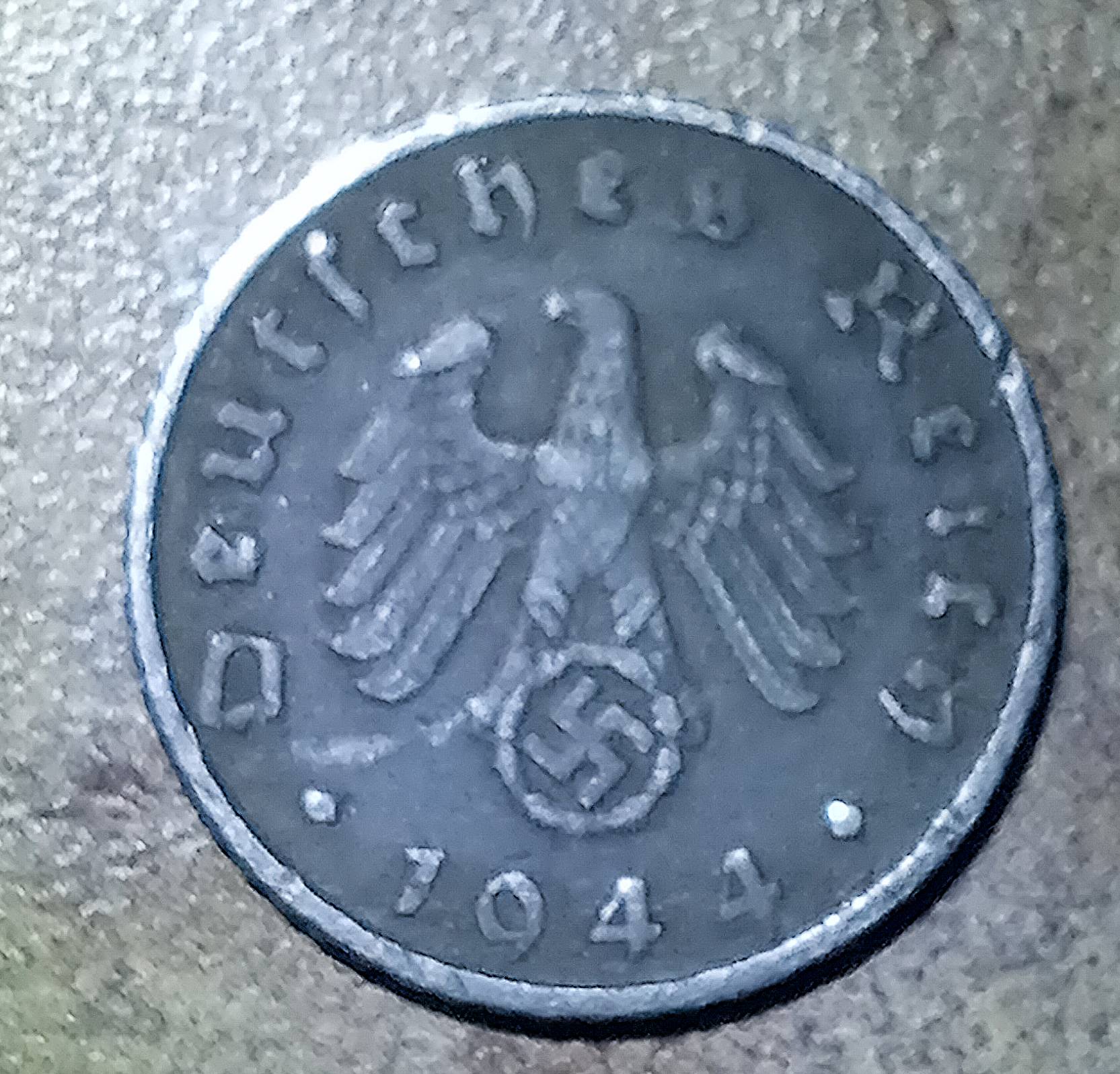
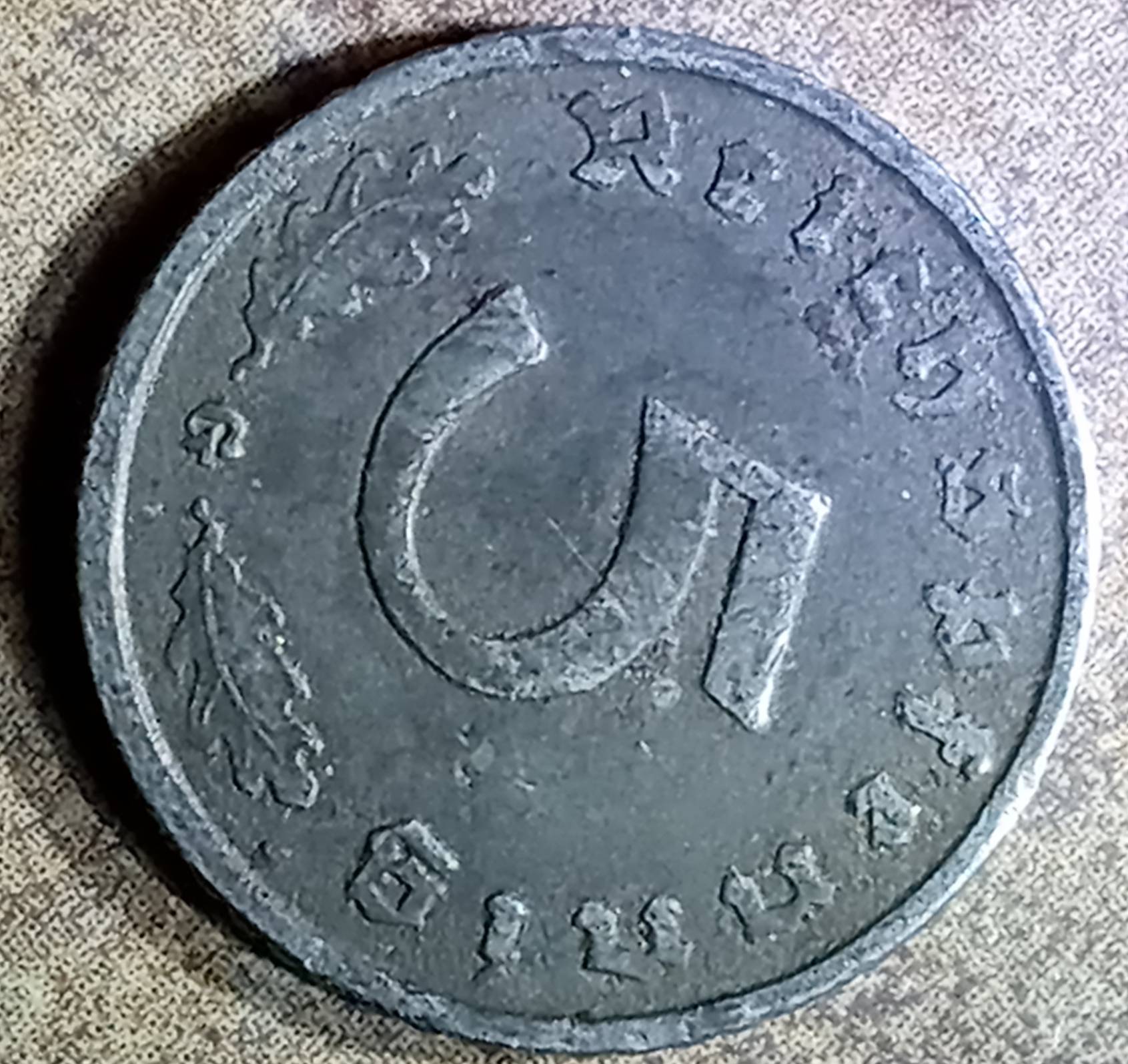
Your coin is a perfectly normal German 5 reichspfennig coin from 1944. Nazi Gerrmany had seven mints: the five mints that modern Germany currently has (Berlin, Hamburg, Karlsruhe, Munich and Stuttgart) as well as Muldenhutten (Leipzig) and Vienna, in Nazi-annexed Austria. Your coin has the "G" mintmark, for Stuttgart.
Your coin is made of zinc - the same stuff that's at the core of modern US 1 cent coins, except these German coins were never plated with anything. Zinc is a rather terrible metal to make coins from; it corrodes easily, and quickly turns black after just a short time in circulation. The Nazis used it because zinc was (a) cheap, and (b) not really essential as a war material, compared to the other possible options for coinage metals. The Nazis used zinc on not only their own coinage, but for coinage in most of the territories they occupied.
The font or script used on this coin is known as "Fraktur". It was popular among the intelligentsia in 19th and early 20th century German society, and became the sole official script for writing German under Nazi rule, as they considered it to be more "truly Germanic" than Latin script, up until 1941 when the Nazi Party suddenly reversed it's opinion and declared Fraktur to be "too Jewish". In reality, I suspect the difficulty in attempting to rapidly read signage written in Fraktur script caused unnecessary delays, which by 1941 the Germans could ill afford. However, the Fraktur script remained on the coinage until after the war ended.
Swastikas began to appear on German coins within a year of the Nazis taking power, and remained on the coinage until the surrender. Allied coinage struck for use in Occupied Germany up until 1948 retained much the same design, only with the swastika removed.
Collecting Nazi-era coins is controversial in some quarters; some people would prefer that all Nazi artifacts - including coins - be either locked up in museums or destroyed. In some countries, public display of a Nazi swastika is illegal and buying or selling Nazi coins is controlled, but in the United States, it's perfectly legal. For statistics about your coin (mintage, market value, etc) see this NGC database page: https://www.ngccoin.com/price-guide...duid-1319360
The 1944-G 5 reichspfennig is actually quite rare, and worth considerably more than your typical Nazi 5 reichspfennig coin.
Your coin is made of zinc - the same stuff that's at the core of modern US 1 cent coins, except these German coins were never plated with anything. Zinc is a rather terrible metal to make coins from; it corrodes easily, and quickly turns black after just a short time in circulation. The Nazis used it because zinc was (a) cheap, and (b) not really essential as a war material, compared to the other possible options for coinage metals. The Nazis used zinc on not only their own coinage, but for coinage in most of the territories they occupied.
The font or script used on this coin is known as "Fraktur". It was popular among the intelligentsia in 19th and early 20th century German society, and became the sole official script for writing German under Nazi rule, as they considered it to be more "truly Germanic" than Latin script, up until 1941 when the Nazi Party suddenly reversed it's opinion and declared Fraktur to be "too Jewish". In reality, I suspect the difficulty in attempting to rapidly read signage written in Fraktur script caused unnecessary delays, which by 1941 the Germans could ill afford. However, the Fraktur script remained on the coinage until after the war ended.
Swastikas began to appear on German coins within a year of the Nazis taking power, and remained on the coinage until the surrender. Allied coinage struck for use in Occupied Germany up until 1948 retained much the same design, only with the swastika removed.
Collecting Nazi-era coins is controversial in some quarters; some people would prefer that all Nazi artifacts - including coins - be either locked up in museums or destroyed. In some countries, public display of a Nazi swastika is illegal and buying or selling Nazi coins is controlled, but in the United States, it's perfectly legal. For statistics about your coin (mintage, market value, etc) see this NGC database page: https://www.ngccoin.com/price-guide...duid-1319360
The 1944-G 5 reichspfennig is actually quite rare, and worth considerably more than your typical Nazi 5 reichspfennig coin.
Don't say "infinitely" when you mean "very"; otherwise, you'll have no word left when you want to talk about something really infinite. - C. S. Lewis


