The 1936 Cleveland, OH Centennial / Great Lakes Exposition Half Dollar was struck "in commemoration of the centennial celebration of Cleveland, Ohio, to be known as the Great Lakes Exposition." It's important to understand that the coin was not sponsored by the group that organized/managed the Exposition but rather the Cleveland Centennial Commemorative Coin Association (aka, Thomas G. Melish), a separate organization with a much more limited scope but one that sought to "piggyback" on the enthusiasm for the Exposition.
Note: In this way, the coin is similar to the 1934-38 Texas Independence Centennial Half Dollar, it is often connected to the Texas Centennial Exposition held in Dallas, TX, but was sponsored by a separate, independent organization - the American Legion Texas Centennial Committee of Austin, Texas - with net proceeds being directed to funding a Texas Memorial Museum vs. defraying expenses of the Exposition.1936 Cleveland, OH Centennial / Great Lakes Exposition Half Dollar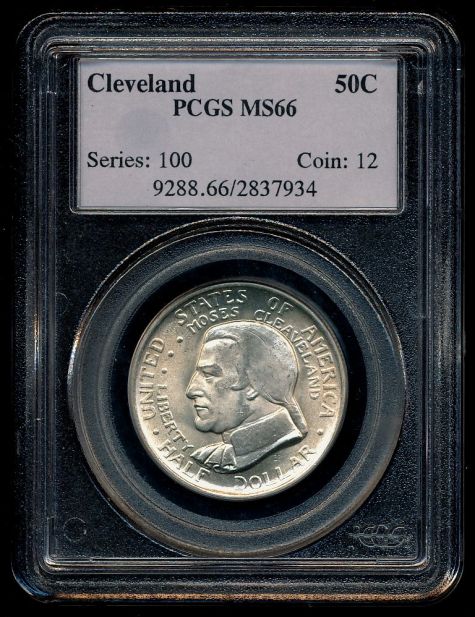

Cleveland had experienced terrific commercial growth in the early 1900s - accompanied by strong population growth - and had become one of America's leading and largest cities by 1930; it was the 6th largest with a population of ~900,000.
The economic depression that hit the United States (and the World), beginning in 1929 and carrying through the 1930s, hit Cleveland hard and shook the city to its foundation. The city had a very high unemployment rate (>15%-50% depending on sector), an overwhelmed local support infrastructure for those in need (local charitable groups could no longer meet needs) and a growing public anger toward local government officials, the local police and even the city's employers (public demonstrations took place). Local businessmen began to band together to seek solutions and reinvigorate the local economy as best they could. The concept of a World's Fair or Exposition took hold and was soon supported and plans began to be made.
In 1935, as part of its lead-up promotion for the Exposition, the Great Lakes Exposition group produced a
Preliminary Program that described the planned Exposition and included a list of its "Purposes". Among its "Preliminary" comments:
"Cleveland has for several years been so depressed by adverse circumstances that a forward looking enterprise is needed to revive the spirit of civic pride that formerly characterized the city."
The organizers also saw the value in focus for the Exposition:
"This Exposition would not be confined to local interests nor would it make pretensions as a world's fair, but it would relate itself to the most important industrial and commercial district in America."
Note: The Exposition was described as intending to support "Ohio, Michigan, Indiana, Illinois, Wisconsin, Pennsylvania and New York, and to the north a rich section of rapidly growing Canada. What a territory for the expression of enterprise through a Great Lakes Exposition!"The Exposition had a tall order to fill:
"The purposes would be many, and only the most important are listed here:
- to advance the industrial and civic interests of Cleveland through an undertaking in which the entire citizenship would find inspirations;
- to advance the business interests by attracting hundreds of thousands of visitors who would patronize commercial institutions, become better acquainted with local products and see first-hand the advantages of the city as a place in which to live and have a business;
- to advertise and publicize Cleveland, constructively--through newspapers, magazines, radio and direct mail throughout the country--and overcome the destructive publicity that has worked serious harm;
- to advance the interests of such undertakings as the National Air Races and the Grand Circuit Races through cooperative promotion;
- to further the efforts of civic and business organizations through stimulating pride, faith, and community patriotism;
- to lay the foundation for the work of securing future conventions and expositions through demonstrating Cleveland's ability to take care of important events;
- to imbue in every man, woman and child in Cleveland a new born confidence in the power of the community to go forward under the concerted leadership that will achieve its due recognition through this enterprise."The Exposition was open for the summer season in 1936 and 1937. Over the course of its run, the Exposition attracted approximately 11 million visitors (~4 million in 1936 and ~7 million in 1937). While the Exposition did bring visitors to the area, create a local infusion of cash and renew some of Cleveland's luster, its impact was somewhat temporary as Cleveland never truly regained a long-standing place of prominence within the American landscape. Its population today is ~370,000 and it has fallen to #54 among US cities; it is also no longer the industrial center that it was in 1920s.
Though it unilaterally tied itself into the Exposition, the Cleveland half dollar was issued primarily for the personal gain of Thomas G. Melish, local businessman and coin dealer.
For other posts about commemorative coins and medals, including more about the Cleveland half dollar, see:
Commems Collection.



 Posted 11/21/2023 3:55 pm





