| Author |
 Replies: 24 / Views: 1,711 Replies: 24 / Views: 1,711 |
|
Pillar of the Community
United States
959 Posts |
OK, I admit I'm a sucker for coins with Cuds. I thought this was interesting. In my research I saw that a lot of 1865 3 cent pieces are weakly struck between 4 and 6 on the obverse and correspondingly on the reverse - just as this coin is. I also saw some earlier die state examples where the obverse die was breaking in this area, but this must be a fairly late die state with this more extreme Cud. I also really liked the die clash. Not really a coin in my wheelhouse and I'm curious as to the reaction to sellers's pics. Not great pictures and I do not have the coin in hand yet. 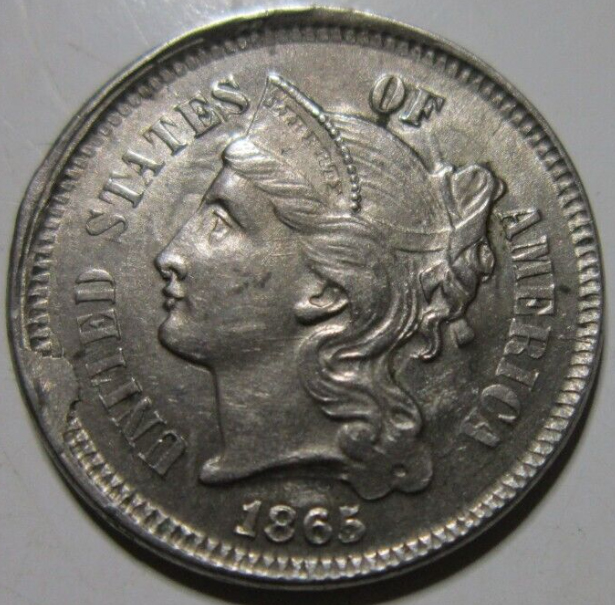 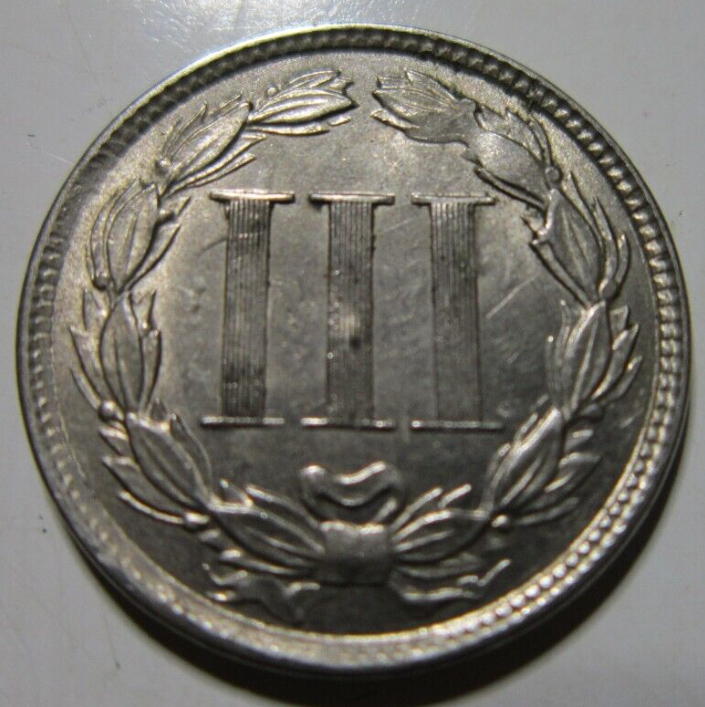 Edited by Blastenpene4
11/30/2023 9:28 pm
|
|
|
|
Bedrock of the Community
United States
12057 Posts |
AU55. Slight trace of rub. That's quite an impressive die break, even by the standards of the coin type.
Member ANA - EAC - TNA - SSDC - CCT #890 "Most of the things worth doing in the world had been declared impossible before they were done." -- Louis D. Brandeis |
|
Bedrock of the Community
United States
94367 Posts |
|
|
Pillar of the Community
United States
6904 Posts |
As a rookie at classics, I'm a bit puzzled by this coin. The hair detail is phenomenal. Except at the very ends, that flat spot looks heavily worn. Grease Filled Die, perhaps? The tiara also has some smearing of the orbs close to the crown, but is that die wear or circulation wear? The reverse also seems strong, except for the second upper right leaf. But I see on comps for that year that many MS coins have the vein missing on the leaf. To me, it looks MS 63-64, but that is a very shaky guess made purely for practice. It's a lovely coin, though! The die clash is definitely cool. Looks like there might be some doubling on the top tips of the III as well? |
|
Pillar of the Community
United States
6904 Posts |
Now seeing that the pros are posting an AU grade, I'm guessing that the mentioned spots can be identified as wear, not die state?
|
|
Bedrock of the Community
United States
12057 Posts |
Grading is subjective. As you noted, things such as clash, die state, die defects, off-center strikes, misaligned dies, grease, etc. can all change the appearance of a coin and make it appear to be a lower grade than it actually is.
I've got no way of knowing if it ever actually changed hands, or went straight from the Mint into a coin collector's cabinet...
That being said, the presence of a few light hairlines and a few areas that show a bit of gunk buildup or spotting would suggest the former.
You could show this coin to 20 different professional graders at PCGS, NGC, or ANACS and some would say AU and some would say Unc. It's just the nature of the game.
Member ANA - EAC - TNA - SSDC - CCT #890 "Most of the things worth doing in the world had been declared impossible before they were done." -- Louis D. Brandeis |
|
Bedrock of the Community
United States
79393 Posts |
|
|
Pillar of the Community
 United States
959 Posts |
I really wonder about the light strike at 4-6 Obv and 12-2 Rev. The end letters of "America" are weakly struck, as is the "5." Reverse shows leaves at 12-2 poorly struck. I looked around a bit and this is not uncommon for 1865, apparently. I have not seen another Obverse Cud like this, but I'm sure they're out there. Just was an interesting coin, and not very expensive. |
|
Pillar of the Community
United States
6904 Posts |
|
|
Bedrock of the Community
United States
11966 Posts |
The 1865 3 Cent Nickel is an important transitional coin. It was the realization of a vision of 19th century industrialist Joseph Wharton who was a Philadelphia Quaker that went on to be one of the founders of Bethlehem Steel and the Wharton School of Business. He also had interests in nickel mines, a metal which was much harder than gold, silver and copper, the traditional metals for coinage. He lobbied Congress for years for the government to buy his nickel for the production of coinage. The 1865 3cn was his triumph in this endeavor. That's the reason for the weak strikes. The mint was only beginning to coin nickel alloys, and it all began with the 3 Cent Nickel which was 75% copper and only 25% nickel. The dies made by the mint weren't hard enough to strike these thin tiny and hard coins and the dies would wear out very quickly. This coin was the humble beginning of nickel in the history of our coinage. The 5 cent nickel would be introduced later in 1866. IN NECESSARIIS UNITAS - IN DUBIIS LIBERTAS - IN OMNIBUS CARITAS THE MAN IN THE ARENA, Theodore Roosevelt at the Sorbonne Paris on April 23, 1910: " It is not the critic who counts; not the man who points out how the strong man stumbles or where the doer of deeds could have done better. The credit belongs to the man who is actually in the arena, whose face is marred by dust and sweat and blood, who strives valiantly, who errs and comes up short again and again, because there is no effort without error or shortcoming, but who knows the great enthusiasms, the great devotions, who spends himself in a worthy cause; who, at the best, knows, in the end, the triumph of high achievement, and who, at the worst, if he fails, at least he fails while daring greatly, so that his place shall never be with those cold and timid souls who knew neither victory nor defeat." My coin website: https://fairfaxcoins.comEdited by numismatic student
12/01/2023 02:59 am
|
|
Pillar of the Community
United States
959 Posts |
Brandmeister, thanks for that link. None of these varieties seems to be a complete match, but I'll be able to evaluate much better once I have the coin in hand. I will post new pics then. Nobody has mentioned the obverse rim at about 10. I can't tell if this is damage of some sort - this was my only hesitation on the coin. That said, it was just a darned interesting coin that I couldn't resist at the price.
Edited by Blastenpene4
12/01/2023 09:53 am
|
|
Pillar of the Community
United States
1870 Posts |
numismatic student is right on - great background. Cool Cud for sure. I'd have this at 53-55 range. |
|
Bedrock of the Community
United States
37201 Posts |
Easy AU-55 leaning towards 58.
|
|
Bedrock of the Community
United States
11966 Posts |
Adding that the 1865 nickel was not the first use of nickel in U.S. coinage. That came in 1856 when the copper-nickel small cents replaced the then ubiquitous large cents, also due to the efforts of Joseph Wharton. The 1865 3cn is the first white metal nickel coin issued as regular coinage. The 1856-1864 copper-nickel cents were copper-colored but contained 12% nickel or less than half of the 25% in the 3cn. But this coin is clearly the precursor of what we all know as the U.S. 5c nickel.
IN NECESSARIIS UNITAS - IN DUBIIS LIBERTAS - IN OMNIBUS CARITAS THE MAN IN THE ARENA, Theodore Roosevelt at the Sorbonne Paris on April 23, 1910: " It is not the critic who counts; not the man who points out how the strong man stumbles or where the doer of deeds could have done better. The credit belongs to the man who is actually in the arena, whose face is marred by dust and sweat and blood, who strives valiantly, who errs and comes up short again and again, because there is no effort without error or shortcoming, but who knows the great enthusiasms, the great devotions, who spends himself in a worthy cause; who, at the best, knows, in the end, the triumph of high achievement, and who, at the worst, if he fails, at least he fails while daring greatly, so that his place shall never be with those cold and timid souls who knew neither victory nor defeat." My coin website: https://fairfaxcoins.com |
|
Pillar of the Community
United States
4992 Posts |
Either AU-58 or MS-62. It's a really nice looking coin and tough to tell from these photos whether we're looking at strike issues or some trace rub.
|
|
Pillar of the Community
United States
959 Posts |
I'll post pictures when I have it in hand. I'm also curious to check out the apparent die doubling at the top of the "III," as Brandmeister commented on. Doesn't look like Machine Doubling, but pictures are pretty hard to evaluate. |
| |
Replies: 24 / Views: 1,711 |





 Posted 11/30/2023 10:01 pm





