Current references for US commemorative coins generally list a total net mintage - i.e., minus assay coins and not including coins returned for melting - for the 1903 Louisiana Purchase Exposition (LPE) Gold Dollars as ~35,000 with a 50/50 (or nearly so) split between the program's two types: Thomas Jefferson Type and William McKinley Type - ~17,500 each. Let's dig into these numbers a bit.
1903 Louisiana Purchase Exposition - Jefferson Type
 1903 Louisiana Purchase Exposition - McKinley Type
 The Final Report of the Louisiana Purchase Exposition Commission
 provides a twist to what is found in the books. The
Report was submitted to the US Congress by the Commission in February 1906, in accordance with the provisions of the "Act to provide for celebrating the one hundredth anniversary of the purchase of the Louisiana Territory," which was approved on March 3, 1901. It included the following regarding the gold dollars::
Premium on Souvenir Gold Coin, less Expense.

    This total represents the premium of $2 per coin on   $67,176.00
      33,588 coins sold
    Less expenses .......................................  13,506.67
      Total .............................................  53,669.33

We have agreed the number of coins sold with the difference between the number originally received and the number now certified to be on hand.
These statements tell me three things:
1. The LPE Commission reported sales of 33,588 Gold Dollars at an issue price of $3.00 each - a $2.00 premium over face value.
2. As of February 1906, more than a year after the Exposition closed, the Commission still had coins in its possession that it had not been able to sell. (Coins Struck/Provided: 250,000; Coins Sold: 33,588; Coins Remaining: 216,412.)
3. The Commission had hoped to realize ~$500,000 in profit from coin sales (250,000 Gold Dollars with a gross profit of $2.00 each), but realized just slightly above 10% of such amount. As generally noted, the program's coin sales were a disappointment.
The Mint later reported that 215,250 of the gold dollars were returned to be melted circa 1914 - a decade after the Exposition closed. This suggests a net distribution of 34,750 of the coins. The difference between this figure and what the Commission stated in its
Final Report as already having been sold at $3.00 each is just 1,167 coins.
It has been stated by multiple researchers/authors that Farran Zerbe promoted the remaining gold dollars for years after the Exposition. It has also been reported that Zerbe sold a large quantity of the coins - said to be thousands - to dealer B. Max Mehl (Fort Worth, Texas) for just over face value and that Mehl, himself, marketed them for years. If the numbers reported by the Commission and the Mint (above) are to be believed, the Mehl "remainders" purchase of LPE gold dollars doesn't reconcile - there weren't thousands of coins available for him to purchase!
What is the truth behind the numbers? It is possible that the inclusion of a William McKinley gold dollar in the LPE program may have caused later researchers some confusion. Mehl stated in his
The Commemorative Coins of the United States that he purchased thousands of the 1916-17 McKinley Gold Dollars. Is it possible that somehow Mehl's actions with the 1916-17 coins was mistakenly applied to the 1903 LPE gold dollars?
The Mehl connection to the 1916-17 McKinley gold dollar is well-known and documented. I don't think the same can be said for Mehl's link to the LPE gold dollars. At the time of the LP Exposition, Mehl was approximately 20 years old (he was born in 1884) and just getting his coin business established. He may not have been in a position to purchase thousands of LPE gold dollars in his early days - he was in a much different position at the time of issue of the 1916-17 McKinley Memorial gold dollars, however. So, a bulk purchase of McKinley Memorial coins seems very plausible.
1916 McKinley Memorial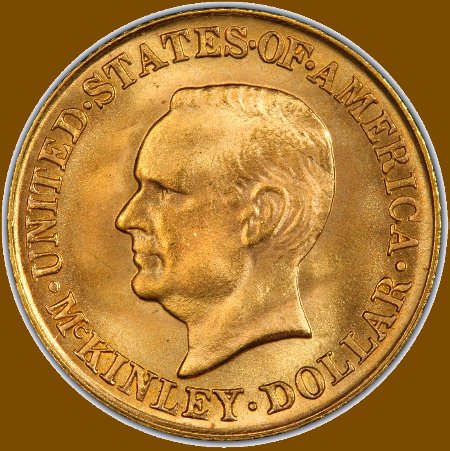

So, while I can't prove my case definitively, I lean toward a Mehl-McKinley Memorial connection vs. a Mehl-LPE connection, and once again wonder if an early, innocent mistake was inadvertentlly propagated forward in multiple references and accepted without challenge. I welcome the input of anyone with definitive information to the contrary.
For other of my posts about commemorative coins and medals, including others about US commemorative gold coins of the classic era, see:
Commems Collection.










 Posted 12/19/2023 6:42 pm


