











 Posted 01/10/2024 11:03 pm


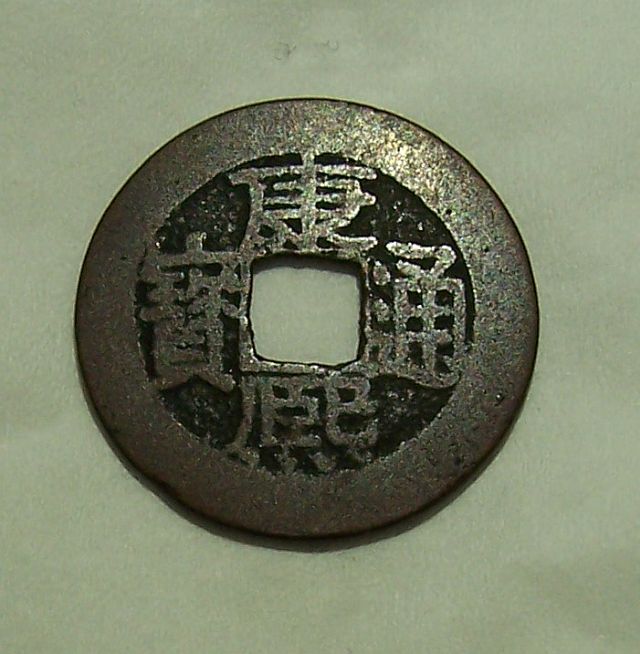
This is a Chinese coin. The denomination is "cash". The coin does not bear a specific date, but does bear the reign-name of the emperor: the Kangxi emperor, who reigned from 1661 to 1722. The four-character inscription reads, in the order top-bottom-right-left, "Kang Xi tong bao"; "tong bao" simply means "current coin". Your picture of this side is the right way up.
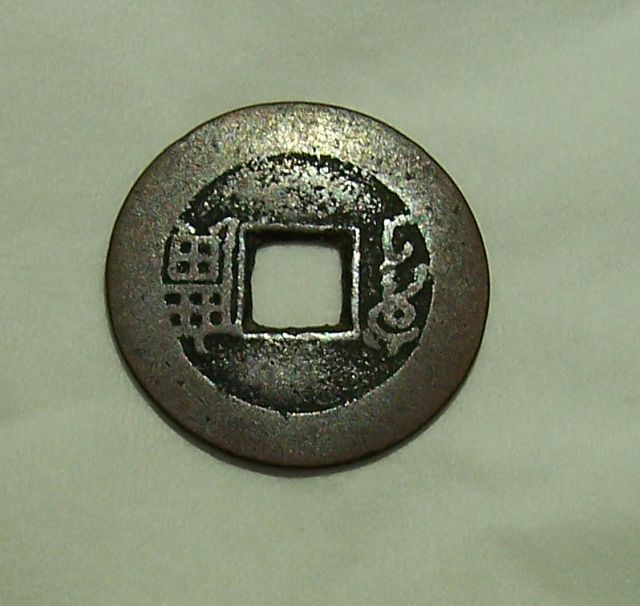
The two characters on the reverse are the mintmark, which on coins of Kangxi is written in both Chinese and Manchu scripts. Your picture is upside-down. In the case of your coin, the mintmark is "guang", for the southern port city of Guangzhou (known in the West as "Canton"). We know from Chinese Imperial records that coins were produced in Guangzhou during this reign in 1669, from 1686 to 1692, and 1695 to 1700. This coin seems to bear the calligraphy from that middle period, 1686-92. I don't believe there's any easy way to narrow down the date range further than that.
Chinese cash coins have a very long history; the round-coin-with-square-hole design being made more or less continuously for over 2000 years, and the four-characters-around-central-hole for at least 1500 years. Imperial China was quite conservative in coinage design! Cash coins were also produced differently from Western coins: rather than being struck between two dies, they would be cast in moulds made of fine sand, then ground round and flat by a lathe. The square hole is there to aid in production: the raw coins could be pushed onto a square metal rod, and rods of hundreds of coins could be lathed round at the same time.
The Kangxi period was one of wealth and prosperity for Imperial China. A very large number of coins were produced during this reign. They often remained in circulation for decades after they were produced, and wherever Chinese colonists went during the Gold Rush era of the 1800s, they brought cash coins like this with them. As such, despite being over 300 years old, they are not rare, or valuable. This coin is very typical of what you might find in a coin dealer's "Chinese cash coins - $2 each" tray.
The two characters on the reverse are the mintmark, which on coins of Kangxi is written in both Chinese and Manchu scripts. Your picture is upside-down. In the case of your coin, the mintmark is "guang", for the southern port city of Guangzhou (known in the West as "Canton"). We know from Chinese Imperial records that coins were produced in Guangzhou during this reign in 1669, from 1686 to 1692, and 1695 to 1700. This coin seems to bear the calligraphy from that middle period, 1686-92. I don't believe there's any easy way to narrow down the date range further than that.
Chinese cash coins have a very long history; the round-coin-with-square-hole design being made more or less continuously for over 2000 years, and the four-characters-around-central-hole for at least 1500 years. Imperial China was quite conservative in coinage design! Cash coins were also produced differently from Western coins: rather than being struck between two dies, they would be cast in moulds made of fine sand, then ground round and flat by a lathe. The square hole is there to aid in production: the raw coins could be pushed onto a square metal rod, and rods of hundreds of coins could be lathed round at the same time.
The Kangxi period was one of wealth and prosperity for Imperial China. A very large number of coins were produced during this reign. They often remained in circulation for decades after they were produced, and wherever Chinese colonists went during the Gold Rush era of the 1800s, they brought cash coins like this with them. As such, despite being over 300 years old, they are not rare, or valuable. This coin is very typical of what you might find in a coin dealer's "Chinese cash coins - $2 each" tray.
Don't say "infinitely" when you mean "very"; otherwise, you'll have no word left when you want to talk about something really infinite. - C. S. Lewis


