| Author |
 Replies: 41 / Views: 3,451 Replies: 41 / Views: 3,451 |
|
|
|
Pillar of the Community
United States
3535 Posts |
Plating could add a slight amount of weight, yes.
|
|
Pillar of the Community
Canada
6244 Posts |
The content of the Ni in an clad quarter it is 8.33% and this mean 0.47 gr. An missing 2 side clad, the coin must be around 5.1 gr.
By the photos this coin was plated. Missing clad, the coin has other color and texture of the material.
|
|
Pillar of the Community
United States
7600 Posts |
No, it looks like it was plated at one time.
|
|
Bedrock of the Community
United States
94367 Posts |
I vote plated. Weight please.
|
|
Valued Member
 United States
51 Posts |
|
|
Forum Dad
 United States
24236 Posts |
Quote:
The content of the Ni in an clad quarter it is 8.33% and this mean 0.47 gr. An missing 2 side clad, the coin must be around 5.1 gr. I'm about sick and tired of you so emphatically posting bad information. It's getting old. Each clad side weighs almost a gram, they have since 1965. So almost 60 years. A quarter missing both clads will weigh 3.7 to 4 grams. Missing one side will 4.7 to 5 grams. |
|
Moderator
United States
108458 Posts |
Quote:
Could it have been an improper alloy mix in the clad layer? I don't think so - if it were, then I would expect to see tons of this. The cladding layers was added to the copper core long before it was punched out into a blank. And that sheet is very long and wide. I think it was intentionally toned or lightly plated. A lot of these State Quarters were mistreated by getting plated or colorized. |
|
Pillar of the Community
Canada
6244 Posts |
Edited by silviosi
01/29/2024 6:34 pm
|
|
Forum Dad
United States
24236 Posts |
Quote:
The mint say 8.33% Ni. And that's correct.... So what? You're flat out wrong, just stop it.  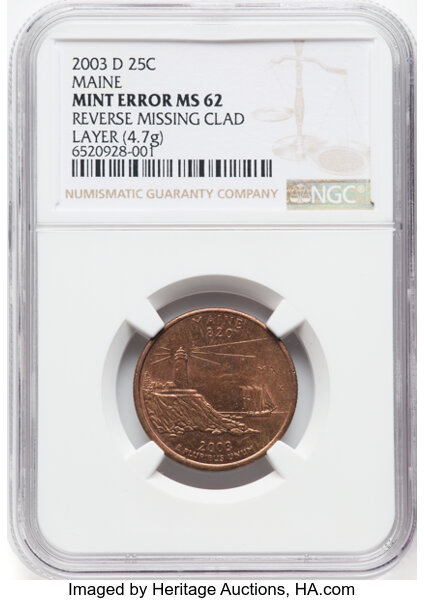 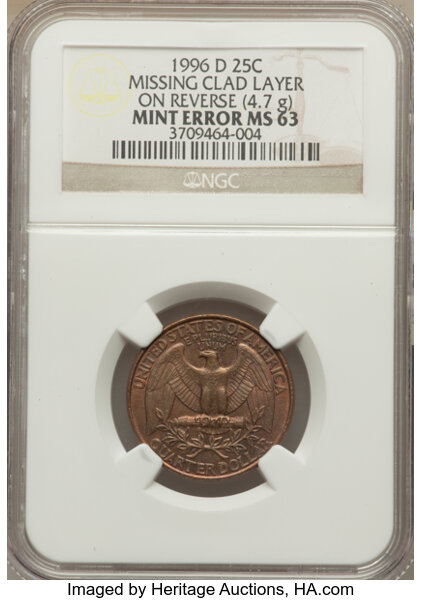 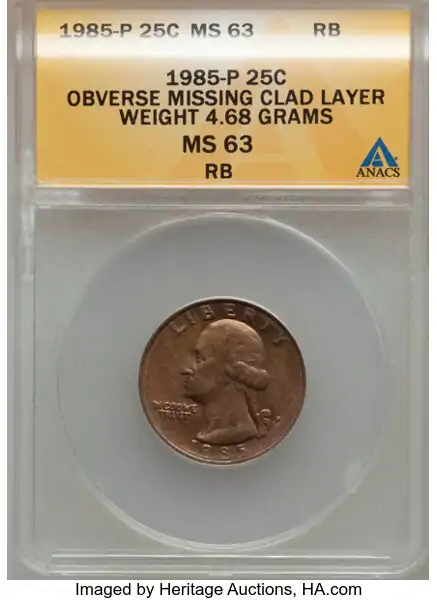 Eagerly awaiting your next excuse.  |
|
Valued Member
United States
116 Posts |
The outer clad layer is a copper-nickel alloy not pure nickel.
While the coin as a whole may contain 8.3% Ni the clad layer will also contain copper so it weighs more than ,47 grams
|
|
Pillar of the Community
United States
1648 Posts |
When a clad layer is missing, the coloring will be much more like copper (see below image for one example) so you can better see the difference in coloring which may help you (and others) in the future when looking. A missing clad layer is a coin that has one of its outer nickel layers missing from the copper core. As a result, the typical missing clad layer coin will be copper on one side and nickel on the other. It also will weigh roughly 15% less than a normal coin so thats why its a good thing to check but not always going to be different in certain cases.There are full, partial, or dual missing clad layers, with each type representing how much of the clad layer(s) is missing and happens on dimes, quarters, halfs, and dollars since 1964 but not nickels. One other type of missing clad layer is called a "dual missing clad layer," which is a coin missing both the obverse and reverse clad layers, with only the copper core remaining. Such a coin will be copper on both sides and will weigh approximately 30% less than a normal coin of its type. The dual missing clad layers are incredibly rare, with less than 10 known for Roosevelt dimes, five to 10 for Washington quarters, and only one for Kennedy half dollars, and none are known for the dollar coin series so its not discussed often. Info from Jon Sullivan https://www.pcgs.com/news/missing-c...-error-coinsMike Diamond: Missing clad layer does not always imply missing weight. Since a quarter dollar clad layer weighs approximately 1 gram, the error coin should weigh about 4.67 grams. This example weighs 4.7 grams. That seems to be in line with the coins posted by Bobby. https://www.coinworld.com/news/us-c...ly-miss.htmlQuote:
The outer clad layer is a copper-nickel alloy not pure nickel.
While the coin as a whole may contain 8.3% Ni the clad layer will also contain copper so it weighs more than ,47 grams All U.S. quarters (25-cent pieces) minted since 1965 weigh 5.670 grams (0.200 ounces). US quarters have a diameter of 24.66 mm, a thickness of 1.75 mm, and are primarily composed of "clad sandwich" of copper (91.67%) on the inside with nickel (8.33%) plating on the outside. 1965-present 5.67g outer layers of copper-nickel 75% copper and 25% nickel bonded to a core of pure copper from a difference source. The mint shows the layers here but not the weight of each. Mike Diamond above said approx 1g each. https://www.usmint.gov/learn/kids/c...-composition  Edited by datadragon
01/29/2024 7:51 pm
|
|
Pillar of the Community
Canada
6244 Posts |
Thanks DATA. I do not have before this information till this moment. I will put in my own data this. I calculated the weight of the clad based on 75/25 and give me one side 0.95 to 0.97 and two sides 1.94 rounded from 6 digits. Me I believe that today the mint move to 70/30 and thinn coins with same EMF.
Now it is interesting point. Philladelphia install the new blanking in 2001 and Denver + SanFancisco in 2004 which eliminate (suppose, exception could be) the variations in the roll thickness. If someone request I will repost the new Shuller blanking machine which if the roll is under or over the acceptable thicness will bypass that portion. With out clad the machine will not strike the blanks and pass the roll till reach the normal thickness.
The samples show here make sense regarding the Mint process. I look the years.
Edited by silviosi
01/29/2024 8:04 pm
|
|
Pillar of the Community
United States
1648 Posts |
Quote:
Now it is interesting point. Philladelphia install the new blanking in 2001 and Denver + SanFancisco in 2004 which eliminate (suppose, exception could be) the variations in the roll thickness. If someone request I will repost the new Shuller blanking machine which if the roll is under or over the acceptable thicness will bypass that portion. With out clad the machine will not strike the blanks and pass the roll till reach the normal thickness What you are saying is that the new blanking machine will not strike the blanks if it is not within the normal thickness after the dates the machine was installed. If that is accurate then that would be interesting to check if missing clad examples exist after those dates or not. The 2003 above is a denver (before 2004). I know I have some 2000-D maryland but thats before 2004. Edited by datadragon
01/29/2024 10:16 pm
|
|
Pillar of the Community
Canada
6244 Posts |
Yes, PM me and I will send you the Shuller blanking machine.
|
|
Pillar of the Community
Canada
6244 Posts |
DATA you are complete right. The base of coins is in the Minting Process. If we do not master this our decision could be false. This point I discussed with JP Martin in the weekend. Maybe I will go for some time there to enjoy the very skill team.
Edited by silviosi
01/30/2024 5:43 pm
|
| |
Replies: 41 / Views: 3,451 |





 First Page


 Posted 01/29/2024 4:23 pm


