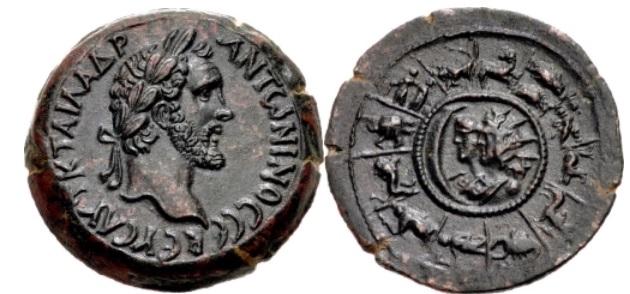
A great many "Zodiac animals" found on ancient coins are intended to represent the actual animals, rather than be zodiacal symbols. For example, the Capricorn might be intended to represent an actual mythological capricorn, rather than the star-sign.
Aries: a ram. Surprisingly difficult, but not too hard. And much easier if you're prepared to extend it to portraits of people wearing ram's-horns headgear.
Taurus: a bull. Relatively easy, as bulls were associated with royalty from earliest times and appear even on the earliest coins.
Gemini: the celestial twins, Castor and Pollux, appear very frequently on Roman coins.
Cancer: a crab. Akragas is the most common "crab city".
Leo: a lion. Like with the bull, a very very common image on coins. The coins of Miletus, with the lion looking over its shoulder at a star, are perhaps the best representatives.
Virgo: difficult to image a virgin, specifically, as opposed to a more generic woman. Perhaps the best representatives are goddesses like Vesta, or Athena Parthenos.
Libra: scales. Possible, but not easy. Scales being held by an allegorical figure like Justice are more common than scales sitting by themselves.
Scorpio: a scorpion. Perhaps the rarest of the Zodiac animals on coins. There is a popular "star sign coin" issued on Cyprus under Augustus, with a Capricorn on one side and a scorpion on the other.
Sagittarius: a centaur-archer. Centaurs are relatively common, centaur-archers much less so; that's a very specific iconography and when it appears is almost always linked to the astrological sign. I found just one doing a quick search, a colonial of Gordian III from Singara, Mesopotamia.
Capricorn: a water-goat. Not as hard to find as the centaur-archer, and more ambiguous as to whether or not it's intended as astrological symbolism.
Aquarius: the water-carrier. Can't say I've seen one of those on an ancient coin.
This website suggests substituting a river-god coin.
Pisces: two fish. One fish is easy, two fish is harder, and yet even then when it appears it almost never has astrological significance.
For me, you need to move forwards in time into the Islamic series to get some core astrological coins. Under Islamic law, pictures of people and animals on coins were strictly forbidden as being "graven images", but some mediaeval Islamic rulers believed they'd found a loophole to make their coins more artistic by depicting their horoscopes. "The Sun in Leo" on a Seljuq silver dirham, and "The Centaur-archer shooting a dragon on its tail" on an Artuqid bronze dirham, representing the solar eclipse of AD 1201 in Sagittarius, are two of my favourites. The particularly "Islamic" treatment given to imagery of Mars is also worthy of mention. Then of course you have the "zodiac coins" of Mughal emperor Akbar over in India, but that's moving more towards the Modern era.
Don't say "infinitely" when you mean "very"; otherwise, you'll have no word left when you want to talk about something really infinite. - C. S. Lewis










 Posted 02/12/2024 5:28 pm