











 Posted 02/21/2024 11:03 pm


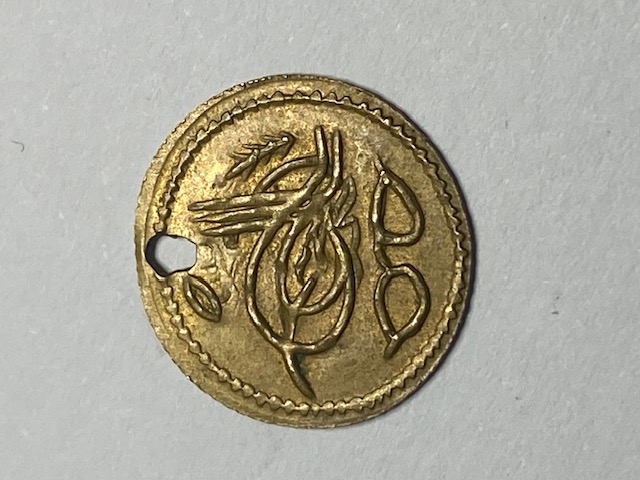
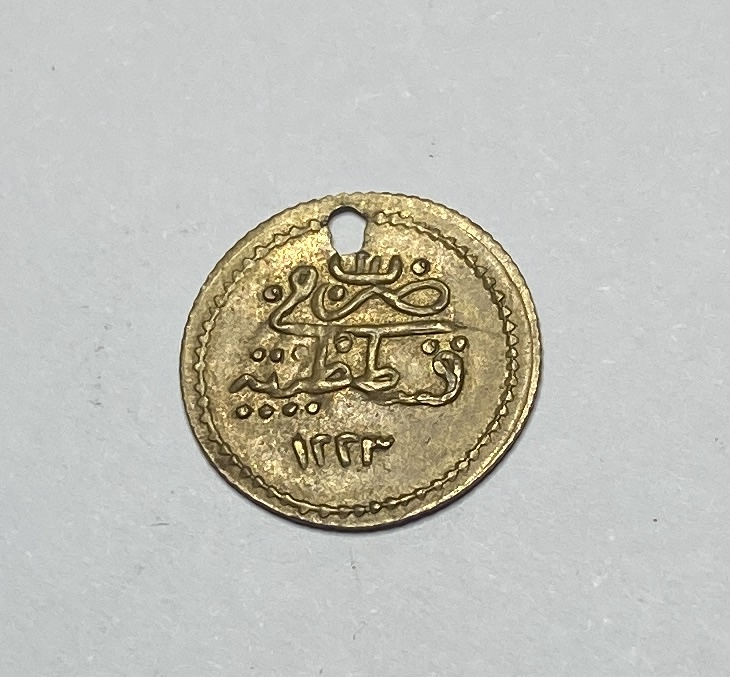
Unfortunately, I would agree - this is a "jewellery imitation", and not an actual coin.
It might still be gold, but these jewellery imitations almost always aren't made of gold - if they could have afforded real gold, they would have bought a real gold coin.
The date on your coin is Accession 1223 Regnal Year 11, which would convert to AD 1817. However, as an imitation, it almost certainly is not actually that old and it more likely dates from the 20th century. It is copying the design from the Zeri Mahbub series of gold coins, but the toughra in particular is very, very stylized - the toughra is the sultan's personal signature, and anyone doing such a sloppy job on reproducing it on an official coin from the Constantinople mint back in 1817 would have likely lost both their job and their head.
Using actual gold coins for jewellery has a long history in Turkey, going right back to Greek and Roman times. The thin gold and silver coins of the Ottoman Empire were particular favourites; it is rare to find genuine coins from this time period without hole punched in them for wearing as jewellery.
But for poorer women who couldn't afford to buy actual gold coins to accessorize their wedding dress or party outfit, replicas were (and still are) commonly used instead. The coins are designed to "look like coins at first glance", but not be realistic enough on close inspection to have the replica-maker charged with counterfeiting.
In the West, such jewellery imitations are sometimes called "belly dancer coins", though this is an oversimplification of what they were normally used for.
It might still be gold, but these jewellery imitations almost always aren't made of gold - if they could have afforded real gold, they would have bought a real gold coin.
The date on your coin is Accession 1223 Regnal Year 11, which would convert to AD 1817. However, as an imitation, it almost certainly is not actually that old and it more likely dates from the 20th century. It is copying the design from the Zeri Mahbub series of gold coins, but the toughra in particular is very, very stylized - the toughra is the sultan's personal signature, and anyone doing such a sloppy job on reproducing it on an official coin from the Constantinople mint back in 1817 would have likely lost both their job and their head.
Using actual gold coins for jewellery has a long history in Turkey, going right back to Greek and Roman times. The thin gold and silver coins of the Ottoman Empire were particular favourites; it is rare to find genuine coins from this time period without hole punched in them for wearing as jewellery.
But for poorer women who couldn't afford to buy actual gold coins to accessorize their wedding dress or party outfit, replicas were (and still are) commonly used instead. The coins are designed to "look like coins at first glance", but not be realistic enough on close inspection to have the replica-maker charged with counterfeiting.
In the West, such jewellery imitations are sometimes called "belly dancer coins", though this is an oversimplification of what they were normally used for.
Don't say "infinitely" when you mean "very"; otherwise, you'll have no word left when you want to talk about something really infinite. - C. S. Lewis


 to the Community!


