| Author |
 Replies: 28 / Views: 1,605 Replies: 28 / Views: 1,605 |
|
Pillar of the Community
 United States
5209 Posts |
At a recent auction I won a medal from 1866 commemorating the Estonian Song Festival. It is made from a Tin-Lead alloy and therefore relatively soft as metals go. As you can see in the photo below, there is a dark grey blob at 11 o'clock. What do you think it is? Can it be removed safely? There are a few more dark spots in the fields as well, both obverse and reverse. Would it make sense to ask for "conservation" by NGC or PCGS? 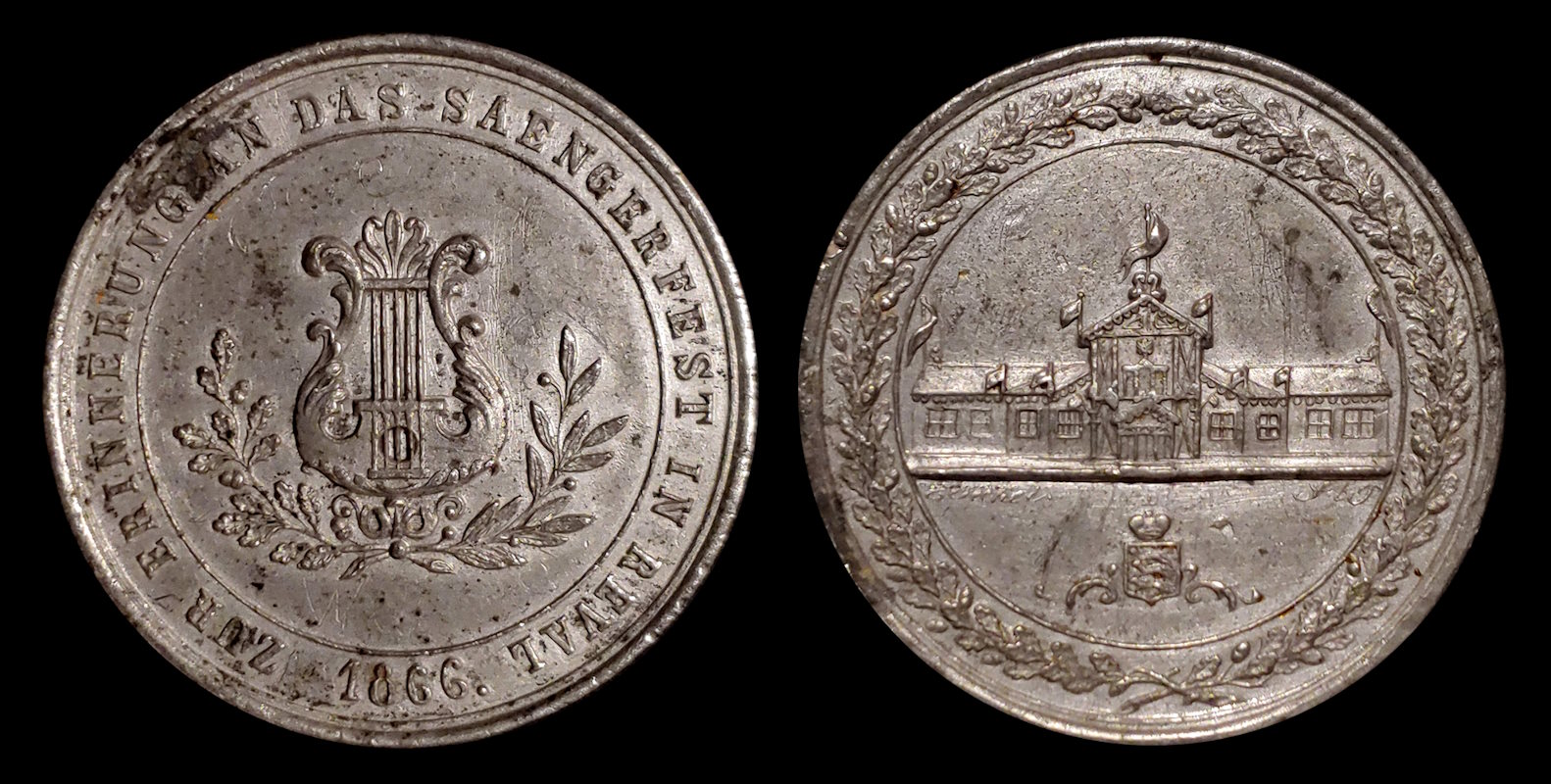 |
|
|
|
Bedrock of the Community
 United States
26164 Posts |
That's an unusual alloy, NumisEd. What does the "blob" look like under magnification - is it some type of tarnish or is it a foreign material on the medal?
Inordinately fascinated by bits of metal with strange markings and figures
Edited by HondoB
03/23/2024 04:01 am
|
|
Pillar of the Community
 United States
5209 Posts |
It is hard to see, even with a loupe, but I think the grey "blob" is foreign material on top of the field as it is slightly higher than the surface of the field itself.
|
|
Moderator
United States
191235 Posts |
Nice win!  I would be afraid to do much beyond distilled water then acetone. |
|
Pillar of the Community
United States
5209 Posts |
Quote:
I would be afraid to do much beyond distilled water then acetone. Agreed. I plan to send it to NGC for conservation. |
|
Moderator
United States
191235 Posts |
Quote:
I plan to send it to NGC for conservation. Good choice.  |
|
Moderator
Australia
16898 Posts |
"Tin-lead alloy" would be a kind of "lead pewter", and more broadly related to "white metal". White metal was a class of lead-tin-antimony alloys commonly used for making cheap but nice-looking medals back in the 1700s and 1800s, before aluminium became widely available. By 1900, aluminium had essentially replaced white metal for medal-making.
These alloys look nice and shiny when new, but after 100+ years they tend to start turning nasty, being prone to corroding. Which makes me think this may be corrosion, rather than adhered foreign matter.
Don't say "infinitely" when you mean "very"; otherwise, you'll have no word left when you want to talk about something really infinite. - C. S. Lewis
|
|
Pillar of the Community
United States
5209 Posts |
Quote:
Good choice. Package was noted as received by NGC today! I'm very curious what they will be able to do, if anything. |
|
Moderator
United States
191235 Posts |
Quote:
Package was noted as received by NGC today! I'm very curious what they will be able to do, if anything. Excellent!  |
|
Pillar of the Community
Portugal
695 Posts |
It is surely corrosion. I too am curious about how that restoration will go. Skeptical.
I always avoid medals in tin or lead. But there is one I really want and exists only in tin, with a single copper strike in a museum in Rome.
The research I made convinced me that there is no way to revert corrosion damage in these metals. They do not get back to any good shape without restoration. Going past conservation. That would be a no go for me.
Would be nice to see the spot on this one treated and not looking too bad.
|
|
Pillar of the Community
United States
5209 Posts |
Just called NGC to inquire about my submission, as the "status" hadn't changed from "received" for over a month.
I was informed that it could take up to 90 days to process my submission (conservation + grading)! Ugh ..
|
|
Moderator
United States
191235 Posts |
Oh my.  |
|
Moderator
United States
100400 Posts |
Well keep us informed I would like to see how this turns out for you..
|
|
Pillar of the Community
United States
5209 Posts |
Submission is now listed as "scheduled for grading".
No idea if the medal was conserved or not.
|
|
Moderator
United States
191235 Posts |
Quote:
Submission is now listed as "scheduled for grading". No idea if the medal was conserved or not.  |
|
Pillar of the Community
United States
5209 Posts |
Submission is now listed as "Grading/Encapsulation/Imaging".
Still, no idea if the medal was conserved or not.
|
| |
Replies: 28 / Views: 1,605 |






 Posted 03/23/2024 12:46 pm





