Here's the third/final of three brief posts about the 1928 Hawaiian (European) Discovery Sesquicentennial Half Dollar. I hope you enjoyed these "brief dips" into the history of the coin.I've discussed the obverse and reverse designs of the 1928 Hawaiian (European) Discovery Sesquicentennial Half Dollar in several previous posts; you can quickly access them here:
-
1928 Hawaiian (European) Discovery Sesquicentennial - Design Discussion.
This post supplements these others with a few more official details about the symbolism incorporated into the designs by Juliette May Fraser.
Note: In addition to preparing the designs for the Hawaiian Half Dollar, Juliette May Fraser also created designs for a pair of proposed commemorative postage stamps (2-cent and 5-cent) - the special stamps were not approved, however, so her designs were never used.As part of its
Final Report, the Captain Cook Sesquicentennial Commission included the following regarding the designs for the approved half dollar:
"Miss Fraser was also the creator of the design for the Captain Cook coin. The obverse bore a profile bust of Cook derived from a Wedgewood medallion owned by Commissioner Cartwright. (Refer to image below.) Under the bust were the years "1778-1928." Flanking the year numerals were four pyramided marks, or eight all told, these typifying the eight inhabited islands of the Hawaiian group. The reverse showed a Hawaiian chief in full ceremonial regalia of feather helmet and feather cloak, similar to the design shown on the bronze statue of Kamehameha I (the Great) in Honolulu, stepping up over summit of a cliff, and with hand extended as though in the act of making a welcoming gesture. The attitude symbolized the emergence of Hawaii from barbarism into civilization. Behind him was shown a coconut tree, denoting Romance. In the distance was shown a shore village of grass huts, nestled along Waikiki Beach, with Diamond Head in the background, denoting History and Antiquity.
"The acceptance of the design by the Treasury Department was a tribute to the importance of the event, and for Hawaii, for this was the only coin so far issued for an insular area of the United States. Miss Fraser's design was highly complimented by the Federal authorities for its originality and symbolisms."
When I first read these descriptions, I was pleased to see the reference to Kamehameha I for the design on the coin's reverse. I discussed this at length here:
Quick Bits #15 - The 1928 Hawaiian Chieftain, but did not have "official" support for my position at the time - now I do! (Uncovering details like this is one of the reasons why I never stop searching the history of the classic US commemorative coin series!)
The Commission appears to have chosen wisely with its selection of Juliette May Fraser as the designer of the coin, but design credit is also due to Chester Beach who created the coinage models from Fraser's drawings.
1928 Hawaiian (European) Discovery Sesquicentennial Half Dollar
 Wedgewood Medallion of Captain James Cook
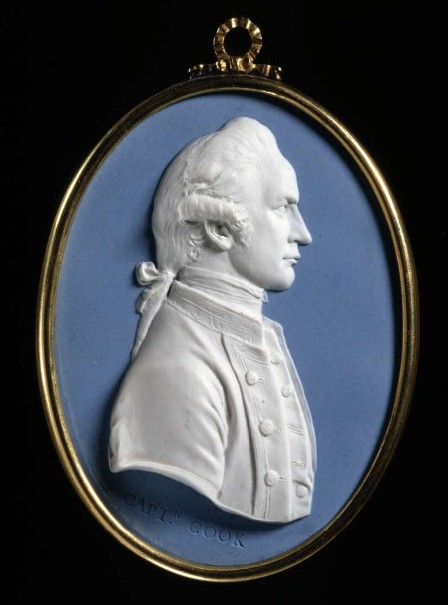 Image Credit: The British Museum, https://www.britishmuseum.org/colle...-0307-I-70_1
For other of my posts about commemorative coins and medals, including a number about the 1928 Hawaiian, see:
Commems Collection.







 Posted 05/06/2024 1:56 pm





