The significant majority of classic-era US commemorative coins were authorized after either an initial single bill or an initial pair of companion bills were introduced. Sometimes, however, it took multiple bill introductions to get a coin through to the approval stage.
I've written before about coins that were introduced and approved in two different Congresses (you can read it here:
Quick Bits #67 - Multi-Congress Commemorative Coins, but here I'm discussing coins whose initial attempts failed but perseverence ultimately won the day (and coin!).
1925 California Statehood 75th Anniversary & 1925 Ft. Vancouver Centennial Half DollarsThe extended sagas of these two coins are intertwined, so I thought it best to discuss them together.
In May 1924, Albert Johnson (R-WA) introduced a bill in the House of Representatives that called for "the coinage of 50-cent pieces in commemoration of the one hundredth anniversary of the founding of Fort Vancouver, State of Washington." Wesley Livsey Jones (R-WA) introduced a companion bill in the Senate, also in May 1924.
Neither bill was reported by the Committee to which it was referred.
In January 1925, a bill was introduced in the Senate by Samuel Morgan Shortridge (R-CA) that called for "the coinage of 50-cent pieces in commemoration of the seventy-fifth anniversary of the admission of the State of California into the Union."
The bill was approved in the Senate, but stalled in the House of Representatives.
Frank Lester Greene (R-VT) also introduced a coin bill in January 1925 - it called for "the coinage of gold $1 pieces and silver 50-cent pieces in commemoration of the one hundred and fiftieth anniversary of the Battle of Bennington and the independence of Vermont." The bill was the subject of a Senate Hearing, was amended to drop the gold coin and had its authorized silver half dollar mintage adjusted from 15,000 to 40,000 - but it moved toward passage! The amended bill passed the Senate then moved on to the House of Representatives.
It was in the House that perseverance paid off for the California and Fort Vancouver coin sponsors. John Edward Raker (D-CA) rose to request the California coin be amended to the Bennington-Vermont Independence coin bill. A challenge to the California coin amendment was raised by Albert Henry Vestal (R-IN) but the bill, as amended, was passed.
Sensing where the train was heading, Albert Johnson moved to jump on board and requested that the Fort Vancouver coin be added to the bill as well. Such was done and, in a matter of minutes, a single-coin bill became a triple-coin bill. The Senate concurred with the House Amendments and passed the bill. Subsequently, US President Calvin Coolidge signed the Bennington/Vermont Independence-California Statehood-Fort Vancouver bill into law on February 24, 1925.
1927 Battle of Bennington / Vermont Independence Sesquicentennial Half Dollar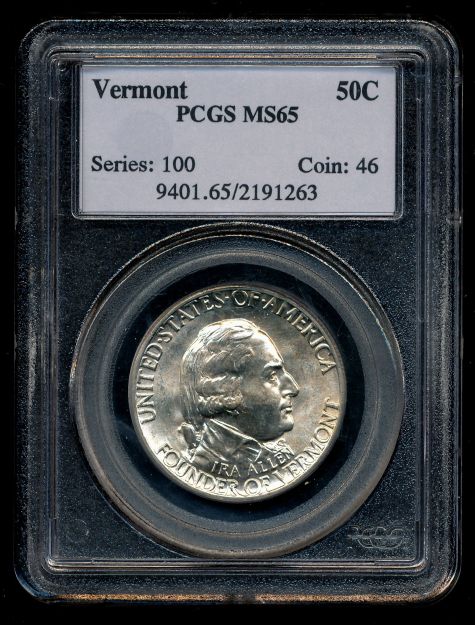
 1925 California Statehood 75th Anniversary Half Dollar
 1925 Fort Vancouver Centennial Half Dollar
 1936 Norfolk, VA Tricentennial/Bicentennial Half Dollar
The next example of perseverance involves only one commemorative coin sponsor, but presents a story of coin-to-medal-to-coin that took place in 1936 and 1937.
In May 1936, Colgate Whitehead Darden, Jr. (D-VA) introduced a bill that called for "the coinage of 50-cent pieces in commemoration of the three-hundredth anniversary of the original Norfolk (Virginia) land grant and the two-hundredth anniversary of the establishment of the city of Norfolk, Virginia, as a borough." Carter Glass (D-VA) introduced a companion bill in the Senate at the same time.
The bills were each referred to Committee, with the Senate bill moving forward. The Senate Committee on Banking and Currency reported the bill out with a recommendation to pass, but changed the call for a 50-cent piece to one for a medal. The Senate passed the medal bill, as did the House. US President Franklin Delano Roosevelt signed the bill into law on June 26, 1936.
The legislation's sponsor - The Norfolk Advertising Board - was not excited by the medal, however, and did not push for the medal to be struck by the US Mint even though it was getting late in the anniversary year.
When the new Congress (the 75th) convened in January 1937, Senator Glass re-introduced his Norfolk coin bill, at the Norfolk Advertising Board's urging, even though the anniversary year had passed.
This time, the coin bill was passed by both chambers and was signed into law by US President Roosevelt on June 29, 1937 (just over one year after the medal bill had become law). This time, the Advertising Board moved forward and the 1936 Norfolk, VA Tricentennial/Bicentennial Half Dollar was struck by the US Mint. (Note: The 1936 date on the coin was specified in its Act.) Once again, persistence paid off - the sponsor got its coin!
1936 Norfolk, VA Tricentennial/Bicentennial Half Dollar

Sometimes, you don't have to take "No!" for an answer!




 Posted 08/11/2024 3:42 pm





