For a bit of Background on Eisenhower, see Part I - Background. This part of the coin's story is fairly long as its legislation followed an atypical process.The 1990 Dwight David Eisenhower Birth Centennial Silver Dollar began its path to authorization with a pair of bills introduced in the House (November 1987) and the Senate (December 1987). The House bill, introduced by William F. Goodling (R-PA), was referred to the House Committee on Banking, Finance and Urban Affairs, with a subsequent referral to its Subcommittee on Consumer Affairs and Coinage. The Senate bill, introduced by John Heinz (R-PA), was referred to the Senate Committee on Banking. The Senate bill stalled.
Goodling worked diligently over the summer of 1998 to bring on co-sponsors to his bill to the level where the House Subcommittee on Consumer Affairs and Coinage would call a Hearing on the bill. While Goodling's bill was introduced with 22 co-sponsors, a total of 218 was needed for the Subcommittee to act.
While Goodling was building his co-sponsor list, Senator Robert Joseph "Bob" Dole (R-KS) was attempting to secure the Eisenhower coin via an amendment to a bill that called for the 1989 US Congressional Bicentennial coins. The amendment called for the striking of up to 10 million (!) Eisenhower Silver Dollars. The coins were to have a surcharge of $9 per coin and the collected surcharges were to be deposited in the General Fund of the US Treasury to reduce the US Federal debt.
The amendment called for an obverse design of a "likeness of Dwight David Eisenhower" and a reverse design of "an illustration of the home of Dwight David Eisenhower located in the Gettysburg National Historic Site." These design specifications were carried through in subsequent bills.
Eisenhower Home, Cumberland Township, Pennsylvania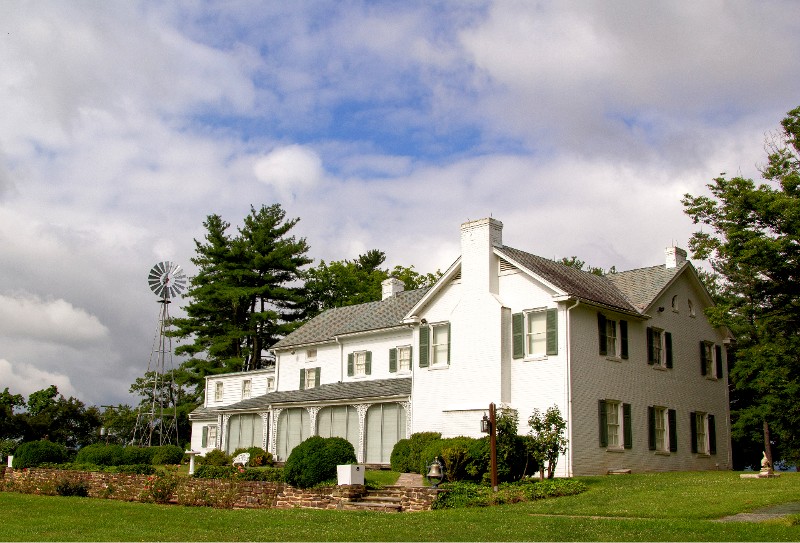 (Image Credit: National Park Service. Public Domain.)
The amendment was agreed to in the Senate without objection. When the amended bill was considered in the House of Representatives, the amendment was not agreed to - due to inadequate technical review and no Hearing - and the Congress Bicentennial bill moved forward without the Eisenhower coin included.
Goodling's efforts paid off, and, with the help of others, the House Subcommittee threshold was met and even exceeded - Goodling secured 251 co-sponsors. With that, the Subcommittee called a Hearing on the coin bill.
The Hearing was held in September 1988, and was effectively a tribute-to-Eisenhower session, with Committee Chairman Frank Annunzio (D-IL), Senator Dole, and Representatives Goodling and Charles Patrick "Pat" Roberts (R-KS) all offering unbridled praise for Dwight Eisenhower and his years of public service; a supportive written statement by Susan Eisenhower - granddaughter of Dwight Eisenhower, President of the Eisenhower Group, Inc., Director of the Eisenhower World Affairs Institute and member of the Dwight D. Eisenhower Centennial Commission - was also included as part of the Hearing's record.
US Mint Director, Donna Pope, was present to provide testimony regarding the actual marketing and production of the coins - she framed her comments with "at some point, someone had to talk about some of the realistic issues..."
On the production side, Ms. Pope recommended:
1) the proposed maximum mintage of 10 million coins be reduced to 4 million to more closely align with the Mint's sales forecast of approximately 3 million coins and to help positively support sales vs. the negative collector reaction that would greet a 10 million coin potential mintage;
2) a reduction in the coin's surcharge from the proposed $9 per coin to $7 per coin using previous commemorative Silver Dollars as a guide; and
3) remove the requirement that only one Mint facility be used to strike all of the coins (Proof and Uncirculated). Pope stated that while the Philadelphia Mint was in the process of bringing Proof coin production in house, it was not yet ready and that the San Francisco facility would be a better choice for Proof coin production.
Pope also commented that, as the proposed program did not include a gold coin, the marketing campaign could not have as large a marketing budget as a program with a gold coin. She outlined a campaign that would be directed at the numismatic community - the group that would likely purchase the majority of coins available. Such a focused program would be supplemented, however, with limited print-based advertising to appeal to the broad, overall potential market.
Pope's recommendations were accepted/approved by the Subcommittee and were incorporated in an amended bill. In an interesting turn, the original Goodling bill was passed by the House, then Annunzio offered an amendment, in the form of a substitution, that included the Mint's recommendations; this substitute bill was quickly passed. Then, Annunzio again rose to ask unanimous consent that the newly-passed House bill be set aside and the new, already-passed Senate bill, that also incorporated the Mint's recommendations, be passed in lieu of the House bill. The Senate bill was passed without objection in the House and its bill was laid on the table (i.e., put aside).
Note: Senator Dole introduced a bill in the Senate, the same day as the House Subcommittee Hearing (immediately following it). Dole's bill was quickly passed without objection and was in place when the House considered its amended bill two days later.With the Senate bill passed by both chambers, all that was left was for each chamber to examine and sign the final bill and present it to the President for approval. US President Ronald Reagan signed the bill into law on October 3, 1988.
The coin's obverse presents the dual dates "1890" and "1990" below the conjoined portraits of Eisenhower (one wearing the hat of a military uniform, the other in professional attire befitting a President). The dates represent Eisenhower's birth year (1890) and its centennial anniversary (1990).
The coin's reverse presents Eisenhower's Cumberland Township home (near Gettysburg), Pennsylvania, which is now part of the Eisenhower Gettysburg National Historical Site. Eisenhower, and his wifie Mamie, purchased the home and surrounding farm after World War II. Eisenhower originally planned on retiring at the home after the War, but was called to Europe to serve as Supreme Commander of NATO forces and then served two terms as US President. After his second term as President was completed in 1961, Dwight and Mamie retired to Pennsylvania and lived out the rest of their lives on the farm; Dwight died in 1969, Mamie in 1979.
1990 Dwight D. Eisenhower Birth Centennial Silver Dollar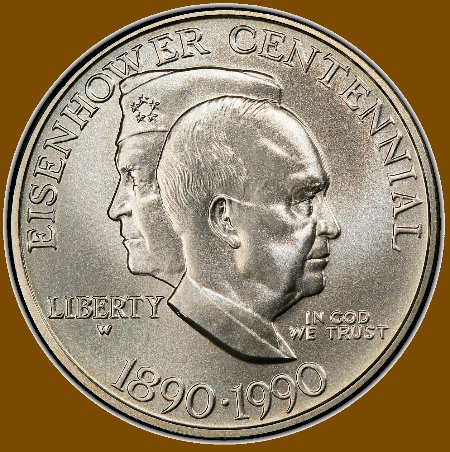
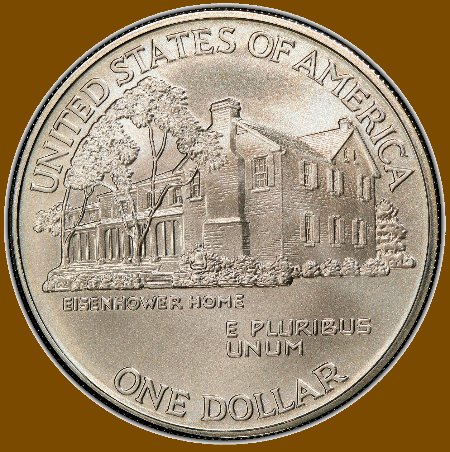
(It's likely we'll see images of the proof version of this Silver Dollar before too long if a certain IKE fan stops by.

My preference is for Unirculated commemorative coins.)
The Silver Dollar was available in Proof and Uncirculated versions. The Proof version had individual sales of 638,335 units, plus an additional 506,126 examples included in the 1990 Prestige Proof Set. The Pre-Issue price for the individual coin was $25; the Regular Issue price was $29. The 1990 Prestige Proof Set was issued at $45.
The Uncirculated version of the Silver Dollar had sales totaling 241,669 coins; only individual coins were offered. The Pre-Issue price for the coin was $23; the Regular Issue price was $26.
Though total sales did not approach 4 million coins - or even the Mint's initial forecast of ~3 million - the fact that total sales did reach almost 1.4 million is fairly impressive IMO.
For more of my stories about commemorative coins and medals, including more from the Modern US seies, see:
Commems Collection.







 Posted 09/16/2024 01:03 am





