| Author |
 Replies: 15 / Views: 3,704 Replies: 15 / Views: 3,704 |
|
|
Pillar of the Community
United States
4589 Posts |
|
|
|
|
Pillar Of The Community
Turkey
1205 Posts |
This is an Ottoman indeed:)
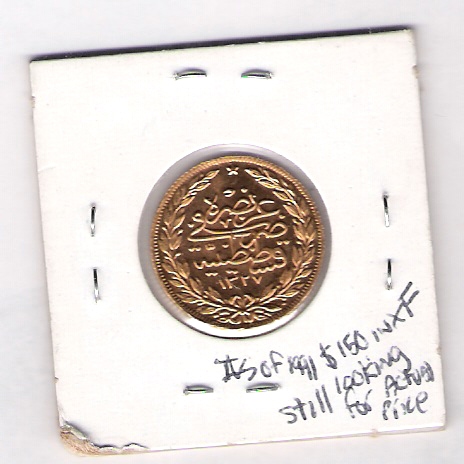
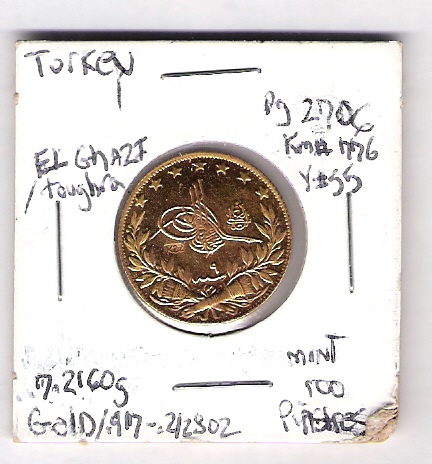
100 Kurus, Minted in 1327/9 AH (1917 - 1918 AD) Sultan Mehmet Resad reign.
The dates on the Ottoman coins are slightly different than others. Such as; there's the date that the Sultan is accessed to the throne. (in this case 1327 AH) and on the other side that the Tughra-seal is, the date after that year is written (in this case 9). So in order to get the year of mintage, one should add these two dates. (and convert to AD :) 1336 AH =1917 or 1918 depending on the month of 1336.
I can not say for sure that it is Constantinople. Constantinople is Istanbul:)
There are coins that say "Konstantiniye" on them, but according to an Ottoman coin site here, it is a city in Algeria - Konstantine. The calliography seems as this coin is Konstantiniye mintage.
Turks didn't refer to Istanbul as Constantinople, only foreigners did:)
By the way, this coin is sold at 215 YTL nowadays app. 165 USD.
Jim, I noticed some kind of a mark on the left of the Tughra, like K22? did someone grade its purity?
|
|
Pillar of the Community
 United States
4589 Posts |
that mark is there, I am not sure if somebody seperate than the turkish mint garded it or what it does look like it was minted that way and thanks for the info . have written on the 2x2 from when I tried to atrribute it El Ghazi (toughra) what does that mean again
|
|
Pillar Of The Community
Turkey
1205 Posts |
"El Ghazi" is the small calliographic figure to the right. meaning the person who fights on behalf of Islam, but in modern Turkish, gazi means war veteran. The Tughra is the big figure to the center. reads as "Mehmed Han bin Abdulmecid, victorious forever, Resad" the Tughra is a very intricate sign, different for every Sultan. http://www.tugra.org/okunus/pages/35.htmhttp://www.tugra.org/en/okunuslar.aspI am pretty sure that the sign like K22 is not an original mark, post mintage thing. they didn't use latin letters or numbers then:) Edited by RenaL
04/05/2006 4:30 pm
|
|
Moderator
 Australia
16982 Posts |
quote:
Originally posted by RenaL
I can not say for sure that it is Constantinople. Constantinople is Istanbul:)
There are coins that say "Konstantiniye" on them, but according to an Ottoman coin site here, it is a city in Algeria - Konstantine. The calliography seems as this coin is Konstantiniye mintage.
Turks didn't refer to Istanbul as Constantinople, only foreigners did:)
I hate to contradict a local,  but the Ottoman Empire did indeed have "Constantinople", in Arabic, on their coins minted there. The "Guide to Eastern Mint Names" in the front pages of Krause show both cities mentioned. Constantine (Algeria) is transliterated as "Qusantinat". Constantinople/Istanbul is "Qustantiniyah". Remember, that's Arabic on the Ottoman coins, not Turkish. According to the 19th century Krause, the Constantine (Algeria) mint only seems to have operated briefly in the 1830's, and their products are much cruder than this. As to the "K22" mark, sounds like it's a jewellers mark. The key issue here is whether it's punched into the coin (incuse) or raised up like the rest of the lettering. If it's punched in, it's just "damage" which may add interest to the coin - akin to an asian "chop mark" on silver dollars. If it's raised up, then I'm afraid the entire coin may be a "jeweller's copy", and not genuine (though it would still be made of gold). Don't say "infinitely" when you mean "very"; otherwise, you'll have no word left when you want to talk about something really infinite. - C. S. Lewis
|
|
Pillar Of The Community
Turkey
1205 Posts |
You may have a point Sap, I'm no expert on Ottoman coins and I cant read arabic, I just mentioned the info I found on a webpage. But I always thought that Constantinople is Greek name for the city and not liked by Turks. interesting that it's on the coins. Now I checked a little deeper; I am mistaken indeed; along with Istanbul  also Konstantiniye-Constantinople  is used as mintmarks Kostaniye-Algerian one is like this  |
|
Forum Kid
Kuwait
1523 Posts |
Wow! Sweet coin!
Turkish did sure have Constantinople on it!
I learnt it in History!
|
|
Pillar Of The Community
Turkey
1205 Posts |
I must have skipped that class  |
|
Pillar of the Community
United States
4589 Posts |
yes the K22 is incuse and I may not be correct but I thought for sure it was a constaninople mint But I could easily be wrong. I brought this back from Iraq along with some others with me. you can get really good buys there, if you find a local vender you can trust
|
|
Pillar of the Community
United States
4589 Posts |
thank you everyone for all your hard work in helping me figure it out
|
|
Pillar of the Community
United States
4589 Posts |
do you know if they made this one in proof it sure looks proof or proof like
|
|
Pillar Of The Community
Turkey
1205 Posts |
Well, back in that time, I don't think they used to do such things.
Mine is just a guess though.
|
|
Pillar of the Community
United States
5362 Posts |
Jim - I am looking at your other coin posts and have a question on this Ottoman gold coin. The stamp (puncheon) with the K22 strikes me as a test mark indicating the coin was proofed for metal content. This is often done for bullion restrikes. There is a whole series of "unofficial" restrikes of gold coins made in the 1960s and 1970s to allow gold to enter the US markets legally. In 1960, it was not legal for US citizens to buy raw gold or coins dated after 1933 so enterprising individuals overseas made copies of older common gold coins in high grade gold (22K) so that the metal could be imported as coins. As long as bullion prices are paid everyone was kept whole, so few people objected. However, when dealing with a numismatic item it is important to sort out these restrikes.
Some restrikes were "proof marked" on the die. This results in no distortion of the other side of the coin by the punch. Does your coin show distortion on the side exactly opposite the punch?
|
|
Pillar of the Community
United States
4589 Posts |
I really dont believe so , this coin was not imported in to america though, I brought it back ,from iraq I purchased it from a Tukoman(Turkish Decendant left in Iraq from times of the ottoman empire) my self but what you say is quite possible and might be true , thank you for your knowledge on the matter, now I have heard that jewelers might have but the mark on it after testing its purity.. If I had a scale we could check weight
|
|
Pillar of the Community
United States
5362 Posts |
Jim - the majority of the bullion restrikes I am familiar with were made in Lebanon. The dies are usually great. They are still turning up in the bazaars in the Middle East. I have a good friend who travels to the Middle East three times a year on buying trips - two years ago he brought back 13 identical coins of the type I am describing. He bought them at melt but none was real. They were all from 1913 (supposedly). I believe he got them at a market in Haifa. But he has gotten other nice restrikes in Turkey and Egypt as well. He was only fooled once. One batch was gold plated copper - those were English Sovereigns all with the Australian mint marks.
|
|
Pillar of the Community
United States
4589 Posts |
Oh No I beleive you , Believe me I can tell you are WAy more knowledgeable on that stuff more than anyone I know , well maybe its all gold atleast I hope Didnt pay a whole lot but a fair price
|
| |
Replies: 15 / Views: 3,704 |
|










 coinanccient ottoman r 001.jpg
 coinanccient ottoman o.jpg

 Posted 04/05/2006 4:07 pm


