The 1893 Queen Isabella Quarter Dollar of the World's Columbian Exposition is inextricably linked to the Board of Lady Managers ("Board"). The coin was conceived by the Board, sponsored in Congress by the Board, distributed by the Board and, ultimately, liquidated by the Board. It seems like the Board deserves a closer (but condensed) look...
As the 400th Anniversary (1892) of Christopher Columbus' voyages to the New World approached - and before Chicago was awarded the World's Columbian Exposition - two different women's groups formed in Chicago: The Queen Isabella Association ("Association") and The Chicago Women's Auxiliary ("Auxiliary").
The group's had differing missions. The Association formed in August 1889 with two primary objectives: 1) Construct a large meeting hall / pavilion for women, and 2) erect a statue dedicated to Queen Isabella of Castile (Spain). This was followed in October 1889 by the establishment of the Auxiliary. The Auxiliary's primary objectives were to: 1) Assist Chicago businessmen with the sale of shares in the Chicago Fair corporation, 2) construct a Women's Building and 3) engage in philanthropic activities.
While both groups supported women's rights / equality between men and women, the groups differed in their general philosophy. The Association favored a mission focused on advancing equal rights for women, including support of women's suffrage. The Auxiliary, on the other hand, wished to focus on philanthropic endeavors to support its causes. The differences came to the forefront when Chicago was awarded the World's Columbian Exposition in April of 1890 - the differing views of the two groups led to some pointed debates regarding the involvement of women in the management of the Columbian Exposition.
The two groups battled for recognition by the Exposition's all-male National Commission; the Commission was established by the US Congress and approved by President Benjamin Harrison in April 1890 (when Chicago was awarded the Exposition). The Act also established the Board of Lady Managers and specified that its members were to be appointed by the National Commission.
Though both groups had roots in Chicago, the Association looked to become a national organization and set up chapters in cities such as New York, St. Louis and Washington, DC to help accomplish this goal, while the Auxiliary looked to keep its focus on Chicago.
In the ensuing months, the two women's organizations aggressively lobbied for their positions and sought appointment of their members to the Board. Though both groups did receive appointments, the Auxiliary received more - Bertha Palmer and the Auxiliary secured the upper hand. As a result, the Association was left in a weakened position regarding the Exposition and the Board.
Dealing with the hand it was dealt, the Association continued working on its plan, including its Isabella statue. It commissioned noted sculptor Harriet Hosmer for the task and began raising the needed funds via private donations. (Note: The statue was not to be funded with proceeds from coin sales.)
In addition, the Association requested space on the Exposition grounds to build a small pavilion and erect its planned statue. The Association was directed by the various Exposition committees it approached to make its request to the Board of Lady Managers. The Board was not then in session, however. As a result, "Association Adversary #1" - Bertha Palmer, president of the Board of Lady Managers - would have had the authority to independently make a decision on the request. The Association sensed this would not result in a favorable decision, so it did not formally make its request to the Board/Palmer.
Instead, the Association arranged to place the statue outside of the Exposition's California Building. When the statue was complete, however, the Association found that it did not have the necessary funds ($25,000) to complete the purchase of it. An offer to purchase the statue - by Bertha Palmer - for display in the Women's Building at the Exposition was rejected.
The statue at the Exposition was only a temporary plaster model; funds to create a permanent version in cast bronze, marble or granite (for example) could not be raised. (My understanding is, if the statue still exists today, its location is unknown. If anyone knows differently, I would enjoy hearing about it.)
Statue of Queen Isabella at the World's Columbian Exposition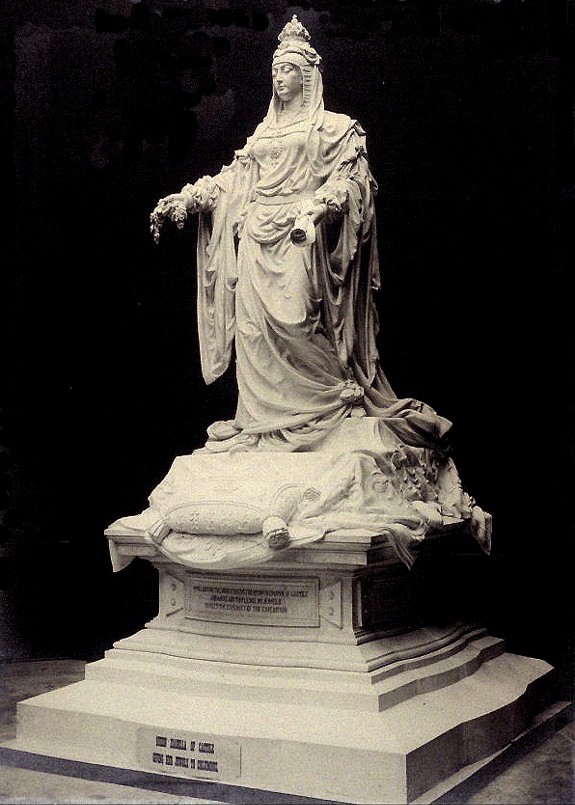 (Image Credit: Public Domain.)
The story of the Board of Lady Managers for the World's Columbian Exposition is a long and fascinating one that is beyond the scope here, but suffice it to say - the Board was not without its struggles and controversies.
1893 Isabella Quarter - World's Columbian Exposition

For more of my topics on commemorative coins and medals, including other
Isabella Quarter stories, see:
Commems Collection.







 Posted 11/06/2024 8:03 pm


