Coin Community Family of Web Sites Join Thousands of Coin, Bullion, & Money Collectors
Join Thousands of Coin, Bullion, & Money Collectors Vancouvers #1 Coin and Paper Money Dealer Specializing in Modern Numismatics Coin, Banknote and Medal Collectors's Online Mall 300,000 items to help build your collection! Shop for APMEX Bullion on eBay!Royal Canadian Mint products, Canadian, Polish, American, and world coins and banknotes.


Username:
Password:
Save Password
Forgot your Password?


This page may contain links that result in small commissions to keep this free site up and running.

Welcome Guest! Registering and/or logging in will remove the anchor (bottom) ads. It's Free!

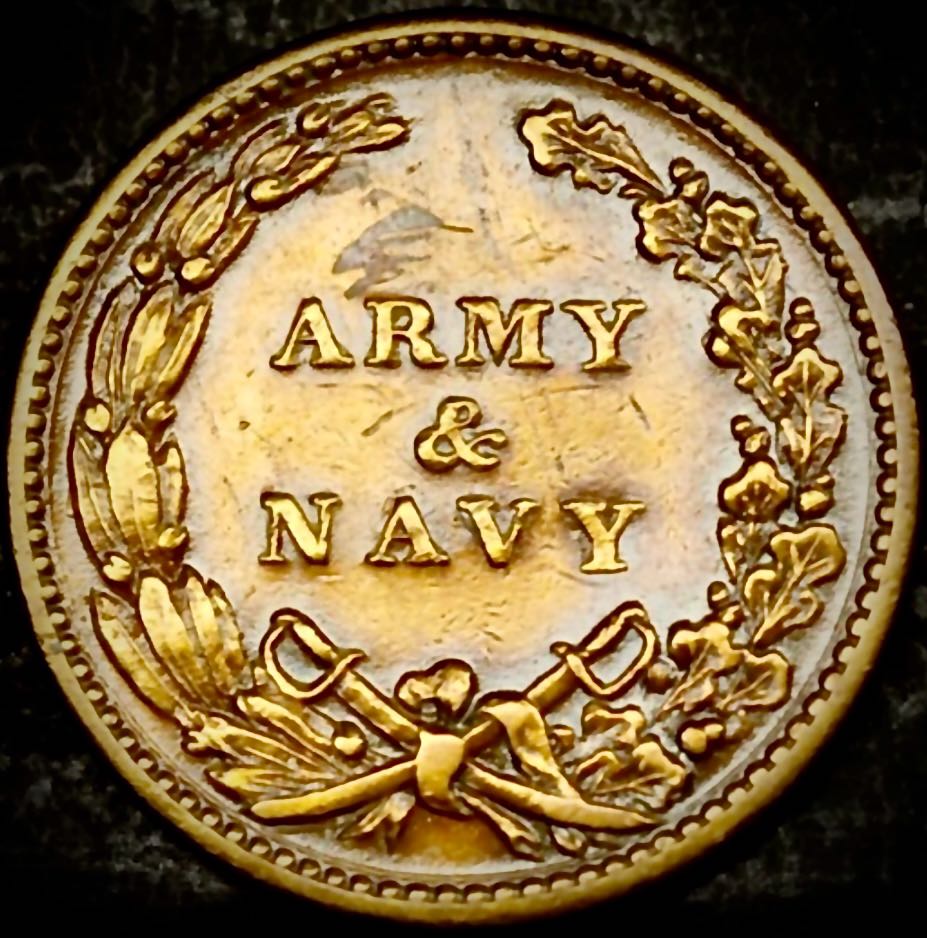
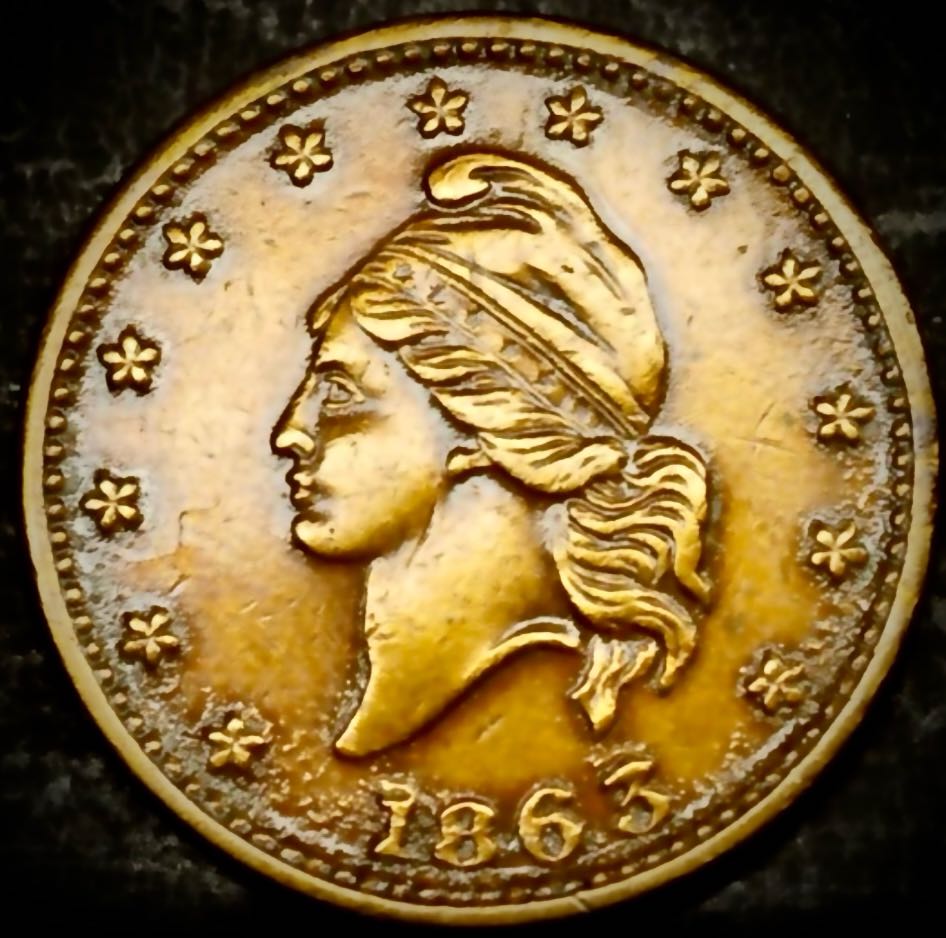
1863 Army & Navy Coin (Civil War Token?)

To participate in the forum you must log in or register.
Author Previous TopicReplies: 7 / Views: 1,173Next Topic  
Valued Member
TeeEss86's Avatar
United States
181 Posts
 Posted 02/16/2025  8:30 pm Show Profile   Bookmark this topic Add TeeEss86 to your friends list Get a Link to this Message Number of Subscribers
Greetings! Hopefully, I am posting this in the correct place I believe that I am, but if not, I'm sure I will be swiftly corrected. I came across this coin in one of the binders in the collection that I inherited from my grandfather that I am currently working my way through still. It does not have anything on it to suggest that it is any type of federal currency from the US treasury and from what I can best gather it is called a civil war token? If anybody could give me a little more information about this, it would be greatly appreciated! As always, thank you
1863-Army-&-Navy-Coin-Civil-War-Token?
Pillar of the Community
mrwhatisit's Avatar
United States
2954 Posts
 Posted 02/16/2025  8:42 pm  Show Profile   Bookmark this reply Add mrwhatisit to your friends list Get a Link to this Reply
Yes, this is for sure a patriotic Civil War Token. These were issued by numerous private issuers beginning roughly in 1862 through mid-1864 all due to the fact that our country did not have enough small change for everyday transactions. So tokens like yours were basically treated like a cent value in everyday commerce until the United States government cracked down in the middle of 1864 and pretty much put a stop to civil war token production, coupled with a glut of more than 50 million cents minted and issued in 1864.

Your example to my eyes appears About Uncirculated (AU) details cleaned which is unfortunate but still probably carries some $5-$20ish in value to some collectors.
Edited by mrwhatisit
02/16/2025 8:46 pm
Moderator
Learn More...
Spence's Avatar
United States
34402 Posts
 Posted 02/16/2025  8:59 pm  Show Profile   Bookmark this reply Add Spence to your friends list Get a Link to this Reply

Quote:
I am posting this in the correct place I believe that I am, but if not, I'm sure I will be swiftly corrected


Swiftly correctly, but gently so (hopefully). This is a perfect spot for this thread. Thx for sharing. That layer of lacquer is super-thick on this one and partially obscures what looks like re-punching to me in the date.

Added: you didn't give us the weight or diameter, but it might be a match for this one on numista:

https://en.numista.com/catalogue/pieces119450.html
"If you climb a good tree, you get a push."
-----Ghanaian proverb

"The danger we all now face is distinguishing between what is authentic and what is performed."
-----King Adz
Valued Member
TeeEss86's Avatar
United States
181 Posts
 Posted 02/16/2025  9:08 pm  Show Profile   Bookmark this reply Add TeeEss86 to your friends list Get a Link to this Reply

Quote:
Swiftly correctly, but gently so (hopefully). This is a perfect spot for this thread. Thx for sharing. That layer of lacquer is super-thick on this one and partially obscures what looks like re-punching to me in the date.

Added: you didn't give us the weight or diameter, but it might be a match for this one on numista

Thanks for the kind reply Spence. let me go ahead and measure and weigh it and I will post another reply ASAP.
Bedrock of the Community
Errers and Varietys's Avatar
United States
74044 Posts
 Posted 02/16/2025  9:41 pm  Show Profile   Bookmark this reply Add Errers and Varietys to your friends list Get a Link to this Reply
Nice Civil War Token.

If you want to get rid of that lacquer, try giving it a few soaks in 100% pure acetone.
Errers and Varietys.
Valued Member
TeeEss86's Avatar
United States
181 Posts
 Posted 02/16/2025  9:45 pm  Show Profile   Bookmark this reply Add TeeEss86 to your friends list Get a Link to this Reply
Thanks Errers and Varietys! I have a bunch of Indian head pennies with the same stuff on them. It seems, would that be something that would make sense?
Bedrock of the Community
Errers and Varietys's Avatar
United States
74044 Posts
 Posted 02/16/2025  9:55 pm  Show Profile   Bookmark this reply Add Errers and Varietys to your friends list Get a Link to this Reply

Quote:
Thanks Errers and Varietys! I have a bunch of Indian head pennies with the same stuff on them. It seems, would that be something that would make sense?


You're welcome.

The coins that have lacquer on them, was used to protect them. It was a common practice from many years ago for people to do that. It helped protect coins from damage, corrosion, etc.

Here's a link you might find helpful. See BadThad's comment on acetone soaks. http://goccf.com/t/57008#447106

From BadThad's reply.


Quote:
THE FIRST STEPS OF CONSERVATION

ALWAYS be aware that sometimes organic residues can be green and mistaken for verdigris. Just because a coin surface contaminate is green doesn't necessarily mean it is verdigris. Coins can be exposed to anything and everything during their existence. That green spot could be a very old piece of gum. For this reason it is recommended to first try what I call the solvent POLARITY LADDER shown below:

Wannabe Geek Note: Polar means a chemical has a negative charge on one end and a positive charge on the other end.

Very Important Note: Only use glass containers with a tight fitting lid for soaking coins.

TABLE 3: The coin solvent Polarity Ladder.

SOLVENT POLARITY
Deionized or Distilled Water Polar
Acetone Less polar than water
Xylene or Hexane Non-polar


STEP 1: WATER

Water will remove many polar surface contaminants. On the Polarity Ladder we start with the absolutely safest coin solvent in the world. As long as soak times are kept reasonable, probably less than 7 days, distilled water will not damage a copper coin. When water soaking, be sure to change out the water at frequent intervals. The more frequent the water changes, the better. Remember, the water is dissolving unwanted contaminants so it becomes contaminated. Each time you change it you're throwing away the bad stuff. Always use distilled or deionized water for soaking. Unpurified water or tap water contains contaminants that may deposit on the coin defeating the conservation attempt.

STEP 2: ACETONE

Acetone chemically, OC(CH3)2 , is a very polar, organic, volatile solvent. High grade acetone can be purchased at most hardware stores. It can also be ordered over the internet in a higher grade like ACS (American Chemical Society) but at a much higher cost. It will remove many organic materials from the coin surface.

Warnings: Do not soak in directly sunlight and store your acetone away from sun. UV light can degrade acetone and produce some chemicals that might be hazardous to your coin. Never allow the acetone to evaporate while the coin is soaking or everything that was dissolved will simply be redeposited on the surface. Use high quality acetone only! DO NOT USE NAIL POLISH REMOVER! Acetone will dissolve plastics and styrofoam so only use a glass container with a tight sealing lid when soaking in acetone. Acetone is flammable; keep open flames away from it. Be sure to read the label and MSDS so you understand the hazards of working with this organic solvent.

A good test to perform before using acetone on a coin is to place some in a glass dish and allow it to evaporate. Inspect the bottom of the dish once it's gone and make sure there's no residue, haziness or sticky film. Any acetone that fails this test is impure and should not be used on a coin.


STEP 3: XYLENE

Xylene is what we call a non-polar solvent and it's completely safe on copper. It's important to use a non-polar solvent because it's the only thing that will dissolve some organic residue. If the surface debris is non-polar, chances are that xylene will be able to dissolve it. Remember "like dissolves like"! Do not over-soak in xylene or you may affect the patina, it can lighten a brown patina with enough time.

That is the process of stepping through various coin safe solvents before attempting conservation. If the green is removed, then it was most likely organic (carbon containing) in nature.


Errers and Varietys.
Edited by Errers and Varietys
02/16/2025 10:00 pm

Moderator
Learn More...
jbuck's Avatar
United States
188213 Posts
  Previous TopicReplies: 7 / Views: 1,173Next Topic  

To participate in the forum you must log in or register.


Disclaimer: While a tremendous amount of effort goes into ensuring the accuracy of the information contained in this site, Coin Community assumes no liability for errors. Copyright 2005 - 2026 Coin Community Family- all rights reserved worldwide. Use of any images or content on this website without prior written permission of Coin Community or the original lender is strictly prohibited.
Contact Us  |  Advertise Here  |  Privacy Policy / Terms of Use

Coin Community Forum © 2005 - 2026 Coin Community Forums
It took 0.36 seconds to rattle this change. Forums