Ferdinand II (July 9, 1578 - February 15, 1637), of the House of Habsburg, Holy Roman Emperor (1619-1637), King of Bohemia (1617-1619, 1620-1637), King of Hungary (1618-1625). A devout and very pious Catholic, his recognition as King of Bohemia and suppression of Protestantism precipitated the early events of the Thirty Years War, and he remained one of the staunchest backers of the Anti-Protestant Counter Reformation efforts as one of the heads of the German Catholic League, prolonging the Thirty Years' Wars by insisting the Edict of Restitution be enforced. The duration of his reign was occupied by confessional and military concerns, and some historians blame him for the large civilian loss of life in the Sack of Magdeburg in 1631, as he'd instructed Count Tilly to enforce the edict upon Saxony—his orders causing Tilly to move the Catholic armies east, ultimately to Leipzig, where they suffered their first substantial defeat at First Breitenfeld.
My new Ferdinand II Taler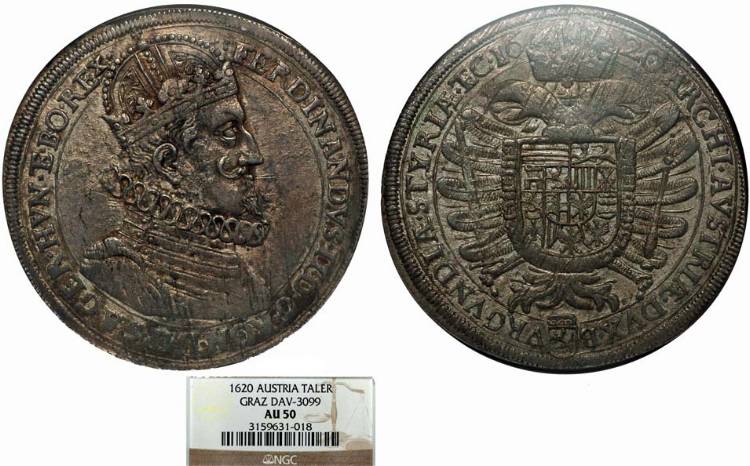 Early years
 Born in Graz to Charles II of Austria (1540-1590) and Maria Anna of Bavaria (1551-1608), Ferdinand was provided with a strict Jesuit education culminating in his years at the University of Ingolstadt. After completing his studies in 1595, he acceded to his hereditary lands (where his older cousin Archduke Maximilian III of Austria had acted as his regent 1593-95) and made a pilgrimage to Loreto and Rome. Shortly afterwards, he began to suppress the practice of non-Catholic faiths within his territory.
King of Bohemia In 1617, Ferdinand was elected King of Bohemia by the Bohemian Diet. He also secured support from the Spanish Habsburgs for his claim to succeed the childless Emperor Matthias on the throne, granting them future rule over Alsace and Imperial fiefs in Italy. Ferdinand's staunch Catholicism led to infringements on the religious freedoms of non-Catholics. Among other things, the king did not respect the religious freedoms granted in the "Majestät" (or "Majestic Letter") signed by the earlier emperor Rudolf II to end the Brothers' War, which had granted freedom of worship to nobles and the inhabitants of cities. Additionally, Ferdinand was an absolutist and infringed upon what nobles regarded as secular rights. Given the relatively large number of Protestants within the kingdom, including many among the noble classes, the new king soon became unpopular and some dissidents participated in the ensuing Bohemian Revolt. On May 22, 1618, two royal (Catholic) officials in Prague were thrown out a castle window by Bohemian Protestants (the Defenestration of Prague). Though the officials were uninjured, such actions did not fall within the realm of standard protocol, and the clear offense against the royal dignity led to a hardening of attitudes and full rebellion.
This is Emperor Ferdinand II and his Court Midget: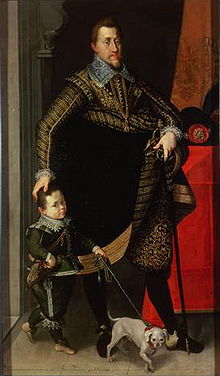
The nobility revolted against Ferdinand and replaced him with the Protestant Elector Frederick V of the Palatinate, known as the "Winter King."
Holy Roman Emperor Emperor Matthias died in Vienna in March 1619. As earlier agreed, Ferdinand succeeded him on the throne. Supported by the Catholic League, which included the rulers of Poland, Spain, and Bavaria, Ferdinand sought to reclaim his Bohemian possessions and stamp out the Protestant rebellion. On November 8, 1620, Catholic forces engaged those supporting the Protestant Frederick, who had taken the Bohemian kingship, at the Battle of White Mountain. After only two hours of fighting, the Catholics emerged victorious. The now-deposed Frederick fled to the Netherlands and Duke Maximilian I of Bavaria, the leader of the Catholic League, moved to confiscate his lands in the Palatinate. The restored Ferdinand set about strengthening the Catholic church in Bohemia, reduced the authority of the Diet, and forcibly converted Austrian and Bohemian Protestants.
By 1625, despite receiving subsidies from the Spanish and the Pope, Ferdinand was strapped for cash and looking for a means to raise his own army. His solution was to charge the Bohemian soldier and "military entrepreneur" Albrecht von Wallenstein with raising and commanding an Imperial army. Wallenstein accepted the position with the proviso that the management (and possession) of the army's funds were solely his, as was the right to take and distribute loot and ransoms taken in the course of operations. Quickly raising at least 30,000 men (he would later command at least 100,000), and fighting alongside the Catholic League army under the Count of Tilly, Wallenstein defeated Protestant forces in Silesia, Anhalt, and Denmark.
With his forces scoring important victories against the Protestants, Ferdinand crowned his religious policies by issuing his Edict of Restitution (1629), which was designed to restore all ecclesiastical properties which had been secularized since the Peace of Passau in 1552. This blatantly pro-Catholic policy has been widely credited with bringing the Protestant King of Sweden, Gustavus Adolphus, into the war against Ferdinand.
Despite the successes of Wallenstein, many of Ferdinand's advisors saw a genuine political threat in the general, citing his growing influence, his increasing number of estates and titles, as well as his extortionate methods of raising funds for his army. Ferdinand responded by dismissing Wallenstein in 1630. With the loss of his commander, he was once again forced to rely on the Catholic League army under Tilly, who was unable to stem the Swedish advance and was killed in 1632. As a result, Ferdinand recalled Wallenstein from retirement.
In the spring of 1632, Wallenstein raised a fresh army in a matter of weeks and drove the Protestant army out of Bohemia. In November came the great Battle of Lützen, at which the Catholics were defeated, but Gustavus Adolphus was killed. Wallenstein withdrew to winter quarters in Bohemia. Although he had lost strategically and been forced out of Saxony, the Protestants had suffered much greater casualties.
The campaigning of 1633 was indecisive, partly because Wallenstein was negotiating with the enemy, thinking that the army would be loyal to him, rather than Ferdinand, and follow him if he switched sides. In early 1634, he was openly accused of treason and assassinated at Eger, probably at Ferdinand's instigation.
Despite the loss of Wallenstein, Imperial forces took Regensburg and won a victory at the Battle of Nördlingen. Swedish strength was greatly weakened, but France entered the war on the side of the Protestants out of fear of Habsburg domination. Although the country was Catholic, France feared both the Germans and the Spanish, so Cardinal Richelieu convinced King Louis XIII of France to ally himself with the Dutch and the Swedes.
The French were highly dissatisfied with the terms of the Peace of Prague concluded in 1635, the last important act of Ferdinand. Therefore, although a treaty was signed, peace did not come. At Ferdinand's death in 1637, his son Ferdinand III
inherited an embattled empire.
In 1600, Ferdinand married Maria Anna of Bavaria (1574-1616), daughter of Duke William V of Bavaria.
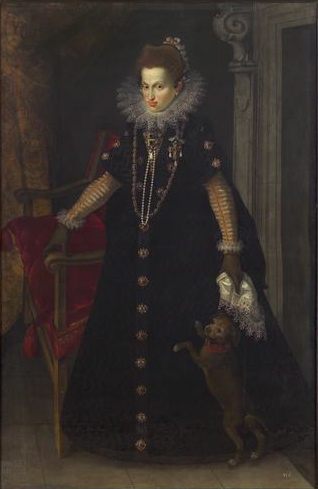
They had seven children:
1) Archduchess Christine (1601-1601)
2) Archduke Charles (1603-1603)
3) Archduke John-Charles (November 1, 1605 - December 28, 1619)
4) Ferdinand III (July 13, 1608-April 2, 1657) married:
1631 Infanta Maria Anna of Spain
1648 Maria Leopoldine of Austria
1651 Eleanor Gonzaga (1630-1686)
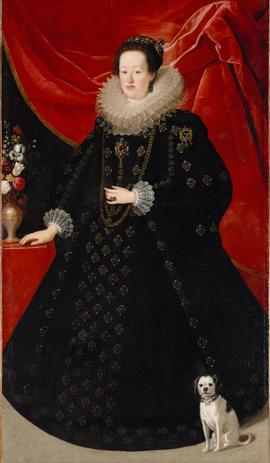
5) Archduchess Maria Anna of Austria (January 13, 1610-September 25, 1665)
6) Archduchess Cecilia Renata of Austria (July 16, 1611-March 24, 1644), who married her cousin W³adys³aw IV Vasa, King of Poland.
7) Archduke Leopold Wilhelm of Austria (1614-1662).
In 1622, he married Eleonore of Mantua (Gonzaga) (1598-1655), the daughter of Duke Vincenzo I of Mantua and Eleonora de' Medici, at Innsbruck.






 Posted 05/30/2009 10:02 pm





