|
This page may contain links that result in small commissions to keep this free site up and running.

Welcome Guest! Registering and/or logging in will remove the anchor (bottom) ads. It's Free!
To participate in the forum you must log in or register. | Author |
 Replies: 25 / Views: 2,293 Replies: 25 / Views: 2,293 |
|
|
|
Bedrock of the Community
 United States
11963 Posts |
Thanks @gxseries. Yes, as you point out, there are two distinct possibilities: 1. The coin was struck on an existing, struck 1795 draped bust dollar (the overstrike). 2. A 1795 draped bust dollar obverse die was repunched with a #8 punch over the 5 in a 1795 die (the repunched die). I was using these two distinct possibilities interchangeably. I think that it would be rare that the U.S. Mint would be striking coins over existing struck coins, but it would explain why I can't find other examples of this overdate. However, a repunched die is the more likely answer but if this is the case, the die would likely yield other coins with the overdate which I haven't been able to find.  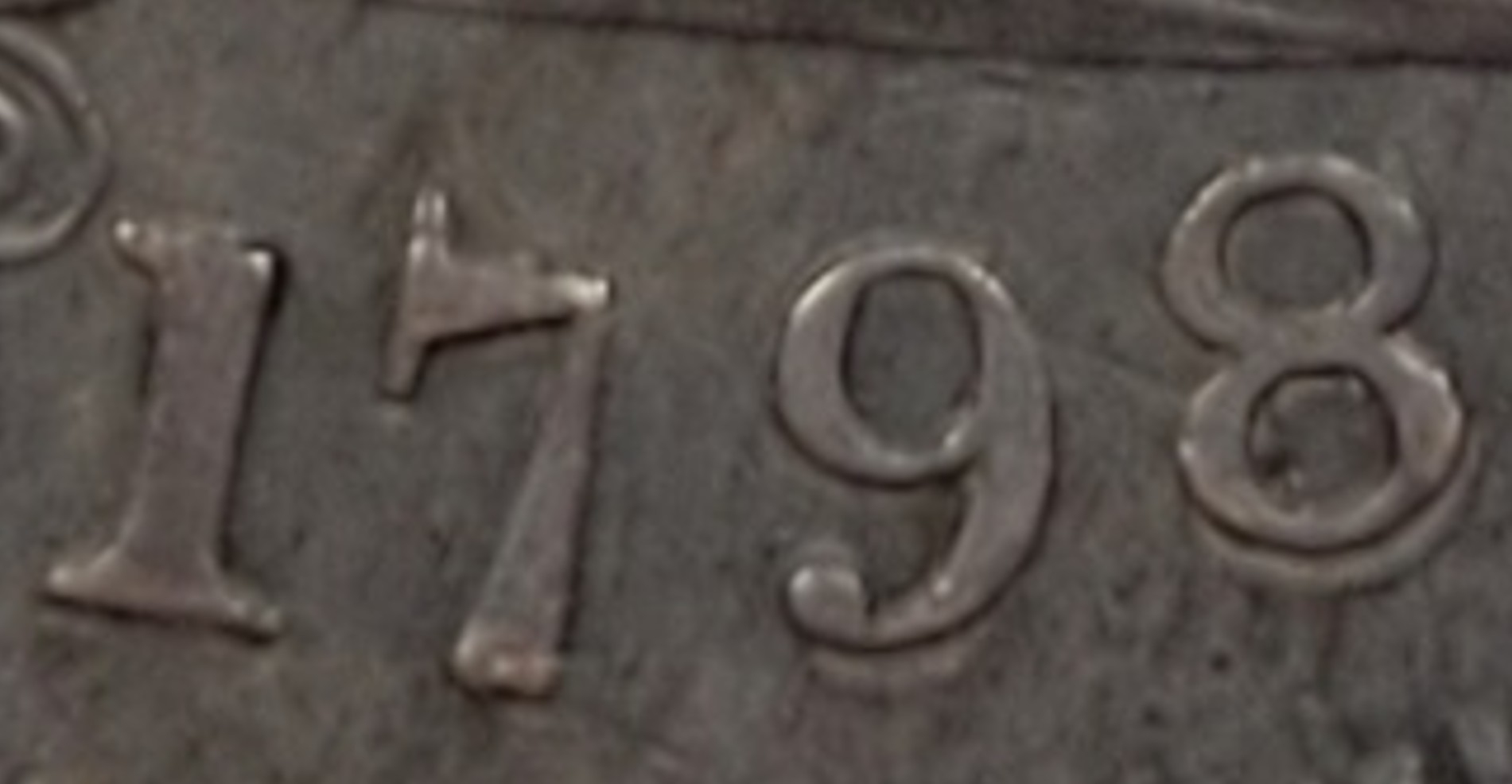 IN NECESSARIIS UNITAS - IN DUBIIS LIBERTAS - IN OMNIBUS CARITAS THE MAN IN THE ARENA, Theodore Roosevelt at the Sorbonne Paris on April 23, 1910: " It is not the critic who counts; not the man who points out how the strong man stumbles or where the doer of deeds could have done better. The credit belongs to the man who is actually in the arena, whose face is marred by dust and sweat and blood, who strives valiantly, who errs and comes up short again and again, because there is no effort without error or shortcoming, but who knows the great enthusiasms, the great devotions, who spends himself in a worthy cause; who, at the best, knows, in the end, the triumph of high achievement, and who, at the worst, if he fails, at least he fails while daring greatly, so that his place shall never be with those cold and timid souls who knew neither victory nor defeat." My coin website: https://fairfaxcoins.com |
|
Bedrock of the Community
United States
10982 Posts |
That is bizarre. Since you have the coin in-hand can you plainly see this area raised relative to the field around it? The image in your OP looks almost look shadowing/lighting or image artifacts. The second image above does appear different. Whatever it is it certainly warrants investigation. Thanks for sharing.
|
|
Pillar of the Community
United States
2016 Posts |
Congrats, just a super coin that will remain in my dreams only.
|
|
Moderator
 United States
15894 Posts |
Beautiful coin. I can see what you are talking about with the date. I hope you can arrive at a conclusion as to what caused it.
Take a look at my other hobby ... http://www.jk-dk.art |
|
Bedrock of the Community
 United States
18902 Posts |
you are acquiring an amazing collection over the years, I'm just blown away with this one. its just an awesome strike and the overdate may be unique. it probably warrants additional investigation. I would think if it is, the premium increase would be substantial.  |
|
Pillar of the Community
United States
3848 Posts |
Quote:
it appeared to be overstruck at the nine and the eight. The brighter areas under the date the result of the outward planchet expansion during the striking process. This effect is particularly prominent with this earlier coinage that lacks a retaining collar during the strike. It also can be commonly seen on Morgans dollars. This is proven by the stars exhibiting an identical effect (mostly the lower stars in the OP photos due to the striking pressures in relative areas), as well as the reverse particularly above STATES. Any overdate or modification to the dies would be visible on all others of that same die marriage and die state. Especially an overdate since that occurs during preparation of the working dies before a single coin is struck. A double struck coin has a special effect and would be clearly visible in some areas. The dentils would be the most obvious, and I don't see anything unusual here. A nice coin regardless, congrats on the find. Suffering from bust half fever. Want to learn how to attribute early half dollars by die variety? Click Here: http://goccf.com/t/434955Shoot me a PM if you are looking to sell bust halves. |
|
Bedrock of the Community
United States
11963 Posts |
Thanks for the many kind comments. If the protrusions below the digits are due to planchet expansion, why are those area raised? Also, why is there a knob inside the lower opening of the 8? IN NECESSARIIS UNITAS - IN DUBIIS LIBERTAS - IN OMNIBUS CARITAS THE MAN IN THE ARENA, Theodore Roosevelt at the Sorbonne Paris on April 23, 1910: " It is not the critic who counts; not the man who points out how the strong man stumbles or where the doer of deeds could have done better. The credit belongs to the man who is actually in the arena, whose face is marred by dust and sweat and blood, who strives valiantly, who errs and comes up short again and again, because there is no effort without error or shortcoming, but who knows the great enthusiasms, the great devotions, who spends himself in a worthy cause; who, at the best, knows, in the end, the triumph of high achievement, and who, at the worst, if he fails, at least he fails while daring greatly, so that his place shall never be with those cold and timid souls who knew neither victory nor defeat." My coin website: https://fairfaxcoins.com |
|
Bedrock of the Community
United States
18902 Posts |
Quote:
The brighter areas under the date the result of the outward planchet expansion during the striking process. This effect is particularly prominent with this earlier coinage that lacks a retaining collar during the strike. It also can be commonly seen on Morgans dollars. This is proven by the stars exhibiting an identical effect (mostly the lower stars in the OP photos due to the striking pressures in relative areas), as well as the reverse particularly above STATES. jacrispies - thanks for this assessment. I think your referring to the bolder strike of the denticles in those areas. is this what you are referring to? if not if you could give me something more detailed as to what you mean by brighter as I want to add this to my knowledge base for Morgans. |
|
Pillar of the Community
United States
3848 Posts |
Quote:
If the protrusions below the digits are due to planchet expansion, why are those area raised? Also, why is there a knob inside the lower opening of the 8? What are your observation tools? I would recommend a 15x+ loupe and looking at it in hand. There is no otherwise observable evidence that would point to the areas being raised on the dies. The photo below is of a high grade BB-51 with a clean digit, and no evidence of die polishing that would point to a removal of an undertype. The darker patina of your coin accentuates the photographic illusion of a repunched date, maintaining less toning on the spread portion while the areas around tone slightly darker. That is a known effect that is shown vividly on the Morgan dollar imaged at the bottom of this post. 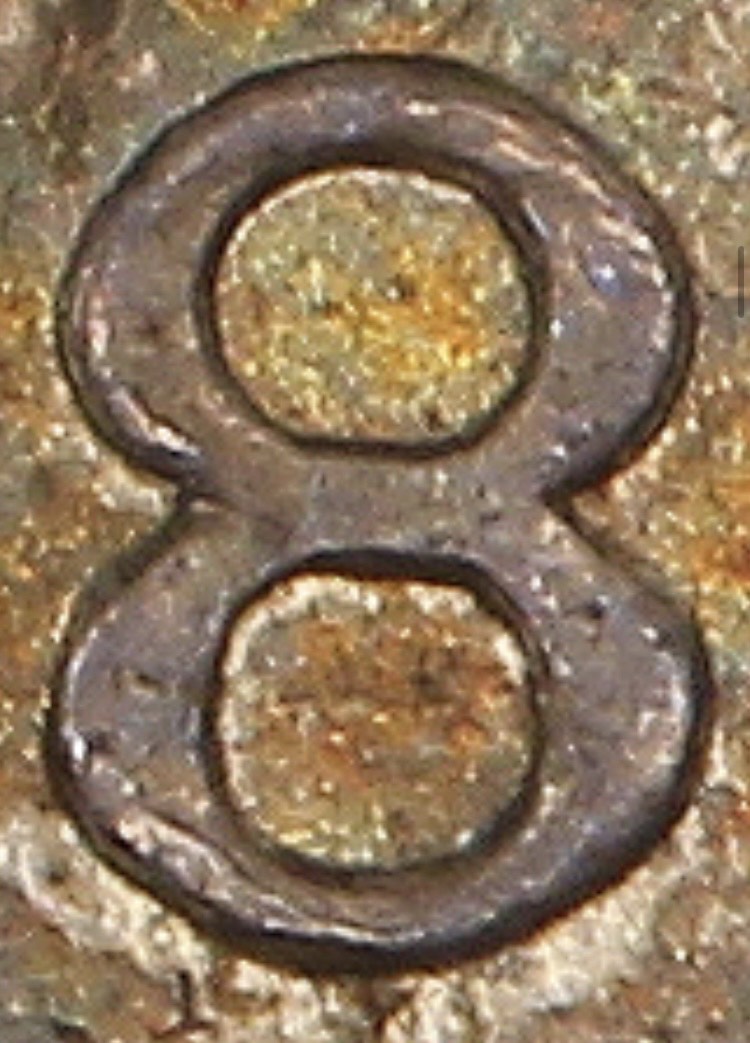 Quote:
I think your referring to the bolder strike of the denticles in those areas. is this what you are referring to? if not if you could give me something more detailed as to what you mean by brighter as I want to add this to my knowledge base for Morgans. Not quite. I am referring to the areas underneath the date numerals. 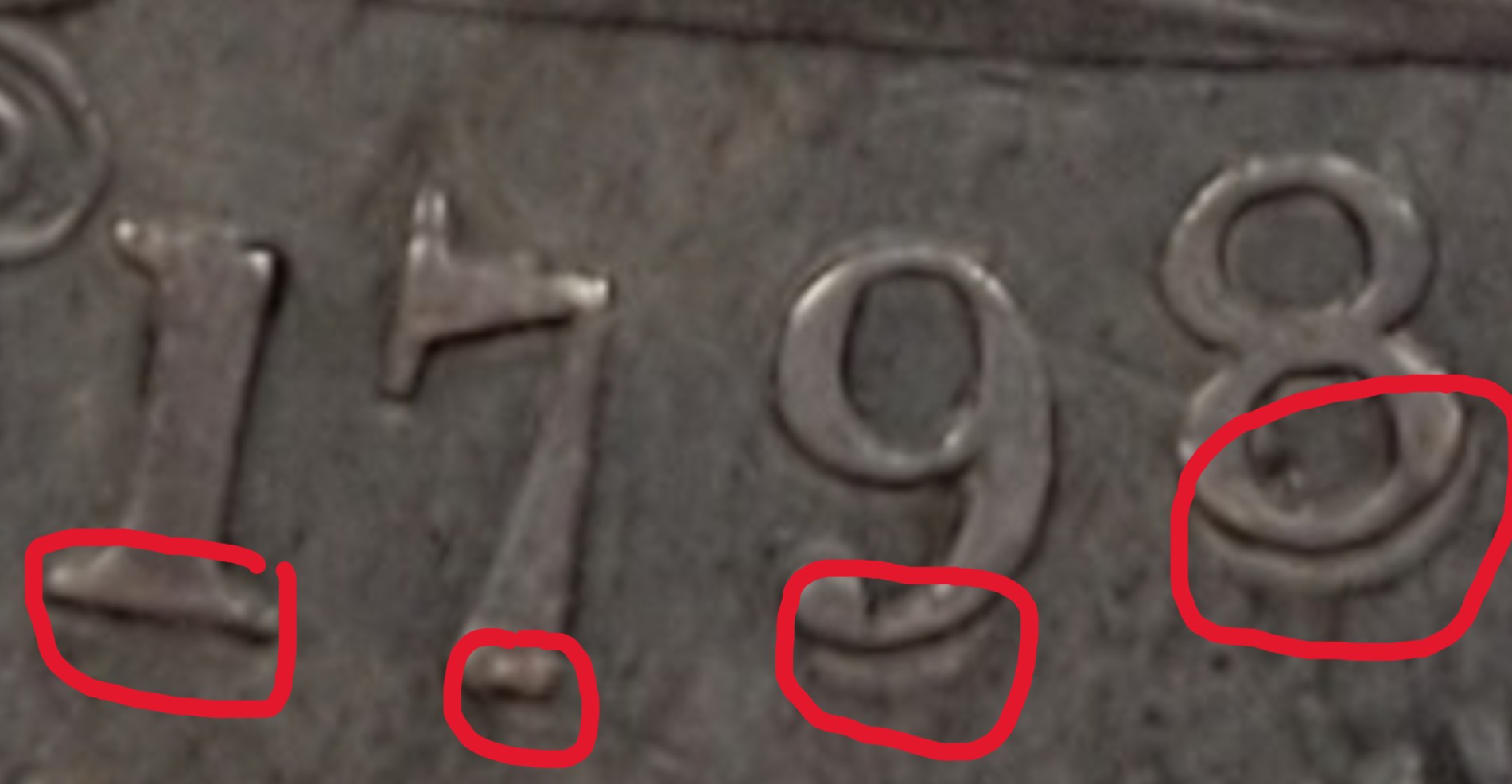 You can see it well on this toned Morgan dollar. 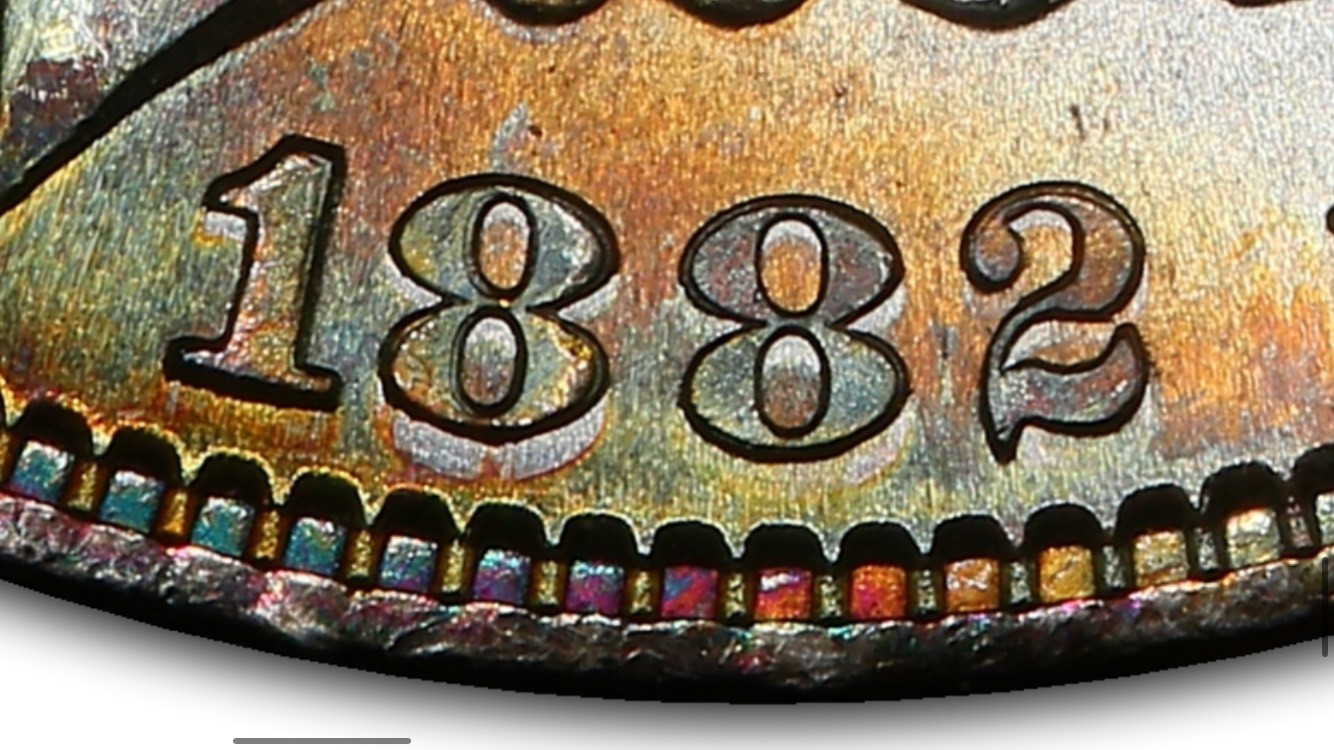 Suffering from bust half fever. Want to learn how to attribute early half dollars by die variety? Click Here: http://goccf.com/t/434955Shoot me a PM if you are looking to sell bust halves. |
|
Pillar of the Community
United States
2316 Posts |
Pull away effect/toning.
You realize when you know how to think, it empowers you far beyond those who know only what to think.
-Neil deGrasse Tyson
|
| |
Replies: 25 / Views: 2,293 |
To participate in the forum you must log in or register.
 
- 1969-S Lincoln Cent Machine Doubling Or Double Die Obverse
- 1999 Lincoln Cent - Die Clash
- 1809 Half Cent For Grading
- 1987 - D Lincoln Cent Grade Check
- 1987- D Lhc Possible RPM Or DDO In Date
- You Know What I Want That Final Number To Be
- Bronze Coin To Id. Greek Or Roman?
- A Ridiculously Badly Written Computer Aided Book, Coin Collecting Bible, 2024
- Liberty Head 10/11 Stars Obverse With A Sick Looking Eagle On The Reverse Holed 0.59g 13.06mm
- The Tyrant Collector - PCGS Youtube Interview
- Counterfeit Detection: ANA Video - Introduction, With Brian Silliman And Jim Robinson Ep. 1
- Counterfeit Detection: ANA Video - Mistakes, Risk Factors, And Counterfeits & Alterations, Ep. 2
- Counterfeit Detection: ANA Video - Pimples And Pits, Looking At Cast Counterfeits, Ep. 4
- Counterfeit Detection: ANA Video - What Year Is That Cent? Key Date Coins, Ep. 5
- Counterfeit Detection: ANA Video - Diagnostics Of The 3, 5, And 10 Cent Coins, Ep. 6
- Counterfeit Detection: ANA Video, Counterfeit Quarter Dollar Diagnostics, Ep. 7
- Counterfeit Detection: ANA Video, Counterfeit Classic Commemorative Coins Diagnostics, Ep. 8
- Counterfeit Detection: ANA Video, Counterfeit Silver Dollar Diagnostics, Ep. 9
- Counterfeit Detectection: ANA Video, Classic US Gold Coin Diagnostics, Ep. 10
- Counterfeit Detection: ANA Video, Diagnostics Of Chinese Made Counterfeits Of US Coins, Ep. 11
Disclaimer: While a tremendous amount of effort goes into ensuring the accuracy of the information contained in this site, Coin Community assumes no liability for errors. Copyright 2005 - 2026 Coin Community Family- all rights reserved worldwide. Use of any images or content on this website without prior written permission of Coin Community or the original lender is strictly prohibited.
Contact Us | Advertise Here | Privacy Policy / Terms of Use
|
| Coin Community Forum |
© 2005 - 2026 Coin Community Forums |
| It took 0.36 seconds to rattle this change. |
 |
|
| |
| |







 First Page


 Posted 06/21/2025 01:33 am


