| Author |
 Replies: 25 / Views: 1,957 Replies: 25 / Views: 1,957 |
|
Pillar of the Community
United States
2831 Posts |
I see a lot of listings on CC and VV for DDO's here but this just looks like a broken T to me. Is this a DDO?  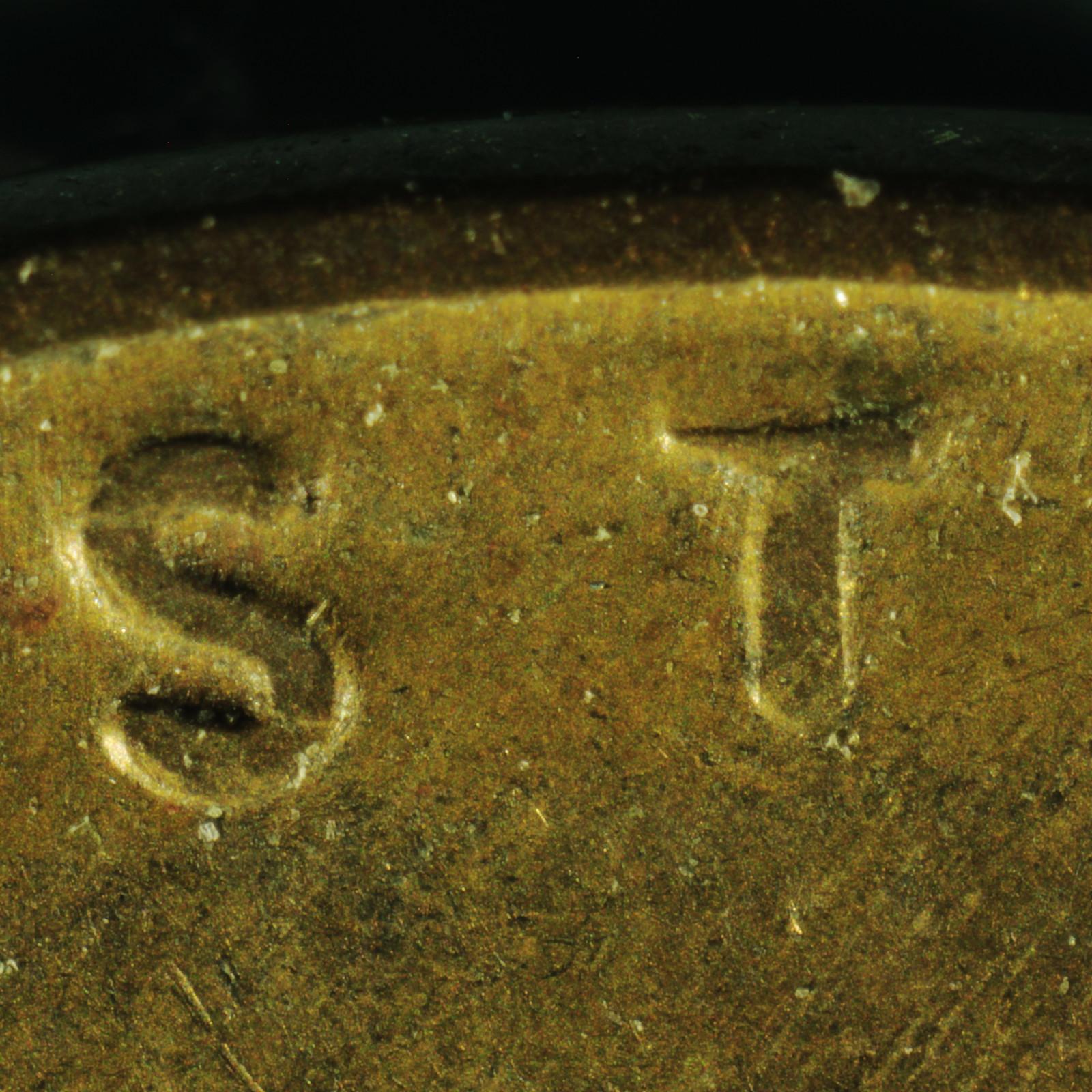 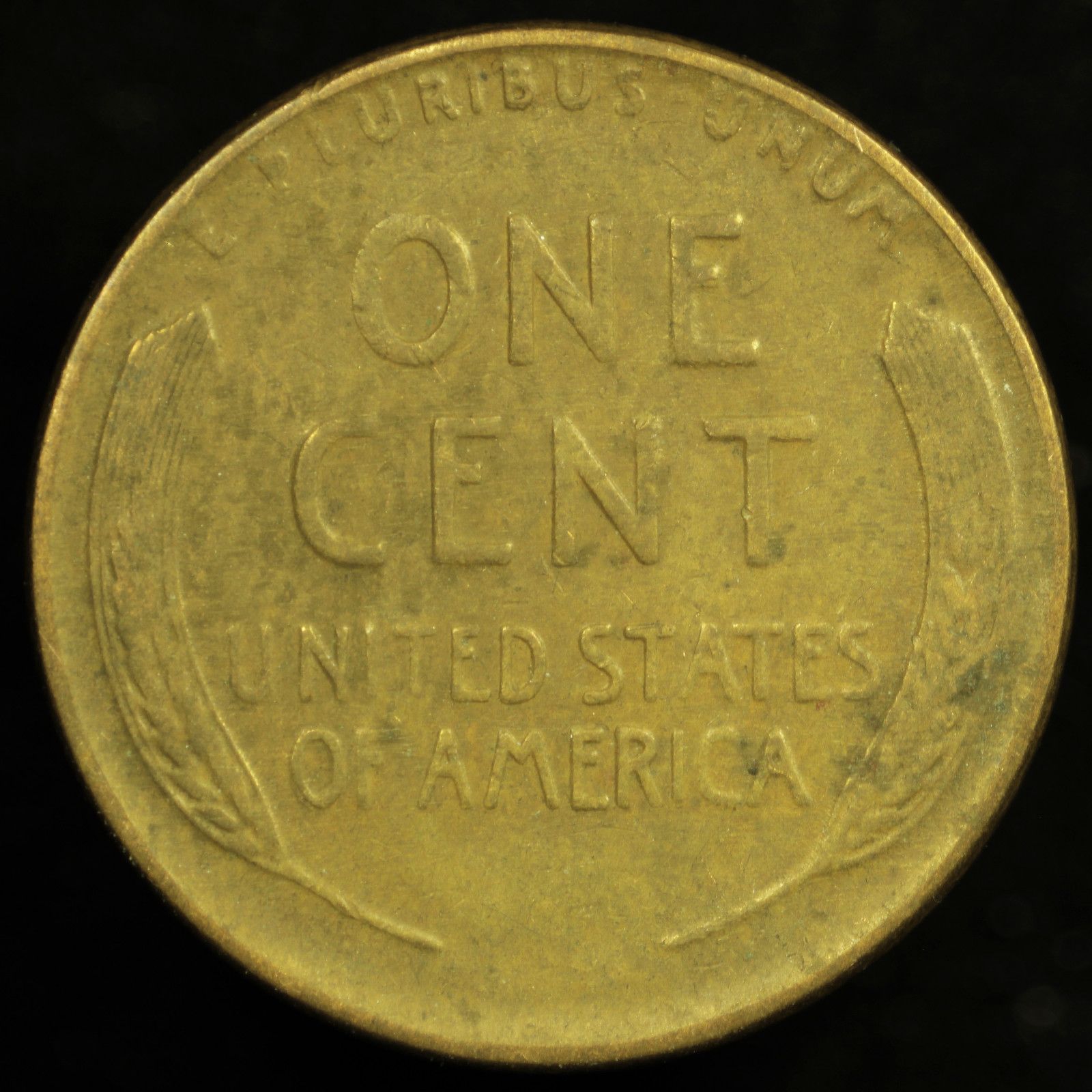 |
|
|
|
Moderator
 United States
110203 Posts |
it could be a partially filled with grease on that letter.
|
|
Pillar of the Community
United States
3747 Posts |
Short answer: yes, it is a DDO, and may or may not be listed. There are dozens of rehubbed second "T" 1941 cents. Not all of them are currently listed, but there are reserved Wexler listings that are currently being updated. I created an eight-page "cheat sheet" with all of the second "T"s in TRUST from the listed coins and dozens more that I have found. I have a coffee can filled over halfway with currently unlisted rehubbed "T" 1941 cents. These may actually be listed, but don't have the listings uploaded again. The Wexler site is revising listings for some of them, so there may be a match when those are uploaded. WDDO-006 to WDDO-018 and WDDO-021 and WDDO-022 currently don't have descriptions, photos, or markers posted. Many of the doubled second "T" coins also have a slightly doubled "4" in the date. Many also have doubled eyelids and some of them a rehubbed first "T" in TRUST. Based on my "cheat sheet," the "geologist's pick" rehubbed T coins that are listed include:  FS-103, DDO-005, 1-DO-006, WDDO-005 DDO-014, 1-DO-021 DDO-015 DDO-017 DDO-027 1-DO-013 1-DO-019 1-DO-029 1-DO-044 There is a ridiculously deceptive unlisted DDO that is very close to FS-103/DDO-005/1-DO-006/WDDO-005, except the shift is straight west, rather than WSW, and the doubling on the "9" is more subtle. It also has a similar second "T." If you can't make a match with those, for now hang on to the coin and wait until the Wexler site is updated. |
|
Moderator
United States
198004 Posts |
Interesting find.  |
|
Bedrock of the Community
United States
10601 Posts |
Great information - I would have missed that one!
|
|
Pillar of the Community
United States
782 Posts |
 with fortcollins. These are fun to find! They are often wrongly looked at as damage and I can understand why. Great find CoinHI.  |
|
Bedrock of the Community
United States
80495 Posts |
Nice find.  Errers and Varietys.
|
|
Moderator
United States
110203 Posts |
Well, I was wrong  Never would have seen that as a DDO.  |
|
Pillar of the Community
 United States
2831 Posts |
Thanks for the comments and for the info here fortcollins. I'll throw it in a 2x2 for later comparisons.
"Pride is yoked with callous behavior, as humility is with compassion." St. Gregory Palamas Top Finds - 1969-S 1c FS-101 http://goccf.com/t/477681 1976 D WQ FS-101 http://goccf.com/t/382777 - 1968 D 1c FS-801 http://goccf.com/t/422254Cool clashed dies - 1972 D 1c http://goccf.com/t/429855&SearchTerms=CCLStruck-In Rim Burr - 1969 S 1c http://goccf.com/t/425587&SearchTerms=burrFloating (Type II) Counterclash - 1978 D 1c http://goccf.com/t/434991&SearchTerms=1978 |
|
Pillar of the Community
United States
5196 Posts |
nice DDO , congratulation |
|
Pillar of the Community
United States
2831 Posts |
Thanks uruman!
"Pride is yoked with callous behavior, as humility is with compassion." St. Gregory Palamas Top Finds - 1969-S 1c FS-101 http://goccf.com/t/477681 1976 D WQ FS-101 http://goccf.com/t/382777 - 1968 D 1c FS-801 http://goccf.com/t/422254Cool clashed dies - 1972 D 1c http://goccf.com/t/429855&SearchTerms=CCLStruck-In Rim Burr - 1969 S 1c http://goccf.com/t/425587&SearchTerms=burrFloating (Type II) Counterclash - 1978 D 1c http://goccf.com/t/434991&SearchTerms=1978 |
|
Pillar of the Community
United States
3747 Posts |
1941 is a playground for weirdness. At least two hubs had different broken second "T"s of TRUST. Some of the coins are doubled with one broken "T" over another. One of those hubs then acquired a broken first "T" as well. A few coins have both "T"s broken. At least half of the 1941 Philadelphia cents have double die obverses.
At some point, Philadelphia rehubbed a bunch of partially hubbed 1941 dies, using a hub with an intact first "T" and second "T." Where did they get that hub?
One possibility is that Philadelphia used a 1940 hub, grinding off the zero in the date. At least two rehubbed second "T" coins show what may be traces of the Lifesaver-shaped zero hubbed lightly over the last "1" in 1941. Several others show heavy oval-shaped die polishing around the last "1," likely in an attempt to remove traces of a zero. Philadelphia then may have re-ground the 1940 hub, removing all traces of a zero. If so, this would explain the further coins with a somewhat weak second "1" in 1941. Bolstering this idea, the "4" in many 1941 dates is doubled. (The OPs coin here is one of them.)
Interestingly, very few Denver or San Francisco 1941 cents have the broken second "T." To me, that suggests that the early dies had intact "T"s, and Philadelphia shipped the branch mint dies early, and not again in 1941.
If the 1940 hub was used, then many 1941 cents would be reverse-overdate doubled dies, 1940/1941. If that sounds weird, it is what Philadelphia did in 1949, for the extra dies sent to San Francisco, using a ground-down 1948 hub for the rehubbing. That created the three major 1949-S doubled dies. I personally believe that the 1941 experience is what gave them the idea to do it (again) in 1949.
|
|
Pillar of the Community
United States
2831 Posts |
Fortcollins, this may have relevance to may 1960P posts. https://goccf.com/t/484565I believe some working hub doubling was mostly abraded but shows on my examples. Do you have photos or links to photos of the supposed 1940/1941 examples? "Pride is yoked with callous behavior, as humility is with compassion." St. Gregory Palamas Top Finds - 1969-S 1c FS-101 http://goccf.com/t/477681 1976 D WQ FS-101 http://goccf.com/t/382777 - 1968 D 1c FS-801 http://goccf.com/t/422254Cool clashed dies - 1972 D 1c http://goccf.com/t/429855&SearchTerms=CCLStruck-In Rim Burr - 1969 S 1c http://goccf.com/t/425587&SearchTerms=burrFloating (Type II) Counterclash - 1978 D 1c http://goccf.com/t/434991&SearchTerms=1978 |
|
Pillar of the Community
United States
3747 Posts |
Quote:
Do you have photos or links to photos of the supposed 1940/1941 examples? Yes, but finding the photos will take some time. I have my coin photos on a backup drive, organized by inventory number. I'll have some time this weekend to look. IMHO, all of the rehubbed "T" cents are 1940/1941, although only two that I have seen so far have what looks like the zero also visible. I'll hunt those down. Most of the "4" doubling looks like the 4 of 1940 hubbed over the 4 of 1941. Notice the doubling areas I marked on the date from your obverse photo (below). The rehubbed 4 is larger than and different from the 4 of 1941, and the only possible other year with a 4 as the third digit then would have been 1940. I haven't made an overlay of the two "fours" yet. The 1941 DDOs have the rehubbed 4 in about every orientation to try to minimize the evident doubling. 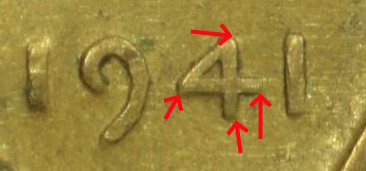 |
|
Pillar of the Community
United States
3747 Posts |
Quote:
Do you have photos or links to photos of the supposed 1940/1941 examples? Here is a set of photos of Die Pair #3 that shows a possible use of a 1940 hub for the second 1941 hubbing. There are four die pair with some suggestion of a zero hubbed over the second "1" in 1941. All four die pair have obverse dies that were polished heavily. Purely conjecture here, but the die polishing is shallower than hubbings, and die wear would tend to expose what was covered by the polishing. I'm still hunting the photos of the other die pairs. I'll post those in separate threads when I finish the 1941 cents. I'm on the prowl for better (and later die state) examples of a couple of those pairings. It seems significant that these appear identically on multiple coins, appear in later die states as the die polishing wears, and are of the right size, shape, and orientation as the last digit on a 1940 cent. This particular die pair shows three, and possibly four, hubbings. The first was a normal first hubbing, but with a broken second "T" in TRUST. The second or third hubbing appears to be directly west of the first hubbing, and is most visible on the second "T" as a light "T" just left of the primary "T." The other of those hubbings isn't for certain. On some of the coins from this die pair, what may be a light hubbing appears to be visible just SE of the primary hubbing. The final hubbing was the intentional DDO, using an intact "T" to rehub over the broken "T." Early die state coins from this and the other die pair are among the most heavily abraded dies I have seen in any modern coin series. The aggressive polishing covered the entire surface of the obverse dies, even reaching some of the deepest parts of the design on the die. My conjecture here is that the intact "T" was a 1940 hub with the final digit ground down. This is known to be the process used in 1949, with a 1948 hub, for the 1949-S DDOs. I believe that 1941 may be similar, and if so, it could be a reason the Mint did that in 1949. The trailing zero (if that is what it is) is very light on all four die pair. If the second "T" was broken on available 1941 hubs, the only possible earlier date that could have been used is 1940. On this coin, like many (most? all?) with the rehubbed second "T" in TRUST, there is doubling on the "4" in 1941. Here are the whole obverse and reverse, date detail, and second "T" in TRUST detail on the third die pair. The inside curve of a possible zero is most clear to the right of the second "1" in the date. The thing closest to the second "1" appears to be a die gouge. What I am seeing is the second object east of the second "1," between the die gouge and the polishing. Note that this hubbing - if that's what it is - isn't oriented correctly, and appears to correspond to what may be a light first "1" and "9" hubbed just NW of the primary "1" and "9." That also would appear to align with a possible second or third hubbing visible left of the "T" in TRUST. Again, this is offered as a possibility that needs a lot more study. 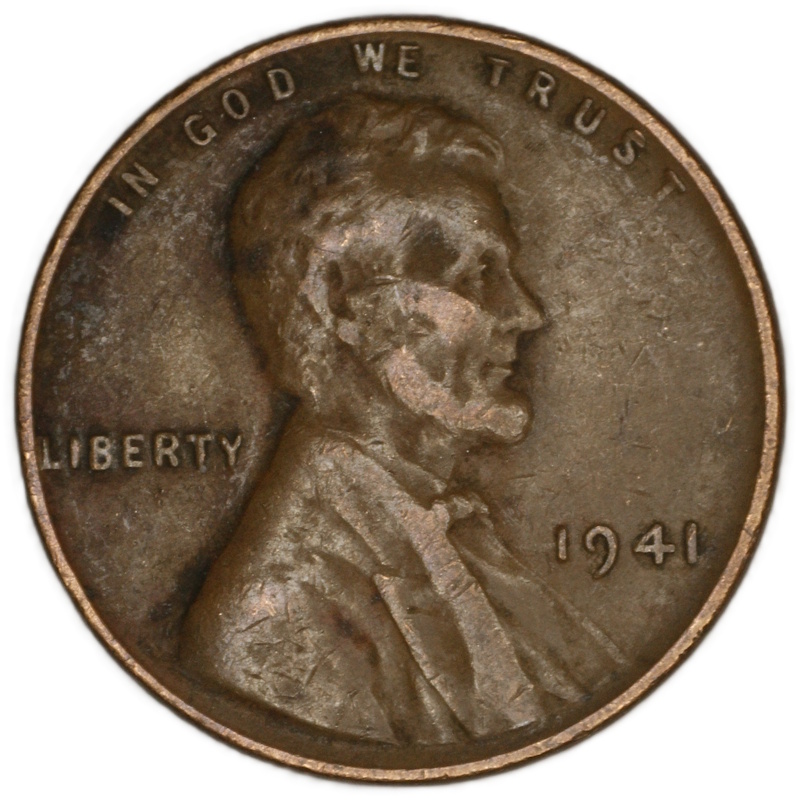 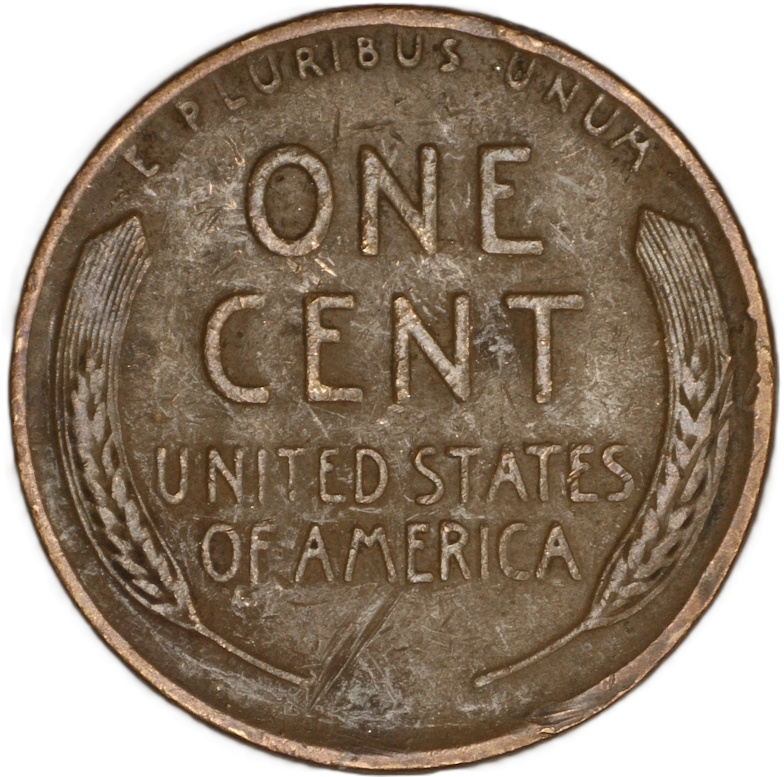 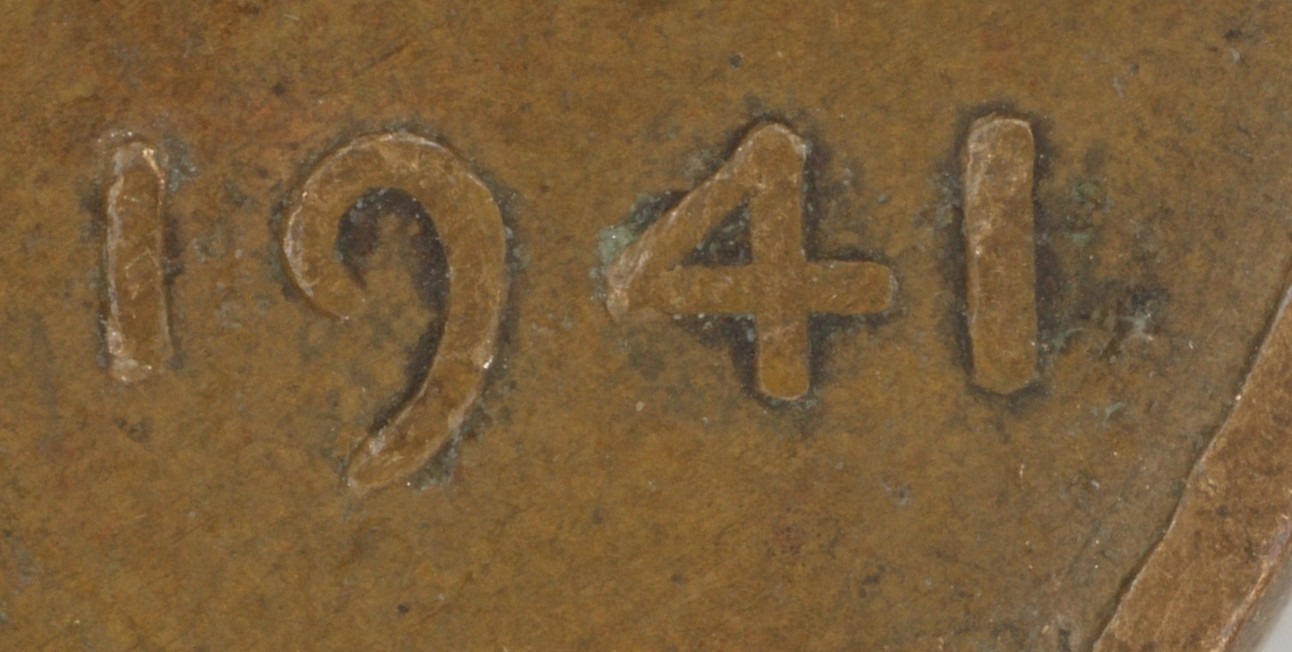 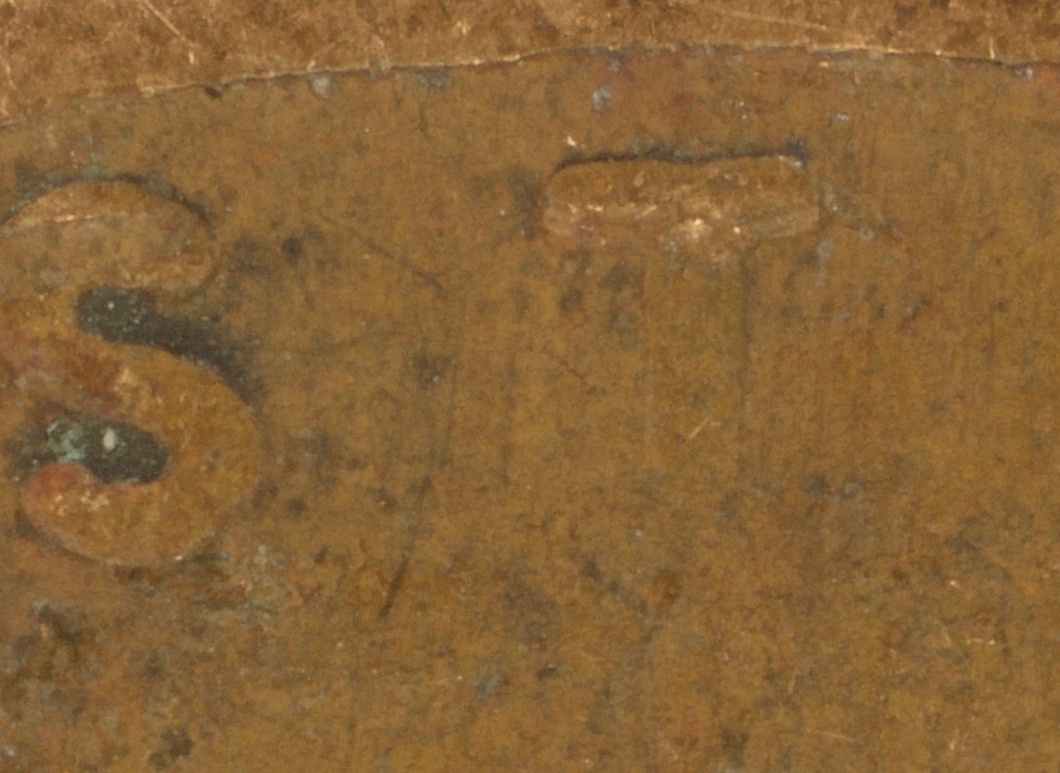 |
|
Pillar of the Community
United States
3747 Posts |
This is a different coin, but it shows the difficulty the Mint had aligning the intact hub "4" with the "4" of 1941 from the first hubbing. This coin has three distinct fours (marked and numbered). The doubling (tripling) is most visible on the point of the primary four, but can be seen east of the foot, at the top point, and on the crosslet, too. 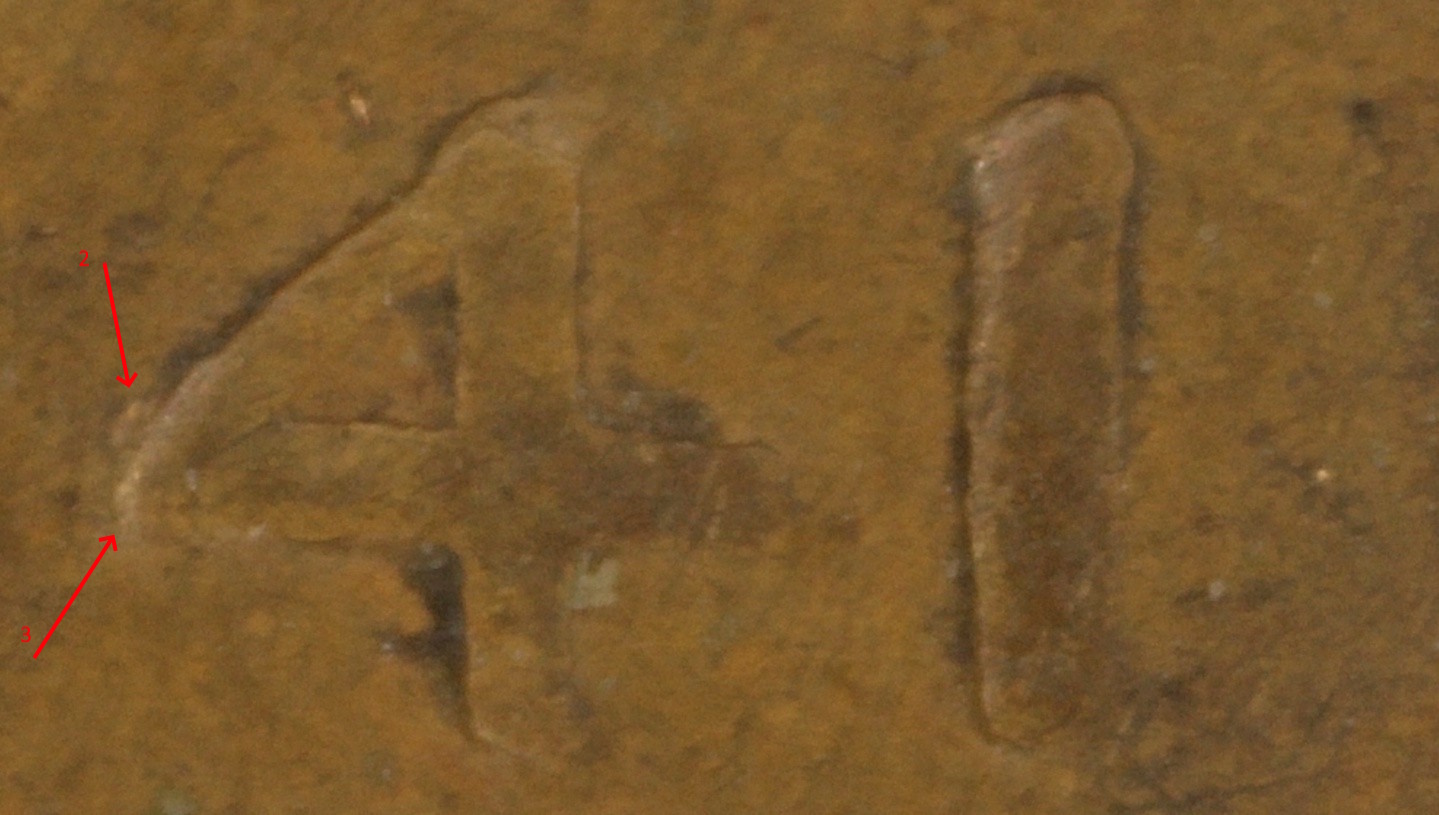 |
| |
Replies: 25 / Views: 1,957 |







 Posted 12/02/2025 4:44 pm


