Depending on your perspective, this is either the story of "Oh, what could have been!" OR "Thankfully, reason and sanity prevailed!" I'll leave it to each individual to decide which.Collectors of the modern series of United States ("US") commemorative coins are likely familiar with the 1991 United Services Organization ("USO") Silver Dollar. The Public Law that authorized the coin set a mintage limit of 1 million; the coin is regularly available in the marketplace. The coin's bill became Public Law on October 2, 1990 with the signature of US President George Herbert Walker Bush.
When the original bills calling for a USO commemorative coin program were introduced in the House of Representatives ("House") (June 1989), and Senate (September 1989), however, they called for a three-coin program - Gold Half Eagle (up to 750,000), Silver Dollar (up to 3,000,000) and Copper-Nickel (CuNi) Clad Half Dollar (up to 3,000,000). Big numbers! High expectations! Proof and Uncirculated coins were to be struck.
The House bill had 15 co-sponsors when introduced, but ultimately secured more than 220; the Senate bill obtained 50+.
The bill was introduced in the House by Thomas J. Ridge (R-PA). Upon its introduction, the bill was referred to the House Committee on Banking, Finance and Urban Affairs, with a further referral to its Subcommittee on Consumer Affairs and Coinage. The parallel Senate bill was introduced by John McCain (R-AZ); it was referred to the Senate Committee on Banking.
The bills specified that the coin designs were to "be emblematic of the services provided by the USO to military service personnel and families." The Secretary of the Treasury was to select the designs for each coin after consulting with the President of the USO and the Commission of Fine Arts.
The Issue Price of each coin was to include a surcharge:
- $35 on each Gold Half Eagle
- $7 on each Silver Dollar
- $1 per Clad Half Dollar
Collected surcharges were to be split 50/50 between the USO "to fund programs, including airport centers, fleet centers, family and community centers, and celebrity entertainment" and the US Treasury to be put toward reducing the National Debt.
The House bill was not subject to a Hearing, but the House Subcommittee assigned did review the bill and hold a mark-up session for it. During its consideration, the Subcommittee amended the bill, via substitution, and reduced the program to a single-coin program - a Silver Dollar - with a maximum mintage of 1 million coins. The substitution/replacement was made in an effort to prevent/minimize potential competition with the 1991 Mount Rushmore three-coin commemorative program that included a Gold Half Eagle and Clad Half Dollar in addition to a Silver Dollar.
The amended bill passed the House and did likewise in the Senate. It eventually was approved by George HW Bush (as noted above) and became a part of the ongoing US series. But the program could potentially have been more if it had been approved prior to the Mount Rushmore coin program instead of after it - it missed by just a few months.
Regarding the sales potential of a USO coin program as initially introduced, it's important to realize, that the topic/theme of the coin was not immensely popular among collectors. The program sold a total of just ~446,000 coins (i.e., less than half of its authorized maximum mintage). Based on this sales volume, it's unclear how successful a three-coin program would have been.
I've previously posted about the USO and its 50th Anniversary Silver Dollar, you can read it here:
-
1991 USO 50th Anniversary1991 United Service Organizations (USO) 50th Anniversary Silver Dollar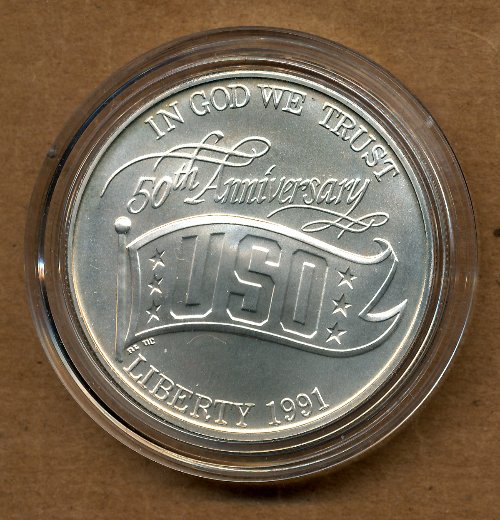

For other of my posts about commemorative coins and medals, including more What If? stories, see:
Commems Collection 



 Posted 12/14/2025 2:17 pm





