I've written before about the failed attempt to secure a commemorative half dollar to mark the 100th Anniversary of the Alaska Purchase - What If? 1967 Alaska Purchase Centennial and mentioned in the post that an Alaska Purchase Centennial medal program was authorized by Congress (and I promised to return to the topic at some point!). Let's take a closer look at the medal...Senators Edward Lewis Bartlett (D-AK) and Ernest Henry Gruening (D-AK) introduced the bill that led to the 1967 Alaska Purchase Centennial medals in October 1965. The bill called for up to 200,000 medals "in commemoration of the 100th anniversary of the purchase of Alaska by the United States from Russia." Upon its introduction, the bill was referred to the Senate Committee on Banking and Currency.
The Committee reported the bill favorably, with a recommendation for it to pass; the Committee did not recommend any amendments. The full Senate accepted the recommendation of the Committee and passed the medal bill without debate or objection. The bill was then sent to the House of Representatives ("House") for its consideration.
Upon receipt in the House, the bill was referred to the House Committee on Banking and Currency, from which it was reported favorably, without amendment, along with a recommendation to pass. The bill's journey in the House was nearly (but not quite) as unobstructed as in the Senate. House proceedings were slowed by Representative Durward Gorham Hall (R-MO), who reserved his right to object to the measure until he verified that the medals would be struck at no cost to the American taxpayer. Such was confirmed by Leonor Kretzer Sullivan (D-MO). With that, Representative Hall withdrew his reservation and the House proceeded to pass the bill without further objection or debate.
After passage in both chambers of Congress, the bill was examined, signed and presented to the President. The bill was signed into Public Law by US President Lyndon Baines Johnson on April 14, 1966.
All in all, a very smooth sail!
The bill specified that the medals were to be provided to the Alaska Centennial Commission, in quantities of at least 2,000; no specifications as to metallic composition or sizes were included - Silver (Minted Quantity: 2.500), bronze (Minted Quantity: 10,000) and a small number of platinum medals (100) were struck. In total the mintage was ~6% of the authorized limit for the program. All varieties of the medal are 1-5/16" in diameter with varying weights based on the metal of the planchet. Authority to strike the medals expired at midnight on December 31, 1967. The medals were available individually as well as in three-piece, numbered sets.
The obverse of the medal depicts a hiking prospector with a backpack and the tools of his trade - a pick and shovel; the reverse features a totem pole at center, there is a Russian church at the pole's base that is surmounted by an American eagle (symbolic of the two parties involved in the purchase agreement); a star with "49" is positioned at the pole's top - it represents Alaska's status as the 49th US State. Alaska's flag - featuring the "Big Dipper" constellation and the "North Star" - is seen to the right (viewer's perspective) of the pole. Snow-capped mountains are also included in the background. The center design is encircled by the inscription "ALASKA PURCHASE CENTENNIAL 1867-1967".
1967 Alaska Purchase Centennial Medal Set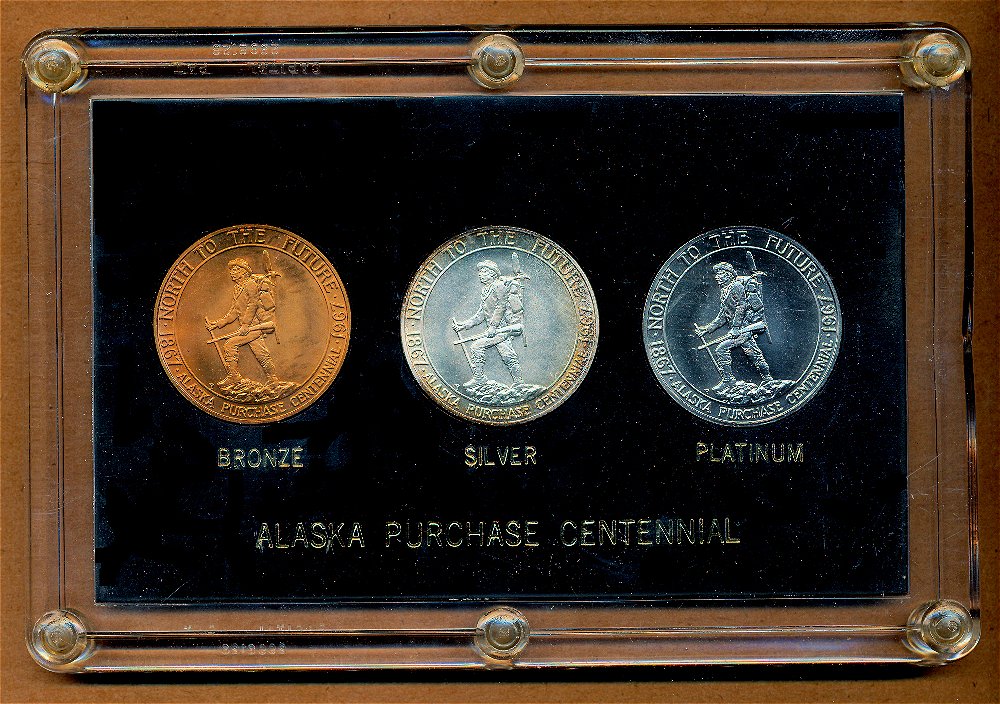
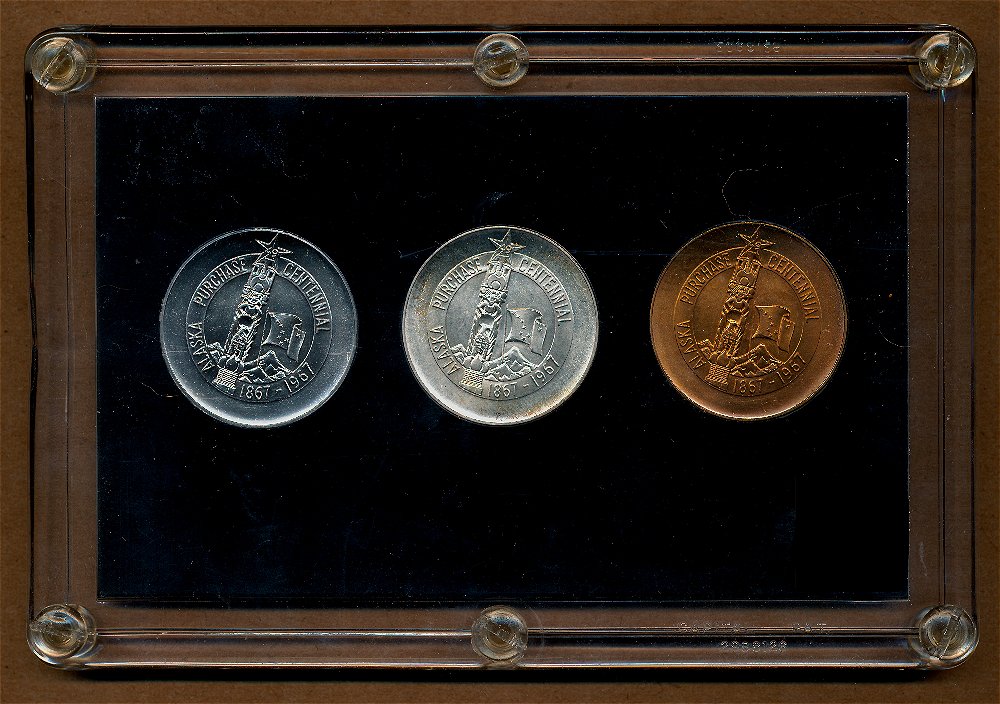
To make it easier to see the included design elements on the medal's reverse, here's a color version of the Centennial logo (as seen on a souvenir button). The Centennial logo appeared on buttons, brochures, glassware, tokens and other commemorative memorabilia.
Alaska Purchase Centennial Button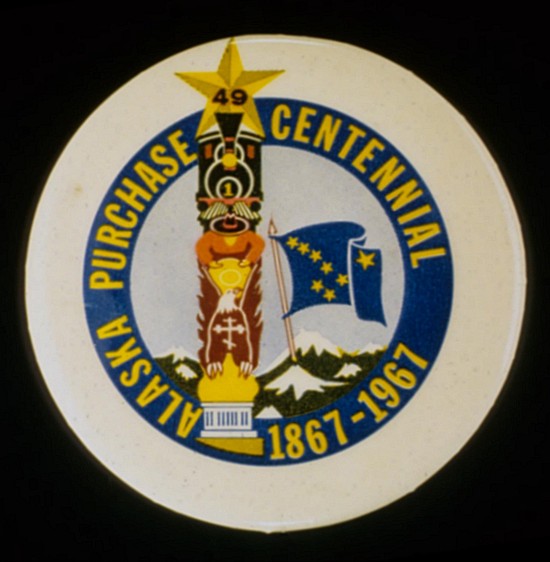 (Image Credit: Smithsonian Institution, National Museum of American History. Fair use, education.)
For other of my posts about commemorative coins and medals, see:
Commems Collection 









 Posted 12/20/2025 11:39 am


