| Author |
 Replies: 15 / Views: 2,160 Replies: 15 / Views: 2,160 |
|
|
Pillar of the Community
United States
1116 Posts |
|
|
|
|
Moderator
 United States
23731 Posts |
I would say EF-40, nice looking coin.
|
|
Pillar of the Community
 United States
1116 Posts |
thanks for the grade any idea on value echizento
|
|
Moderator
United States
23731 Posts |
Krause lists it at $200 for EF condition.
|
|
Pillar of the Community
United States
1116 Posts |
|
|
Pillar of the Community
United States
3499 Posts |
I would agree with the grade of EF40. For some odd reason this coin almost strikes me as looking better when circulated than when BU. There is just something about the darkness by the deeper areas of the design (between the rays and on the sides of the mountains) that just is really aesthetically pleasing.
|
|
Pillar of the Community
United States
5362 Posts |
I agree witht the grade in general, but is there rim damage near the date? These coins were often tested by throwing them on a hard surface to get a ring which is why EF is a high standard to meet.
|
|
Pillar of the Community
United States
1116 Posts |
well I took the coin out of the 2x2 for the first time since my grandfather gave it to me and I wouldn't even call it rim damage but there is a very very small I guess you can call it a little nick near the date but it is barely noticeable I'm just nit picking it is hardly anything. why why would you throw a coin on a hard surface  Edited by scott3270
06/20/2009 11:21 pm
|
|
Pillar of the Community
United States
5362 Posts |
Hi Scott - In the days when intrinsic value (value of the metal) determined the value of a coin - there were numerous forgeries. At least 1 coin in 10 was a fake in the US in 1839 and we had one of the better systems. So in places like Central America, Mexico and many other countries counterfeits were a big problem in commerce. To prevent being swindled many routine tests were developed. Merchants often had scales and discounted the value of your coin for wear. They could also detect fakes this way. Some places test cut or Chopped the coins (like the Chinese and Japanese) to make sure they were not plated base metal. In rural areas especially in the Central Americas it was VERY common to throw a coin onto a stone floor to make it ring. Silver has a very distinctive ring. It is easy to tell silver from lead or zinc and a person with a good ear can tell the difference between copper and silver.
Today we are not used to real silver and all of our coins are TOKENS. They have no real value. So we simply have no experience to match the NORMAL efforts needed in the 1840s to keep from being taken.
|
|
Pillar of the Community
United States
1116 Posts |
thanks for teaching me something new swamperbob
|
|
New Member
United States
29 Posts |
The coin would grade EF as already mentioned though there is some strike weakness obvious at the lower left tree leaves. The volcanoes, (not mountains or you will get in trouble with the locals) are rather weak for a solid EF grade but on the other hand you have what appears to be good old toning. If you sold this coin on E-Bay I would guess it could go as low as $150.00 but more likely, on a good day around the catalog price of $200.00. There are some different kinds, varities, of the 1847 8 Reales. I have identified two die pairs which I call A-1 and A-2 with the latter being more scarce than the first. On the first die pair which is your coin some occur with a raised area in the field which appears to be a rather large die gouge, see below. A nice flawed 1847. Die pair 1-A with gouge on reverse. 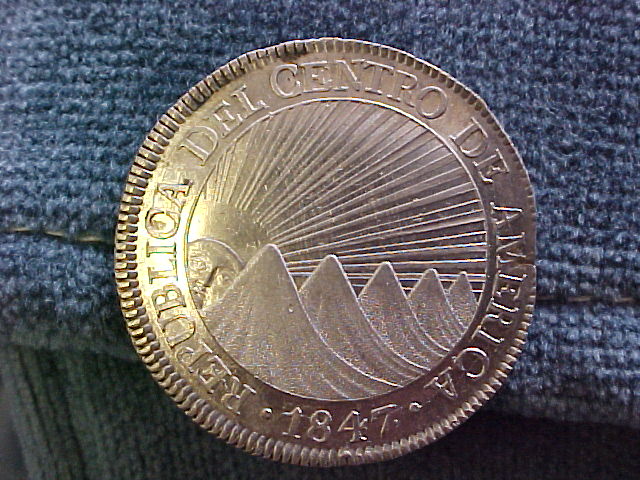 The gouge near the 8 in the denomination. 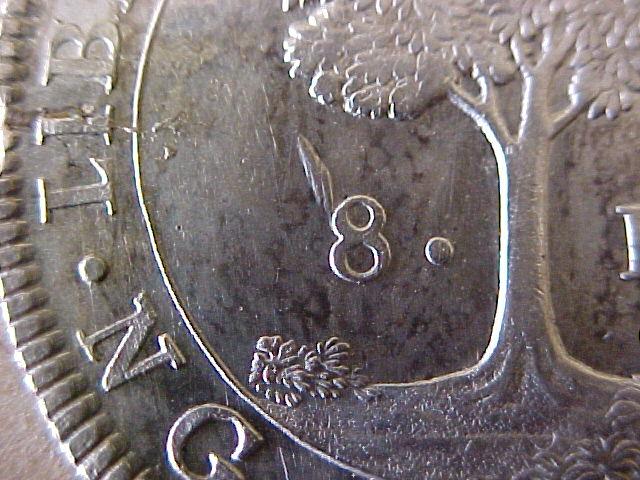 Obverse detail on die pair 1-A see the alignment of the lettering verses the rays, compare to below. 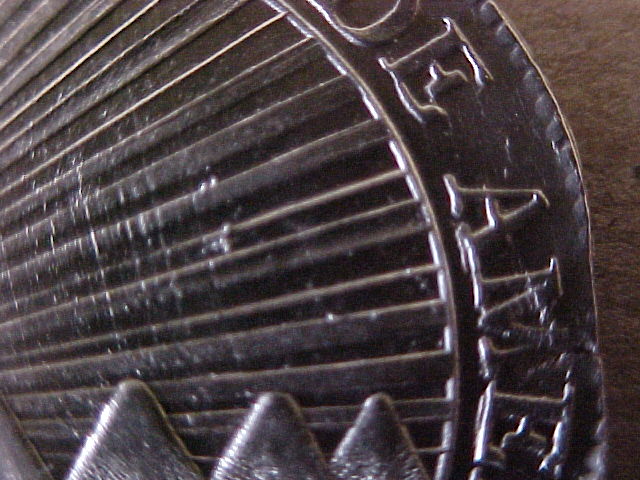 Die pair 2-A. Different letter/ray positioning. 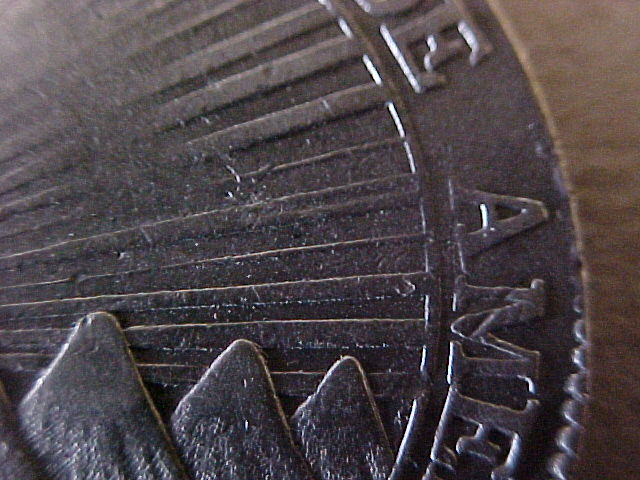 Probably more information than anyone wanted but fun anyway. |
|
Pillar of the Community
United States
1116 Posts |
thanks for the information Kristofferson do you happen to know a mintage number on this coin I am just curious
|
|
New Member
United States
29 Posts |
No mintages are known for most of these coins. There was so much war and conflict in the region that no records are left so far as known. All Central American Republic coin are somewhat scarce and many are just flat out rare. I have a relative rarity scale for the eight Reales but it still needs some tuning. Some of the eight Reales are not as common as the catalog suggests, it seems.
Edit. The survival rate is poor on these coins too. Most being melted for new coins, jewelry and just the bullion over the years. Die life was limited and the fact that there are only two obverse and one reverse dies indicates a lower mintage.
Edited by Kristofferson
06/25/2009 8:31 pm
|
|
Pillar of the Community
United States
1116 Posts |
this is really interesting I think I am going to check out the history on central american republic coins. I only have this coin because my grandfather gave his collection of foreign coins to me.
i think you have just started another area of coins I have to collect oh god
|
|
Pillar of the Community
United States
5318 Posts |
This was a really good read!  |
|
Pillar of the Community
Spain
1361 Posts |
very nice coins |
| |
Replies: 15 / Views: 2,160 |
|




 Posted 06/20/2009 01:07 am





