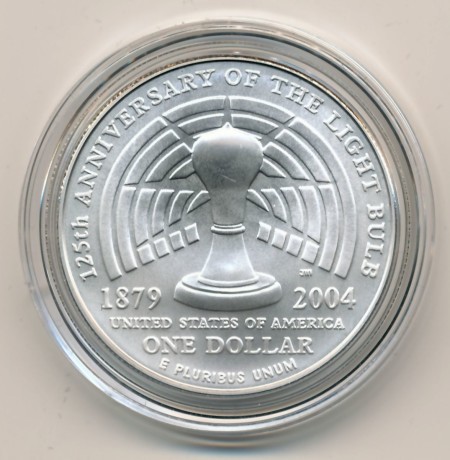
I've written before about the 2004 Thomas Edison Silver Dollar and its seven beneficiaries, (see
2004 Thomas Alva Edison - 125th Anniversary Of Light Bulb), but wanted to revisit the coin's authorizing legislation to discuss an important update to it.
Representative Frank Pallone, Jr. (D-NJ) (for himself, Barney Frank (D-MA)Rodney Frelinghuysen (R-NJ) and Albio Sires (D-NJ)) introduced a bill in the House of Representatives ("House") during the First Session of the 110th Congress that sought a change to extend the period during which surcharge recipients could raise - exclusively through private fundraising - the legally-mandated needed matching funds to gain access to available surcharge funds from coin sales. Pallone introduced the bill during the first week of January 2007. The bill was referred to the House Committee on Financial Services.
Background Note: The bill that led to the Thomas Edison Silver Dollar was introduced in February 1997; it was signed into law on October 31, 1998. The bill named seven surcharge beneficiaries in five States. The original bill did not explicitly state that surcharge funds required matching funds to be raised privately. This omission became the root of the problem and trigger for the extension legislation.David Scott (D-GA) took up the charge in the House a couple of weeks after the bill's introduction, in mid-January 2007. Scott argued that "as a result of some unclear language in the documents provided to both the Mint and to recipient organizations, it was unclear that the matching funds required by law in order for recipient organizations to receive the coin's proceeds must be raised entirely from private sources and that no other government funds could be used for this purpose." For example, the Edison Memorial Tower in New Jersey had not yet reached the needed private funding level; it had been incorrectly assuming that it could apply funds received from the State of New Jersey to meet the Federal requirement.
The Pallone bill extended the deadline for the needed private fundraising by six months.
Multiple Representatives rose to voice their support for the bill, including Judy Borg Biggert (R-IL) who added informative context on the "matching funds" requirement that was the core of the bill's need:
"The matching fund requirements were part of sensible reforms to the commemorative coin program enacted in the 104th Congress at the behest of the gentleman from Delaware (Mr. Castle). They are an important safeguard against misuse of the commemorative coin program. This modest extension creates no precedent for future surcharge recipients who fail to raise the required funds in a timely fashion, and is merely a brief pause to allow satisfaction of the statute."The bill passed in the House without issue and was sent to the Senate for its consideration. Upon receipt, the bill was referred to the Senate Committee on Banking, Housing, and Urban Affairs. The Senate Committee was discharged by the full Senate, which passed it by Unanimous Consent. The bill was enrolled and signed in each chamber, then sent to the President. US President George W. Bush signed the extension bill into law on February 8, 2007.
Note: The House had passed the Pallone bill by voice vote in November 2006 - during the Second Session of the 109th Congress - but the Senate did not act on it before it adjourned.With the legislated extension, the Edison Memorial Tower was able to raise the needed private funds and ultimately received its share ($379,000) of the Silver Dollar's collected surcharges.
2004 Thomas Alva Edison Silver Dollar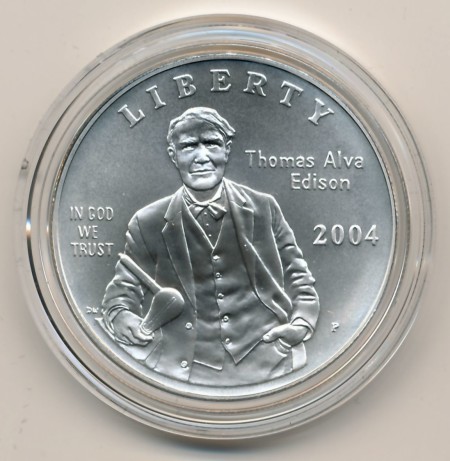
For other of my posts about commemorative coins and medals, including more modern commemorative coin stories, see:
Commems CollectionCheck out what is, IMO, the most interesting special packaging option yet produced by the US Mint, see:
-
2004 Thomas Alva Edison Collector's SetFor a discussion of a medal that marked the Centennial of Edison's birth, see:
-
1947 Thomas Edison Centennial - So-Called Half Dollar









 Posted 04/23/2026 11:36 am


